< Previous | Contents | Next >
Cartergate and Appletongate.
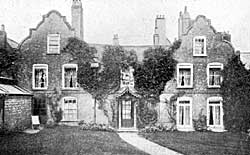
Bishop Warburton's house.
After leaving Beaumond Cross the visitor turns down Cartergate, on the east side of which he will notice a house with a fine classical front, with pediment and cornice supported by modillions. This is the house where Bishop Warburton, author of the "Divine Legation of Moses," and the friend of Alexander Pope, is said to have been born, in 1698. Warburton's father was an attorney at Newark, and the scholar himself spent his early life here, becoming rector of the neighbouring village of Brant Broughton in 1728. He was made Bishop of Gloucester in 1759. Unfortunately the ground-floor frontage of the house is now cut up into shops with plate-glass fronts, but the remainder is used as a Temperance Hotel, and by the courtesy of the proprietor, Mr. E. M. Thompson, may be inspected. The house is built round a courtyard, Italian fashion, and the visitor is always delighted by the glimpse of the fine old garden beyond, which the open front door mostly affords. The garden front has two Dutch gables of the pattern which came in with William of Orange. Ascending the staircase, and turning into the Commercial Room, formerly the Library, a pitched ceiling, handsomely panelled, will be noticed; while in the passage on this floor, leading to the front of the house, can be seen part of a large circular ceiling panel of plaster work, which appears to have been that above the grand staircase, before the house was cut up into its present form.
Warburton kept always a kindly feeling for his native town. We find him writing to the Bishop of Worcester of bye-gone Autumn mornings, when he "used with a book in my hand to traverse the delightful lawns and hedgerows round about the town of Newark, the unthinking place of my nativity."
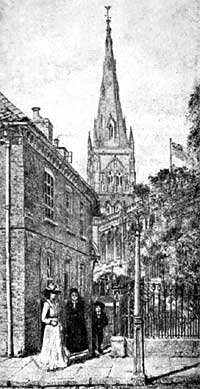
The Church Walk.
Walking down Cartergate and past the end of Bridge Street, formerly "The Dry Brig" (either from "draw-bridge" or because a dry moat here defended the inner ward of the town), where until 1784 stood one of the mediaeval town gates, the visitor enters Appletongate, and just beyond the east end of the Church, and on the opposite side, sees the buildings until recently occupied by the Magnus Grammar School. This was endowed in 1532 by a native of Newark, Thomas Magnus, Archdeacon of the East Biding of Yorkshire, and a henchman of Cardinal Wolsey. The original school, of rag-stone, with mullioned windows and quaint chimney stacks, is now almost hidden from view by an ugly brick front built on to it in 1819.
Here were educated Chappell, Bishop of Cork and Ross (1582—1649); White, Bishop of Peterborough (d. 1698); Dr. John Blow, the “Father of English Music” (1648—1708); Dr. Stukeley, the Antiquary (1687—1765); Dr. Warburton, Bishop of Gloucester, and Shakespearian Editor, (1698—1779); Reynolds Hole, Dean of Rochester, (1819—1904); Gonville Bromhead, the hero of Rorke's Drift, (1845—1891); Lord Hawke, the cricketer, and many others—scholars, divines, soldiers, sportsmen.
For over 350 years successive generations of local boys have acquired, in the old buildings before us, that liberal education which has made the English Public Schoolman what he is, and which the above selection from the School's alumni justifies. Now, alas, with "little Latin and less Greek," the old Magnus foundation, a "Grammar" school no longer, imparts a "secondary" education of County Council type in a hygienic building at the "blind " end of a suburban street. Even the Founder's stipulation that the Master should be in Holy Orders has at last been ignored by its Governors.
Next to the old Grammar School is the Chantry House, already mentioned in the account of the Parish Church. Here stood the house founded by Dame Alice Fleming for the accommodation of the priests who served the numerous chantries in the Church hard by. Its site is now occupied by a private mansion, the purity of whose Queen Anne front is sure to please visitors interested in typical examples of this style. The wrought iron gate and railings are also worthy of notice. On the other side of the house is a walled deer paddock of several acres, which for 120 years has contained a herd of deer (though not of continuous descent), an unusual feature in the centre of a town. The house itself contains many rooms of interest. One pure "Adam" in its ornament and mouldings; another "Queen Anne," and so on. These have been filled with a choice collection of eighteenth century furniture by the present occupier of the house, still further increasing its interest to the connoisseur. Being a private residence, this house is not, of course, accessible to the visitor, like Warburton's.
Below the Chantry House, and still on the same side of the street, beyond the end of Magnus Street, is a long rag-stone wall enclosing "The Friary." Here stood a house of the Augustinians, its site, like that of the Chantry House, now occupied by a private mansion. Some of the older buildings appear to be incorporated in the fabric of the present stables.
Turning back up the street, and passing to the right up Mount Lane, we come to a series of walks of varying widths, known as "The Vicar's Mount," "The King's Mount," "Slaughterhouse Lane," leading from Appletongate across King's Eoad to Bargate. These walks are on the site of the old town wall, which doubtless, after demolition, still existed in heaps of debris, a no-man's land, which thus became a right of way. One of these heaps of debris, containing cannon balls, which formed "The Vicar's Mount," and caused the footway to rise several steps, was only cleared away a few years ago.
At Bargate stood another of the mediaeval gates, pulled down in 1762. The street has here been widened only a few years ago.
OTHER HOUSES.—There are several other houses in Newark well worthy of notice, though the space here available compels us to leave them to the visitor's enterprise and powers of observation to discover. Two on the east side of Millgate may be mentioned, however. One is a late seventeenth century structure, now cut up into three cottages, with shallow bay windows and Dutch gables like Warburton's house, both at the ends and on the wing behind, and three equilateral gables fronting the street. This was the Newark house of the Milnes family, afterwards of Beckingham. The other, once called "The White Hall," at the corner of Parliament Street, is now divided into two houses, one forming the presbytery for the Roman Catholic Church adjoining.
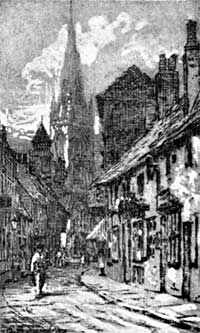
Kirkgate.
There are two picturesque timbered houses of the "black and white" type in Kirkgate, while the eighteenth century house opposite to them (Mrs. Anderson's china shop) should be noticed for its rich and bold cornice executed in ordinary bricks.
At the rear of the premises occupied by Messrs. Boots and Mr. Derry, on the north side of Stodman Street stood a chapel, not entirely demolished until 1818, said to have at one time belonged to the Knights Templars. In the wall of an outhouse may still be seen a carved stone head and in its inner partition wall, bricked up and white-washed, is a fine fourteenth century roof-beam, richly moulded.
THE BEDEHOUSE CHAPEL, in Bedehouse Lane, is a sixteenth century building, but very plain and devoid of interest. Services are held in it every Friday.