< Previous | Contents | Next >
The Castle.
PART II. ITS ARCHITECTURE
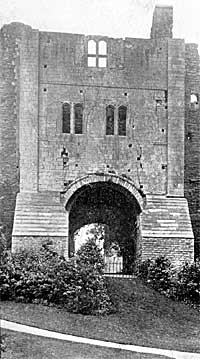
The Norman Gateway.
THE NORMAN GATEHOUSE.—Of Bishop Alexander's work there remain the great Norman gatehouse and the south-west tower. The gatehouse, which is one of the finest specimens of its style and period in England, is three storeys high, with semi-circular archways at its outer and inner ends. These had neither doors nor portcullis, but in the centre is a third arch which has had massive gates, secured on the inner side by a heavy beam, which, when the gates were open, was run back into a recess or hole in the eastern wall as deep as the gateway is wide. Behind the gates in the western wall is a small recess for the warder.
The exterior arch of the gateway, which is of two square orders, is ornamented by a hood-mould enriched by three rows of square billets. At the base of the pilasters have been bold roll moulds, only the westernmost of which remains.
In the second stage can be discerned three Norman round-headed windows, which have been blocked up, to allow the insertion of sixteenth century lights, when the Castle had become a private residence. Below these are parts of a string-course with hatched or "saw-tooth" decoration. Above these windows is a string-course of "folded-ribbon" ornament. In the third stage have been two smaller windows with shafted jambs and square heads under a round arch. These also have been blocked, to admit the insertion of a transomed Tudor window of four lights.
Outside the gateway would be a ditch of great depth, spanned by a drawbridge, and protected by a barbican on the opposite bank.
In the upper stages the gate-house is divided into two parts by the wall above the centre arch. The outer or northern part was of two storeys, with wooden floors; the lower one retains its original Norman chimney; the upper has a fireplace of early Tudor type.
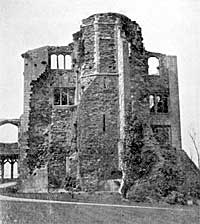
East side of gateway and staircase turret.
The chamber on the south of the dividing wall is worthy of more particular notice. It has originally been of only one storey, so that it was very lofty. It had on its south side a plain circular window, the form of which is best seen from the exterior. The eastern and western windows are round-headed, typically Norman, each with shafted jambs and "cushion" capitals supporting bold roll moulds; the western has a moulding with pellet enrichment on the inside, an ornament which in the case of the eastern window is placed on the outside. The construction of this room, and the character of its windows, point to its being the Castle chapel, which we know by a confirmation of King Henry II. in the twelfth century, was dedicated to the Apostles Philip and James. In later times this chapel, like the rest of the Castle, was adapted for domestic purposes, a floor dividing it into two storeys, the eastern window being blocked up and Tudor windows inserted.
The Castle and its precincts were situate, ecclesiastically, in the parish of East Stoke, not in that of Newark, and in the parish registers at Stoke is the entry of the marriage of William, Lord Burghley. afterwards second Earl of Exeter, with Elizabeth, Baroness Roos, daughter of the third Earl of Eutland, which marriage is described as taking place "in the Chappell of the Castle of Newarke, in the parishe of Stoke," on 13th of January, 1588-9. The Cecils, Earls of Exeter, were at that time lessees of the Castle, which they used as one of their private residences, and the chapel in which this marriage was performed was probably a different apartment from the original Norman one in the gateway, which by then had been transformed into domestic chambers, as has been noticed.
STAIR TURRET.—On the east of the great gateway is a staircase tower, square in its lower stages, but recessing into an octagonal turret above, with a heavy roll mould or string-course above the hip of the junction of the two orders. This turret contains the circular staircase, or "vise" by which the chapel and the chambers above the gateway were reached. It has a continuous spiral vault of small rag-work which carried the step-stones, very cleverly constructed and quite a characteristic of Norman work.
Winding staircases of later periods seldom have this vaulting, but have each step made of a single stone, the wide end of which was built into the main wall, while the other rested upon and formed part of the newel or central pillar.
NORTH WALL.—On the north-east side of this turret can be discerned the abutment, at an obtuse angle, of a former wall of immense thickness, a portion of the outer main wall of the Castle, which would continue eastward to a tower at the N.E. angle, which has long since disappeared, but was probably equidistant with the N.W. tower from the great gateway. The east wall, with its outer ditch, would bring the area occupied by the Castle and its outworks in this direction up to about the line of the present street of Castlegate.
The greater part of the north wall, between the gateway and the north-west tower, is also Norman work of Alexander's period. At its outer base can be noticed the inclined "shoots" of several latrines—all rubbish and filth in those pre-hygienic days being shot into the moat beneath one's windows! High up in the angle beneath this wall and the gatehouse is a carrying arch which has once supported a bartizan, or angle-turret.
THE S.W. TOWER.—The only other considerable portion of Alexander's Castle now remaining, besides the gatehouse and the eastern portion of the north wall, is the South-West Tower. This is plain and massive, of rag-work masonry with quoins of dressed oolite, like all Alexander's work. The doorway at the ground level on its north side is obviously a modern imitation of a Norman one.
Abutting on the east base of the tower can be seen a fragment of the contemporary south wall of the Castle. In a small room in this tower (which has wooden wall-plates, at the height of our "picture-rails," to hold the hooks from which the tapestry was hung) King John is said to have died, though there is no evidence to support the tradition, and it is far more likely that the monarch would occupy the state room adjoining the chapel above the gateway.