< Previous | Contents | Next >
Selston
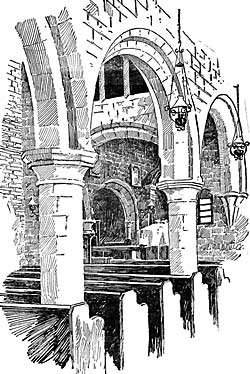
Interior of Selston church.
THE Vicar of Selston, the Rev. Chas. Harrison, in a recent pamphlet issued in connection with the restoration fund tersely described the church of St. Helen, as follows:—Beautiful for situation, on its commanding eminence and Saxon foundation, forming the consecrated centre of a dozen hamlets of miners' homes with an aggregate population of over 2,000, this church is at last commanding the attention it deserves from antiquarians and churchmen generally. Its varied architecture, ranging from Norman to debased Victorian, its weather fretted walls, its ugly mutilations, its gaping cracks and crumbling timbers; its grotesque carvings, its time-tinted glass, its Willoughby monument, its Knight's helmet and tattered banner, its leper window, its King Boswell tomb, it quaint epitaphs together with its centuries of hallowed associations will well repay a visit.
These gaping cracks and crumbling timbers no longer call for attention for the restorer has been at work, and over £4,000 has quite recently been expended upon the church, handsome donations being made by the Right. Hon. Earl Cowper, K.G., Messrs. J. Oakes and Co., Messrs. Barber, Walker and Co., the Butterley Company, and the late Bishop of the diocese, to name but a few.
The most interesting object in the ohurch, undoubtedly, is the ancient Norman font, which the vicar has lately had restored to its proper place. About 150 years ago it was removed from the church, and a family of the name of Gill carried it to Blackwell. It was subsequently brought back to Selston, and for many years did duty as a trough under the pump at the village inn, the "Bull and Butcher." Some few years ago it was carried to a private house and was used as a flower stand. A rose tree planted in it, from all accounts, flourished. At the recent restoration of the church the vicar secured possession of it, and it now occupies a more fitting place than beneath the pump at the village inn. Many immersions, certainly not of a religious nature, have taken place within this interesting relic. The font is the only remaining trace of the Norman period. It is bucket shaped, with a band of cable molding round it. The top has been used apparently for generations by Selstonians as a whetstone, on which to put an edge on pocket, and, perhaps, other knives. Another curious object of interest is the beautiful old Jacobean communion table. This was unearthed by the vicar in the old school house. It was dirty, and exuded a strong aroma of oil, having evidently been used as a table on which to trim and clean lamps. The carving on the legs is excellent, and the table now occupies the place it originally did before its removal from the church. Mr. Harrison has also in his possession a long—unusually long—instrument of the flageolette order which was used for 200 years, to lead the singing in the church. At the time of writing the old musician, who last blew wind through its pipes was living. It is a very curious instrument, but the worms have taken a fancy to it, and it is fast rotting away.
Perhaps the most curious item in the registers is one that relates to Puritan times. It is the most unique entry of the period we have found in the Deanery. The following is a copy of it:
The church of Christ, ye officers, members thereof that continue breaking of bread and walking in ye apostles doctrine associated and retained into church fellowship within ye prescints of Selston which are the persons hereafter written—
Charles Jackson, pastor of ye church of Selston.
Lancelot Coats |
|
Will Cowl |
Ruling Elders |
Ffrancis Brunt |
|
Charles Shepherd |
|
Will Fellow |
|
George Flint |
Deacons. |
Chrystopher Clark |
|
Thomas Rawson, junr. |
|
Thomas Shaw. |
|
Will Sander Smith. Constable 1657. |
|
John Caley. Young Henry Green, of |
|
Bagthorpe. |
|
William Farnsworth. |
|
Elizabeth Jackson. |
|
Prudence Mason. |
|
Eliz. Sanders, Thos. Sanders' wife. |
|
Margaret Rawson, Tho. Rawson's wife. |
|
Eliz. Saunder, ye smithe wife. |
|
Jane Higton. |
|
Jane Brunt. |
|
Elizabeth Coats. |
|
Edith Johnson. |
|
Eliz. Millott, widdow Clarke. |
|
Widdow Herrot, old George herrot's wife. |
|
Old good wife, Shepheard, of Dove Green. |
|
Mary Shaw. |
|
Mary Flint. |
|
Elizabeth Taylor. |
|
Dorothy Cartledge. |
|
The description or some of the persons, mentioned is worth noticing.
Pastor Jackson was one of the few clerics who at the time of the Restoration continued to hold his living. He was, in this respect, like Mr. Firth at Mansfield. We should imagine that Charles Jackson was a man who, to use a modern colloquialism, looked after number one. It is amusing to note an addendum signed by this paster in the year 1641. He was not vicar at that time, as a matter of fact it was ten years later before he came into the living, but he found the entry in the register and signed it. It was this:—Wansley Hall and Selston Hall are to pay, besides all other small dues, tyth calf in kind, besides hemp, flax, bees, hops, apples, pears, plums, cherries, all kinds of fruit in orchards, and piggs, chickens, turnkeys, geese, eggs—two for every hen. Witness Henry Denham, vicar, 10th ult.
To make doubly sure that there should be no misreading of the entry Mr. Jackson added beneath and signed, the line—Hemp, flax, hops, ducks. This same Charles Jackson describes himself as a sinner and preacher of the word of God, for we read in the register an entry of his son's birth couched in the following terms:—Samuel Jackson, ye son of Charles Jackson, a sinner and preacher of the word of God, born ye 20th May, three-quarters past eight in ye morning in ye year since Xt's incarnation 1654. Baptised ye 21st day of May, 1654. This would be soon after Jackson came to Selston, for we gather from the Parliamentary inquiry held in 1650 that Charles Sildon was the "now viccar there who hath the profitte there worth tenne pounde per annum for his sallary, and is a preachinge minister." The impropriate rectory was worth, the same document states, foure score pounde per annum, but it was then under sequestration and the profitte thereof was received for the service of the State.
From the 1654 augmentation survey taken on Jan. 29th, we read as follows:—
In pursuance of an order of ye committee for plundered ministers of the 11th of Mar. 1652 grounded on an order of ye late committee for reformation of ye universities of ye 31st March, 1652. It is ordered yt Capt. John Robinson, Receiver doe, from time to time continue to pay unto Mr. Chas. Jackson, minister of Selston, in ye County of Nottingham (approved) ye yearly sume of Twenty poundes, ye same to be continued for such time as he shall discharge ye duty of ye minister of ye said place or till further order of ye said Trustees together with all arrears of ye said yerely sume of twenty poundes to him due by order of ye said Trustees of the 11th of May, 1653—Jo. Thorogood, Ed. Cressett, Ri Sydenham Rattall, John Humfrey.
On January 30th, 1659, whereas the vicar age exceedeth not the yearly value of £10 "the committee for plundered ministers ordered that £20 be added to ye £20 a year already in pay to ye minister of Selston to make ye whole augmentation £40 a year, and that ye said £20 a year be from time to time paid unto such godly painful preachers of ye gospell as should from time to time be minister ... to hold out of ye revenue of Louth arising within ye county of Lincoln, unto Mr. Charles Jackson, ye said minister of whose godly, sound and seasoned ability and fitness for the said place these Trustees have received good testimony to discharge ye duty of ye ministry of ye said place or further order.”
During his ministry Mr. Jackson apparently became alarmed lest the list of the faithful recorded in the registers should diminish as a result of the teachings of Elizabeth Hooton, of Skegby, the first woman minister of the Friends while evidently feeling very irate, he encountered her, and gave evidence of his " seasoned ability and fitness" to suppress all "herisy and schism " as the following extract from Quaker records shews:—" 1660, 2nd April. Eliz. Hooton passing quietly on the Road was met by one Jackson, priest of Selston, who abused her, beat her with many blows, knocked her down, and afterwards put her into the water." It is satisfactory to know that these drastic measures did no lasting harm, for she afterwards travelled with Geo. Fox, to America, and died in Jamaica in 1671.
It is not every parish church that can trace its rectors back, as far as Selston can. The following is the list:—
1176. Adam.
1244. Roger del Clay.
1252. Verasour de Wansley.
1287. John de Gateyford.
1290. Robt. de Gateyford.
1310. Thomas de Hothum.
1321. Wm. de Ilkeston.
(Presented by Nicholas de Cantelupe).
1322. John de Kendale.
1324. William de Leston.
1339. William de Ros.
(Presented by Nicholas de Cantelupe).
From this year the advowson fell into the hands of Beauvale, and the monks became
vicars.
1344. John Dell Hill de Pauvil.
1344. John de Arnale.
1363. John Sheperly.
1363. Henry Barton.
1434. John Eyswayte.
1434. Rich. Twigge.
1446. Rd. Holt.
1456. John Day.
1483. John Derman.
1490. John Wilson.
1525. Rd. Martyn. Presented by the Prior and
Convent of Beauvale.)
1550. Nicholas Walker.
1575. Thos. Taylor.
1605. Thos. Mylner.
1611. George Longden.
1614. Peter Parote.
(Presented by Archbishop of York.)
1615. Franc Stephenson.
(Presented by Archbishop of York.)
1621. Wm. Williamson.
(Presented by the Archbishop of York.)
1624. Thomas Bowcher.
1631 to 1641. Henry Denham.
1650. Samuel Sildon.
1653. Charles Jackson.
1662. Wm. Pearson.
1669. Nicholas Sore.
1669. Robert Hettcliffe.
Mitchell and Key, curates.
1699. J. Cooper (curate).
1713. J. Cooper (called vicar).
1754. Anthony Carr.
Thos. Carr and Thos Webster,
curates. 1805. I. Pepper (vicar of Alfreton and Selston).
1836. April 6th. This living was sequestrated, and a number of clergy
took duty during that period.
1838. F. Churchill.
1843. J. Hides (officiating minister).
W. Hides (curate). (J. Hides had charge of Greasley
as well).
Geo. Fkd. Williamson.
1855 R. J. Wright.
1887. Charles Harrison.
A list was supplied to us by the vicar, but we have added the name of Thos. de Hothum which we came across in searching the Patent Rolls of Ed. II. 1307—1324. This is the entry in the calendar:—
1310. Oct. 23: Presentation of Master Thos. de Hothum to the church of Selston, in the diocese of York in the King's gift by reason of the custody of the lands and heir of William de Cantilupe, tenant in chief, being in his hands.
Selston was closely bound up in the Priory of Beauvale. It was Nicholas de Cantelupe, Lord of Ilkeston, who having obtained license of the King, founded the monastery in his park of Greasley for a prior and twelve monks of the order of Carthusians, to which he gave £10 per annum of land and rents in the towns of Greasley and Selston, and the advowson of the churches of both the said towns, which he got appropriated. Among other grants made to the prior and monks was one of thirteen messuages and 320 acres of land in the parish of Selston, together with ten of his natives or villains, who held these heraditiments under him, with all that were born of them and their suits and services of every description. He likewise granted that the same prior and monks should have common of pasture for all manner of cattle through the whole dominion or lordship and demesnes of Greasley and Selston, and that they should have stone for all the work of the church and their houses. . . . Other munificent grants were also made, including the whole of his demesne of the town of Selston.We have also added to the list of vicar the name of Thos. Sildon, mentioned in the 1650 inquiry.