CHAPTER X
CLAIMS TO THE PORTLAND PEERAGE BY MRS. DRUCE AND MR. G. H. DRUCE.
Full of romance as the Portland peerage was up to recent years, there is still another chapter to be added, in relating some of the statements made in connection with the claims put forward by Mrs. Druce and Mr. G. H. Druce to the honours and wealth of the Bentincks. It must be stated emphatically that there is no intention whatever to comment upon these claims or to prejudice their fair consideration, in the tribunals of the land. No literary sketch of the great House of Portland would be complete without it summarised the salient points in the Druce claims as they have appeared from time to time in newspaper reports and in the narratives of those who knew the fifth Duke in his lifetime. This compilation is intended to epitomise the history of the illustrious family of Bentinck in consecutive order of the events as they have occurred, in such a manner as is not found in any other publication ; but in no way to influence opinion either on one side or the other. It was in 1898 that public attention was called to the case, when Mrs. Druce set up a claim to the Portland peerage on behalf of her son.
The ground on which it was based was that her father-in-law, Mr. Thomas Charles Druce, and the fifth Duke of Portland were one and the same person; that in fact the Duke had a double existence.
Mr. Druce was in a large way of business at the Baker-street Bazaar, an enterprise opened about 1834 or 1835, with a capital estimated at 100,000l. At that time the Duke had not succeeded to his family estates, but was Marquis of Titchfield. It was known that he and his brothers had been successful in horse-racing and if, as Marquis, he could spare 100,000l. to open this London business, some indication is given of his winnings.
In the construction of the Bazaar it was said that there was an underground passage leading from the back of the premises. By this means of ingress or egress Druce could appear in the midst of his shopmen when they least expected him and as suddenly vanish, possibly into an underground passage, which it was believed was no myth, leading from Baker-street to Harcourt House. While conducting this important business at Baker-street, Mr. Druce married in 1851 Annie May Berkeley, daughter of the Earl of Berkeley. The Earl's marriage with this lady's mother had been disputed, and was held by the House of Lords to be illegal.
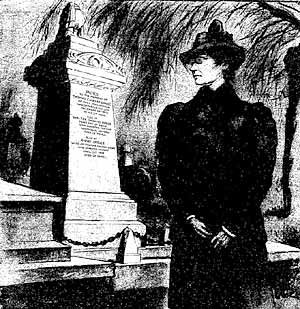
Mrs Druce at T C Druce's grave in Highgate Cemetery (The Penny Illustrated Paper, 18 March 1899).
That, however, has no bearing on the Portland romance, the question that arose in 1898 was whether the Duke, under the alias of T. C. Druce, married Miss Berkeley. The strange part of the contention is that Mr. Druce died, or there was a mock burial of his body in Highgate Cemetery, in 1864, whereas the Duke lived on till 1879. The allegation is that there was no death of that particular person in 1864, and that the coffin at the sham funeral was filled with lead or stones.
Mr. Druce had a residence at Holcombe House, Hendon, and it was here that he repaired to die.
The funeral was on December 31st, 1864, and the vault was prepared in Highgate Cemetery. There was a stately hearse accompanied by six bearers. The coffin was noticed to be of enormous weight, and the strength of the men were taxed when their duties came to carrying and lowering it into the grave.
From this circumstance arose a curious idea that it did not contain the body of Druce, who was not stout and heavy; but that it was filled with stones or lead. There were no burial certificates forthcoming, but the owners of the cemetery accepted the coffin for burial.
When Mr. Druce died there were two sons left of the alliance with Miss Berkeley, one of whom continued the Baker-street establishment.
But what was the astonishment of some of the frequenters of the purlieus of Baker-street to see the man who was supposed to have been buried visiting the same haunts where they had seen him before.
To have witnessed or heard of the funeral of a man, and then to meet that same man in his customary sphere of business afterwards, is of the nature of a ghost-story. "What did the coffin in Highgate Cemetery contain?" was the riddle.
Mrs. Druce's husband was a son of the late Mr. T. C. Druce, and it was on behalf of her son that proceedings were commenced. She made an application to the Consistory Court for a faculty granting her power to have the coffin in Highgate Cemetery opened in order to see whether it contained a body or only some heavy substance such as lead.
It was asserted that T. C. Druce had been seen alive some years after it was supposed that he had been buried; that he was indemnified as the Duke of Portland, and that there were persons cognisant of the fact that the Duke and Druce were one and the same person before 1864. Dr. Tristram, the judge, granted the faculty, but notice of appeal was given to prevent the coffin being opened.
The case then came before the Divisional Court, which ruled that the London Cemetery Company was right in resisting the order of Dr. Tristram, and that the grave could not be opened without the licence of the Home Secretary. The decision was in effect that Dr. Tristram had no jurisdiction to make such an order, except as conditional on the authority of the Home Secretary being obtained.
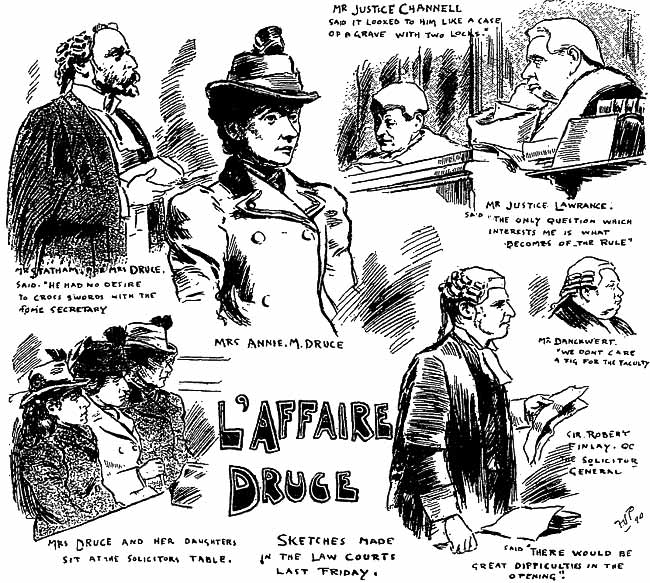
Mrs Druce finds the judges uphold the cemetery company's objections (The Penny Illustrated, 25 February 1899).
At length the case reached the Court of Appeal in December, 1899, when Mrs. Druce made no appearance to support the faculty she had obtained, and the appeal was dismissed with costs against her.
In the course of the proceedings the statements of two or three persons who knew Mr. Druce were published in the Press.
Mrs. Hamilton's narrative was to the effect that from a girl she had known the same gentleman both as Mr. Druce and the Duke of Portland, her father, Mr. Robert Lennox Stuart, being a great friend of his from boyhood days, and, it was averred, distantly related. There were frequent visits both to Cavendish-square and to the Baker-street Bazaar, and on one occasion, about 1849, Mrs. Hamilton says she was taken by her father to Welbeck where they were met by Druce. Then, in 1851, her father attended the marriage of Druce and Annie May Berkeley. At length the time came when Druce determined to be dead to the outer world. "I must die," he said to Mr. Stuart.
The arrangements for the death were duly carried out and there ensued a sham burial, at which Mrs. Hamilton says her father was present.
Two years passed away and Mrs. Hamilton was greatly astonished one day to see Mr. Druce enter the house where she and her father were staying.
"I thought you were dead," she said naively.
Druce was not well pleased at the remark and continued the conversation with her father.
On another occasion Druce took Mrs. Hamilton, then a girl, to Madame Tussaud's, at which her father was angry; he also gave her money for sweets and flowers.
A great many transactions took place between her father and Druce relative to a lady whom they spoke of as "Emmy," and who was eventually sent to France, by Druce, who gave her 5,000l. This was in 1876, and Mr. Stuart went to Welbeck to arrange for the departure with her two children. She died not long afterwards. The last time that Mrs. Hamilton says she saw Druce was in 1876, when he called at her father's and complained of being unwell. He spoke of his visits to his old friend Stuart as being the happiest hours of his life. Some little time after the sham burial Mrs. Annie May Druce came to Mrs. Hamilton's father's house, and was introduced to Mrs. Hamilton as "Mrs. Druce." Another statement was made by Mrs. P. M. Wright, nee Robinson, nee Weatherell, who said that when she was 20 years of age she lived near the Baker-street Bazaar, owned by Mr. T. C. Druce, and frequently saw that gentleman. After the supposed death and burial of Mr. Druce she saw him often, and in her mind he was identical with the Duke of Portland. As to her knowledge of the Duke her father was in the service of his Grace when she was a young girl, and she was familiar with his features. Mr. Druce had a large bump on the left side of his forehead, which appeared to have been caused by a blow. The Duke also had a bump, and in her opinion this resemblance was evidence that the owner of the Baker-street Bazaar and the Duke were one and the same person. While these statements were causing some amount of public interest there was a new development in this extraordinary case. The legal proceedings commenced by Mrs. Druce were widely reported in the Press and accounts of them reached Australia, where they were read by a gentleman pursuing the calling of a miner. His name is Mr. George Hollamby Druce, who put forward a prior claim to the Dukedom than that urged by Mrs. Druce on behalf of her son.
His contention is that the Duke, as T. C. Druce, married in October, 1816, Miss Elizabeth Crickmer, of Bury St. Edmunds, by whom he had a son named George. This youth took to a sea-faring life and eventually settled in Australia, where he had a son, namely Mr. George Hollamby Druce, whose claim to the title takes precedence of that set up by Mrs. Druce for the offspring of the second marriage with Annie May Berkeley.
The question of the exhumation of the body appears to be involved in legal technicalities as to the ownership of the vault. At one time it was vested in the son of Mrs. Druce who commenced the litigation. Then there appeared this other claimant, Mr. George Hollamby Druce, and it is said that the present owner of the vault, Mr. Herbert Druce, is not in favour of complying with Mr. G. H. Druce's wish to open it, therefore the secret of the grave remains unrevealed.
THE END