CHAPTER II
HOW THE BENTINCKS BECAME POSSESSED OF WELBECK.
—A FEMININE INTRIGUE
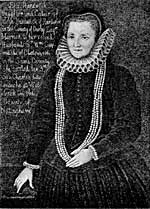
Elizabeth, Countess of Shrewsbury.
Cherchez la femme is a French saying, which has somewhat of a cynical ring about it. The female hand has to be discovered in the family alliances of the Cavendishes and the Bentincks from which a tangle of intrigue may be unravelled. There was in the first instance that accomplished matchmaker, Bess Hardwick, a country squire's daughter, who was married four times, and from her sprang children and grandchildren with whom were intertwined the families of no less than five Dukes.
To the north of the county of Nottingham, in the heart of England, is a rich and fertile tract of country known as "The Dukeries," once embraced by Sherwood Forest, and even now thickly wooded with magnificent oaks and presenting charming forest scenery.
Its fastnesses were the home of the romantic Robin Hood and his "merrie" band of robbers, the subject of legend and adventure. Today there are in this beautiful region, within two or three miles of each other, the seats of the Duke of Portland at Welbeck Abbey, the Duke of Newcastle at Clumber, the Earl Manvers (whose family formerly had the title of Duke of Kingston) at Thoresby, and Worksop Manor, formerly the seat of the Duke of Norfolk. It was this cluster of the homes of the nobility that gave it the name of "The Dukeries."
Both Welbeck and Clumber belonged to the Dukes of Newcastle at one time; but to elucidate their settlement upon these vast estates and the subsequent division of the domains, through marriage, we must take up the thread of Bess Hardwick's machinations.
She was the daughter of the Derbyshire squire of Hardwick, and in 1534 was married, when she was only 14 years of age, to Robert Barley, of Barley, in the same county. It was not long before he passed over to the majority, leaving his fascinating widow with a substantial jointure on his property.
For twelve years she was a widow, and then she was married to Sir William Cavendish, who himself had been married twice before.
He was a Hertfordshire magnate, but the strong will of his new wife induced him to sell his estate in that county in order to provide money for another scheme she had in view. It was the ambitious one of purchasing Chatsworth and building the magnificent mansion which tourists from all parts of the world find so much delight in visiting. A house already existed at Chatsworth, but it was not pretentious enough for the squire's daughter, and she prevailed upon her husband to have it demolished. He had started to carry out her wishes when death overtook him, and Bess was a widow for the second time.
The new house at Chatsworth was not finished; but she had a penchant for building, and continued the work after his death till its completion. There were three sons and three daughters of this marriage, concerning the future wedded lives of which there were deep schemes and plots.
Another courtier fell beneath her wiles in Sir William St. Loe, Captain of the Guard to Queen Elizabeth. He was so enamoured of her that he endowed her with his estates, and disinherited his own kinsfolk. Then he died, and Bess still went on conquering and to conquer.
Her fourth husband was the great prize of all as far as rank was concerned, for he was none other than George Talbot, sixth Earl of Shrewsbury, one of whose seats at that time was Worksop Manor.
It was not Bess's way to accept a suitor without a bargain being made, having ulterior objects. The Earl had been married before, and had children, so that Bess insisted upon two other matrimonial matches before she would enter into the bonds of matrimony herself for the fourth time.
The stipulation was that her daughter, Mary Cavendish, should marry the Earl's heir and his daughter was to marry her son. These alliances were duly entered into, and brought with them new honours and additional wealth. The building of Worksop Manor house had been commenced in the time of the first Earl of Shrewsbury, but was not finished when the new Countess became its mistress. Having built Chatsworth, here was another opportunity for her to display her genius in architecture, and under her direction it was completed, and became a sumptuous residence.
The Earl must have been a nobleman of redoubtable and fearless disposition, or a courtier whose pliant will was easily moulded by accomplished and attractive women, else he would not have been involved in the feminine intrigues that he was.
Not only had he his imperious wife to consider, but he was appointed custodian of Mary Queen of Scots when that unhappy personage was under the ban of Queen Elizabeth and was sent prisoner to Worksop Manor. She was kept strictly in durance vile, for the Earl was a rigid warder, and did not even allow her to walk in Sherwood Forest.
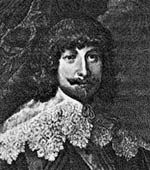
William Cavendish, 1st Duke of Newcastle-upon-Tyne.
There is a portrait of Bess of Hardwick in the collection of the Duke of Devonshire at Chatsworth. When Mary was in the custody of her husband Bess first fawned upon her royal prisoner; but a new matrimonial scheme filled her mind which led her to change her conduct into one of hatred. Bess had a grandchild, Lady Arabella Stuart, for whom she planned an alliance hostile to the Queen's interests, hence her smiles were turned to frowns.
En passant it may be said that the Manor went; by marriage to the Dukes of Norfolk, who held it for generations and then sold it. Of Bess of Hardwick's building enterprises it may be added that she built Hardwick Hall, "more glass than wall" (according to an old rhyme), in 1587. The Earl died in 1590, and the Countess had another long widowhood of 17 years. Her second son, William Cavendish, was created Baron Cavendish and his great-grandson Duke of Devonshire.
Charles Cavendish was another son of this extraordinary woman, and he bought the Welbeck estate, towards the end of the sixteenth century, from two or three men of obscurity to whom it had passed, after Henry the Eighth had ordered the monastic establishment at the Abbey to be dissolved. His son became Baron Ogle and Viscount Mansfield, and subsequently Earl, Marquis and Duke of Newcastle in 1644.
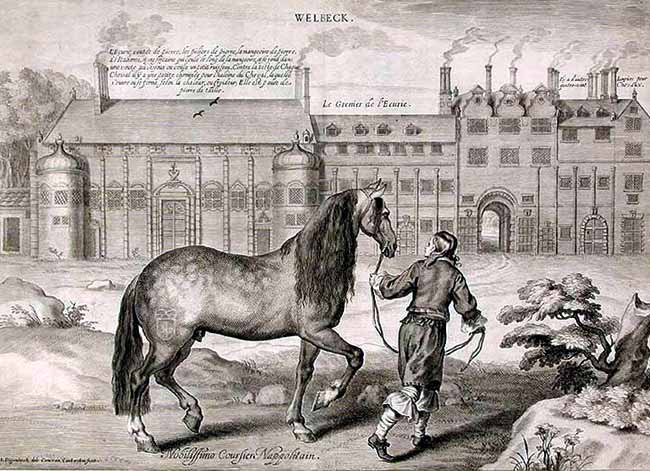
The riding stables at Welbeck in the 1630s.
This nobleman was devoted to the fortunes of Charles I. and was a skilful General during the time of the Civil War. He also wrote a book on "Horsemanship," which was regarded as a remarkable production of its time, and he built a riding-school at Welbeck, where his theories in the training of horses could be carried into effect; but the structure has in recent years been devoted to other purposes, and a new and more spacious riding-school erected to take its place.
The dukedom became extinct for want of male heirs, but his daughter, Lady Margaret Cavendish, married John Holies, Earl of Clare, who, in 1691, obtained a further step in the peerage by the resuscitation of the dukedom, and once more there was a Duke of Newcastle.
A valuable appointment by the Crown came in his way, for he was chosen Warden of Sherwood, with which office went the privilege of enclosing land at Clumber under the royal prerogative. Again there was no prospect of male heirs, so the Duke left the Clumber property to his sister's son, Thomas Lord Pelham, who traced his descent from Bess of Hardwick through the Pierrepoints (Earls Manvers). Thomas Pelham assumed the name of Holles, and was created Duke of Newcastle-on-Tyne in 1715.
But to return to the Duke who was Warden of Sherwood Forest; he had one daughter, Lady Henrietta Cavendish-Holles, who married Edward Harley, second Earl of Oxford. Their only daughter, Margaret, married William Bentinck, second Duke of Portland.
Hers was a fortunate alliance for the Bentincks. She was a rich heiress, and the vast property at Welbeck and Bolsover belonging to her grandfather, John Holies, was her dowry. This was the first introduction of the Dutch family into Nottinghamshire in 1734.
Having thus traced how this delightful domain passed by matrimonial intrigues into the possession of its present owner, it will be appropriate to glance at the ancient history of the Abbey and see how it has been transformed from its original state to what it now is by successive occupants, and especially by the eccentric fifth Duke.
About the twelfth century a new religious order of monks came to settle in England. They were called Premonstratensians, and wore white cassocks and caps, by which they were known as white canons as distinguishing them from black canons, attired in more sombre garb. About 1140, one Thomas de Cuckney founded the Abbey at Welbeck, which was to become an important centre for the Order, as in 1515 there were no fewer than 35 Premonstratensian monasteries in England, all subordinate in importance to Welbeck.
Thomas de Cuckney was a vir bellicosus, and having built a castle at Cuckney, was a formidable subject during the troublous times of King Stephen's reign. John Hotham, Bishop of Ely, obtained possession of the Manor of Cuckney in the 14th century, and devoted its revenues to the Abbey, with an addition of eight canons to be supported from its wealth.
Then came the edict of Henry VIII., which suppressed monasteries as being detrimental to the State. The abbots and their canons were dispersed, and their lands and property given to royal favourites. Eichard Whalley obtained a grant of Welbeck from the King about 1539, and in succeeding generations others who held it were Osborne, Booth and Catterall, till it was purchased by Sir Charles Cavendish.
This was at the beginning of the reign of James I., and Cavendish inheriting the predilections of his mother, Bess of Hardwick, set to work pulling down the old walls and transforming a house of religion into one for the pleasure of the Dukes that were to come of his family. In 1619, King James paid a visit to Welbeck, and Charles I., was entertained there, when "there was such excess in feasting as had scarcely ever been known in England," and Ben Jonson was present at the invitation of the Duke to enliven the festivities with his wit.
The main portions of the abbey and the abbey church became merged in the new structure; but there are legendary stories that the bodies of the Cuckneys and the abbots remain entombed upon the site, and that their stone coffins form part of massive walls and hidden foundations.
The remains of the ancient Abbey of St. James have been carefully preserved, and the arched ceilings of two or three apartments are interesting examples of the Gothic period. The Servants' Hall is a relic of the monastic buildings, and three other rooms adjacent are in the same style. There is a small doorway with Norman features of architecture, and some roomy vaults and parts of inner walls on which are the effigies of departed monks, indicating the original purpose of the great house as an ecclesiastical establishment.
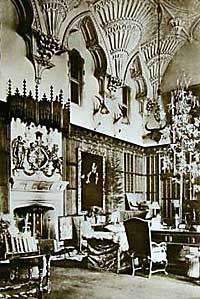
The Gothic Hall at Welbeck Abbey.
Bess of Hardwick had a hand in building part of the present mansion, when the domain came into the hands of her third son, Sir Charles Cavendish. Her design, bearing the date 1604, was on the foundations of the old abbey, and still another noble lady added her quota to its architecture. There is the Oxford wing built by the Countess of Oxford, whose daughter Margaret had Welbeck. as her dower when she married into the Bentinck family. The Countess had the date 1734 affixed to the wing erected under her auspices. There is the Gothic Hall which was part of her design, and by some is regarded as a gem of its particular style of architecture, with an elegantly-adorned ceiling and fan tracery of stucco on basket-work. The carving is rich and over the fireplace are the Countess of Oxford's armorial bearings.
A tradition exists that Bess acted under the spell of a fortune-teller who predicted that death would be relegated to the distant future so long as she kept on her building operations. It was in 1607 that her end came when her masons could not continue their labours owing to a severe frost, although the urgency of the task was such that they tried to mix their mortar with hot ale. It was a fight with the spectre of death and the spectre won the contest.
She was immensely rich but could not number a real friend in the world. Chatsworth, Hardwick, Oldcotes, Bolsover and Worksop Manor were either built or partly built under her auspices. Lodge says: "She was a woman of masculine understanding and conduct, proud, furious, selfish, and unfeeling, a builder, a buyer and seller of estates, a money-lender, a farmer, and a merchant of lead and coals."