
CHAPTER IX
THE DUKE AND DUCHESS AT HOME.—THE DUCHESS AS PRINCESS BOUNTIFUL.—THE DUCHESS AT COURT
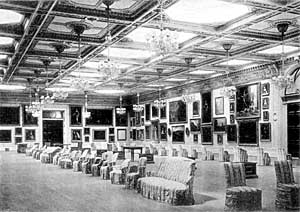 The underground picture gallery at Welbeck Abbey, c.1900.
Christmas is usually spent by the Duke and Duchess at Welbeck, and one of the events of the season is the Household Ball to celebrate the Duke's birthday, which falls on December 28th. It is held in the vast underground picture-gallery, with the subjects of the old painters looking down from their canvases upon the gay dancers.
Choice exotics, stately palms and seasonable shrubs add to the variety of the decorations. The band is almost hidden in a bower of foliage in the centre of the great saloon, and there are 500 guests of all ranks of society from peers and peeresses to the humblest domestic servant.
About ten o'clock the Duke and Duchess appear with their house party, and dancing commences with a Circassion Circle. The Duke has the housekeeper for partner and tbe Duchess the house-steward, while the aristocratic guests find partners among other chiefs of departments in the Welbeck household.
With midnight comes supper, served in two adjacent underground rooms, that owe their excavation to the grim hobby of the old Duke. All the festive party sit down to supper at the same time, the Duke's French chef providing the menu. The house-steward presides and proposes the health of the ducal family. This is welcomed in the manner it deserves and then dancing is resumed in the picture-gallery.
On another evening the children on the Welbeck estate are invited to a party when the head of a giant Christmas-tree is reared in the centre of the ball-room, laden with toys for distribution to them, and the pleasures of the entertainment are varied with the tricks of a conjurer and ventriloquist. Thus is afforded a glimpse of the happy relations existing between the Portland family and their retainers.
In the neighbourhood of Sutton-in-Ashfield, Cresswell, and the mining district between Mansfield and Worksop the Duchess is regarded as a Princess Bountiful in reality, rather than a creation of fairyland. Her visits to some of the homes of the miners are generally unexpected; for instance one Monday morning in the late autumn she rode up to the unpretending dwelling of a collier to enquire about "an old friend," as she called him, who had worked in Cresswell pit. A few years before he had met with an accident and injured his spine. The occurrence came to the ears of her Grace, who arranged for the patient to visit London to undergo an operation, which he did, with favourable results. A bath-chair was obtained for him and since then she had evinced sympathetic interest in his condition.
As may well be imagined appeals to the Duchess's sympathies are made from all quarters. One day she is taking the chair at the annual meeting of the Children's Hospital at Nottingham. On another day the Nottingham Samaritan Hospital for Women is having her support in the opening of a bazaar in its aid.
Not only suffering humanity, but suffering brute creation has found in her a sympathetic chord. The Rev. H. Eussell, who is well known in the county for his efforts on behalf of the Royal Society for the Prevention of Cruelty to Animals, told two interesting stories of her Grace in her presence at the opening of the bazaar.
A show of cab-horses and costermongers' donkeys was being held in Nottingham, when Mr. Russell called the attention of the Duchess to an old rag-and-bone dealer, who had won no prize, but who was known to treat his donkey humanely.
"What shall I give him?" asked the Duchess.
"Half a sovereign will be enough, I should think," replied the clergyman.
She then handed the money to the man, but she had to borrow it though, "and," added Mr. Russell, "I do not know whether she ever paid it back but the result was the same."
When in Scotland once she found that a man with a cart-load of herrings had been using a piece of barbed wire to flog his horse with.
He was taxed with the barbarity, but denied it.
The Duchess thereupon walked back and found the wire. She and the Duke then bought up the horse, cart, harness, and herrings, rejecting the only worthless part of the lot—the man.
Sandy's greed and Sandy's conscience were most likely on a par in their flinty qualities, and the dour Scot would be glad to bargain with the Duchess again on similar terms, eliminating the factor of humanitarianism.
On another occasion she is presiding at the annual meeting of the local branch of the Royal Society for the Prevention of Cruelty to Animals at Grantham. "Such meetings as these," she told her audience, "are valuable because they call attention to the cruelty which exists in such forms as the decrepit horse traffic, of which the general public has little or no knowledge. To be ignorant may save trouble; but if it makes us indifferent and lethargic with regard to suffering, when we ought to be helpers in the cause of humanity, the sooner we increase our knowledge the better we shall be able to stop this great evil and rouse public opinion on the valuable work done by the officers of the Society."
Again she is a visitor at Mansfield to distribute the prizes in connection with singing, needlework, and other competitions organized by the girls' clubs in the district. She spoke of these competitions as promoting a healthy spirit of rivalry, and promised to give a silver shield for proficiency in physical drill among girls.
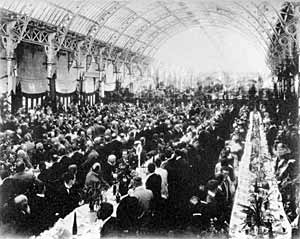
The annual Welbeck Agricultural Tenants Luncheon in the New Riding Stables in 1889.
Her catholic spirit was evinced on her attendance one day early in February, 1907, at the Mikado Cafe, Nottingham, when the members of a Sunday afternoon Wesleyan Bible Class, numbering ninety men, assembled for dinner. She expressed her interest in the aims of the Bible Class and in all efforts for the encouragement of right living. A bouquet was presented to her from the members.
The Duchess as a flower-seller was a delightful attraction at a Church bazaar at Sutton-in-Ashfield, a town where there is considerable ducal property. In a graceful little speech declaring the bazaar open she said: "I know you are all tired of bazaars and desirous of adopting some better method of collecting money, if such could be devised, but until some brilliant or practical mind finds such a way, you are forced to move in the old groove and repeat the same efforts."
The story of borrowing half a sovereign is not the only well-authenticated instance of her Grace having to negotiate a loan in consequence of her liberal instincts having prompted her to outrun the resources of her pocket.
After opening a bazaar for the Newark Hospital she passed round the stalls and made purchases freely, so that by the time she had made the round she had completely exhausted her purse. It was necessary that she should have enough to pay her railway fare to London, whither she wished to travel, and the honour of tending her the amount she wanted, fell to one of the stewards. The loan, I believe, was promptly repaid.
A Court of exceptional, splendour was held by the King and Queen at Buckingham Palace in May, 1905, and as the then Mistress of the Robes, the Duchess of Buccleugh, was unable to attend through being in mourning, her place was taken by the Duchess of Portland, none eclipsing her in that brilliant throng of English nobility. She wore a gown of ivory velvet, brocaded round the skirt with bouquets of flowers and trimmed with Italian lace and cream chiffon; the train of superb Brussels lace belonged to Marie Antoinette. Her jewels were diamonds, pearls and emeralds.
A brilliant Chapter of the Garter was held in November, 1906, and was followed by a banquet. The regal appearance of the Duchess may be gathered from a description of her dress of cloudy white, embroidered with mother-of-pearl, a high diamond tiara on her dark hair and a magnificent bouquet of flowers, surrounded with a wealth of glittering diamonds on her corsage.
Miss May Cavendish-Bentinck was married to Mr. John Ford on November 3rd, 1906, when Lady Victoria Cavendish-Bentinck made her appearance for the first time as a bridesmaid. Mr. Ford was secretary of the British Legation at Copenhagen and the bride was one of the Duke's cousins. Lady Victoria Cavendish-Bentinck, the Duke's only daughter, will probably be presented at Court next season.