
< Previous | Contents | Next >
HAUGHTON
THE RAPID RISE OF THE HOLLES FAMILY
“This is the state of man: to-day he puts forth
The tender leaves of hopes; to-morrow blossoms,
And bears his blushing honours thick upon him;
The third day comes a frost, a killing frost, And, when
he thinks, good easy man, full surely His
greatness is a-ripening, nips his root, And then he
falls, as I do.”Shakespeare.
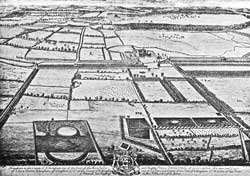
Map of Haughton, a seat of John, Duke of Newcastle.
Nearly two hundred and fifty years ago, while an exile in Holland, Gervase Holles, a relative of the first Earl of Clare, a learned antiquary and staunch supporter of the royal cause during the Civil War, compiled an account of the great family of which he was a member. In carrying out this work to the death of the first Earl, he says: “I originally intended to include in my collection an account of the antiquities and families of my native county of Lincolnshire, and to this purpose I had gathered very many materials out of history, records, charters, and church monuments, but this dire rebellion robbed me of my whole leisure and a great part of my collection. The remainder of the wreck I took care to preserve, and at length got it transported over to me in the Low Countries, whither I had escaped from the barbarous tyranny of those bloody regicides who now domineer in England. When I had these with me ... I thought it would not be time misspent to form a discourse concerning my own family and ancestors; to the performance of which the records yet in my hands would indifferently well enable me. This I did conceive would be an act of piety to those that are dead and gone, whose memories every day (more and more) threaten to forgettenness.”
This work of Gervase Holles’ eventually fell into the hands of the Right Honourable Henrietta Cavendish Holles, Countess Dowager of Oxford, who gave encouragement to Arthur Collins, a clever genealogist, to publish the work, which was completed to the death of John, fourth Earl of Clare and Duke of Newcastle. The publication of this handsome folio volume has rescued much interesting matter from oblivion, and has been of considerable use in preparing the following account of the family.1
“St. John's Square, May 8, 1754.
“May it please your Grace,—The book of the Holles family, &c., which I gave your Grace in large paper, being printed at my own expense, and containing only a few families, such a number is not yet sold as defrayed the charge thereof, and the printer lately wanting the remainder of the money owing to him, I was obliged to give it to him, which has reduced me to great straits.
“Your Grace, I humbly hope, won't let it be said, that, after retrieving the memory of your ancestors, and of others who have deserved well of their country, I was allowed to die in a starving condition, when it was in your power to relieve me.
“I earnestly beg you will be so humane as to order a warrant for some money for me, being in such want as I know not how to act or to turn myself, and am ashamed to make my case publicly known, who am, with the greatest submission, your Grace's most faithful, and most devoted humble servant,
“Arthur Collins.”
It is satisfactory to know that Collins received from the King a pension of £400 a year. He did not, however, live long to enjoy it. His death took place in 1760.
There can scarcely be found a more apt illustration of the adage that “Truth is more strange than fiction,” than in tracing the fortunes of the great families connected with Sherwood Forest.
The most sensational of writers might hesitate to commence his romance with such an incident as that of the wild leap of the rich mercer's apprentice to rescue his master's infant daughter from drowning, when a careless maid let her fall from an apartment on London Bridge into the river below, with the sequel of their marriage seventeen years after, the consequent bestowal of great estates upon the hero, and to his descendants a palatial residence on the borders of the Forest, a ducal title, and other honours. Yet this story of Edward Osborne is said to be substantially correct.
Another instance of a rapid change from humble life to one of the most eminent positions in the kingdom may be found in the family of William Holles, who, in the early part of the fifteenth century, was a baker in the city of London.2 His son, Sir William, a wealthy merchant, was knighted by Henry VIII. During the year when he was Lord Mayor, he had the honour to receive in the city “with orations, pageants, and all compliments of state, the greatest that ever had been seen,” the Lady Anne of Cleves, when on the way to her marriage with the King. The early part of the sixteenth century being the most noted for these shows of pomp, of any period of English history, this reception would undoubtedly be an affair of great splendour; and no less can be said of the pageant which took place in the following month, when the King and Queen proceeded by water to Westminster, accompanied in barges by many nobles and prelates, on whom Sir William in pursuance of his office, accompanied by his brethren in scarlet, and twelve of the chief companies of the city in vessels decorated with targets richly covered, with banners waving, and minstrels discoursing sweet music, gave their attendance.3
< Previous | Contents | Next >
1 Like many literary
men of his time, Collins was very poor. In the Gentleman's Magazine of
1783 is a copy of a letter sent by him to the Duke of Newcastle in 1754,
which has an interest in connection with the publication of this family
history.
“St. John's Square, May 8, 1754.
“
May it please your Grace,—The book of the Holies family, &c.,
which I gave your Grace in large paper, being printed at my own expense,
and containing only a few families, such a number is not yet sold as
defrayed the charge thereof, and the printer lately wanting the remainder
of the
money owing to him, I was obliged to give it to him, which has reduced
me to great straits.
“ Your Grace, I humbly hope, won't let it be said, that, after retrieving
the memory of your ancestors, and of others who have deserved well of
their country, I was allowed to die in a starving condition, when it was in your
power to relieve me.
“ I earnestly beg you will be so humane as to order a warrant for some
money for me, being in such want as I know not how to act or to turn myself,
and am ashamed to make my case publicly known, who am, with the greatest
submission, your Grace's most faithful, and most devoted humble servant,
“Arthur Collins.”
It is satisfactory to know that Collins received from the King a pension
of .£400 a year. He did not, however, live long to enjoy it. His
death took place in 1760
2 Dictionary of National Biography.
3 Hall's Chronicle