
< Previous | Contents | Next >
In 1647, after a stormy debate in the House of Commons, and some insulting expressions from Ireton (Cromwell’s son-in-law), Holles induced Ireton to leave the House in his company, and then suggested to him that they two should go over the sea and settle their differences by a personal encounter. Ireton replying that “his conscience would not permit him to fight a duel,” Holles, in choler, pulled him by the nose, saying, “if his conscience would keep him from giving men satisfaction it should also keep him from provoking them.”1 The meeting was frustrated by Sir William Waller; but this affront to the third person in the army so incensed the whole party that it was resolved, in one way or other, to be rid of Holles. Being made acquainted with this feeling towards him, “When Colonel Pride seized on the forty-nine members the very day Oliver returned from Scotland, he had that penetration and judgment to avoid coming to the House, whereby he escaped being imprisoned as they were,” and finding he could be no longer serviceable to the King and country, retired for the second time beyond the seas. He remained in Brittany until General Monk came to London with his army in the latter part of 1659.
On the restoration Holles was created by Charles II. Lord Holles of Ifield. His first wife died June 21, 1640. He married secondly on March 12, 1641-2, Jane, eldest daughter of Sir John Shirley, of Ifield, Sussex, and widow of Sir Walter Covert, of Slougham, Sussex, and of John Freke, of Cerne, Dorsetshire. She was buried April 25, 1666. He married thirdly on September 14, 1666, Esther, daughter of Gideon-le-lou, of Colombiers, Normandy.
By his second and third wives Holles left no issue. He died on February 17, 1680, and was succeeded by his son Francis, Lord Holles, who died March 2, 1689-90, leaving an only son, Denzil, third Lord Holles, born April 9, 1672, at whose death in January, 1693-4, these estates passed to John Holles, fourth Earl of Clare and Duke of Newcastle.
Gilbert, the only surviving son of the second Earl of Clare, was born at Hackney in Middlesex in 1633. When about twelve years of age he was sent abroad by his father, and in company with his cousin Francis, son of Denzil Holles, visited Holland, Germany, France, and Italy. Returning to England on the restoration of Charles II., he married Grace, daughter of the Honourable William Pierrepont, of Thoresby, and succeeded to the earldom in 1665. He was a staunch supporter of the Protestant religion and very zealous in his efforts to prevent any innovation on its ritual. Clare was one of the sureties of the Duke of Monmouth on his arrest in 1682, and on the landing of the Prince of Orange he joined with those peers who petitioned James II. to summon a parliament free in all respects as the only means of avoiding a civil war. He died at Warwick House, Holborn, in 1689, and was interred in his family vault in the chapel at Haughton.
His Countess survived him. By her he had a numerous family, among whom William, the second son, was killed when twenty-one years of age, at the siege of Luxembourg, and his body was brought over for interment at Haughton.2 The fourth (and youngest) daughter, Lady Grace, married Sir Thomas Pelham, Bart., and the estates of her brother John, fourth Earl of Clare and Duke of Newcastle, passed by will to her descendants.
Gervase Holles, the historian, was the only surviving son of Freschville Holles of Great Grimsby, where he was born in 1606. His mother dying in his infancy, Holles was brought up at Haughton by his father’s cousin, the Earl of Clare, of whom he says, “I shall ever acknowledge the time I spent with him to have been happily bestowed.” During his abode at Haughton, the Earl’s brother, Sir George Holles, came into England, and was desirous that Gervase Holles should return with him to the Netherlands. But his father refusing to consent to this, he obtained admittance to the Middle Temple in 1628. A series of events, however, caused an alteration in his plans. He states that “on the third of March, 1629, died my grandmother Kingston, and my father about a year after her, as my grandfather Holles about a year before, whereby after I was twenty-three years of age I was seized both of my father's and mother's inheritance; whereupon, having been contracted to Mrs. Dorothy Kirketon, I was married to her at Great Grimsby in June, 1630.” After a residence of four years at Grimsby he writes: “Hitherto I had only been indulgent to my own contentment, which, from the time of my marriage, was so great that I found no cause to envy any person living; but in 1634 I called back my first resolution of studying the law . . . and in order to my more thriving progress in it I found it necessary to remove from Grimsby, and to plant myself at Mansfield, in Sherwood, in the centre of my principal kindred.” A few months afterwards, owing to the death of his wife and two children, he left Mansfield and returned to the Middle Temple; in October, 1637, he married at St. Andrew’s Church, Holborn, Elizabeth, daughter of Lieutenant-Colonel Molesworth. In March, 1640, he was created M.P. for Grimsby, and again in the following October. He was a strenuous advocate of the King’s prerogative. On the breaking out of civil war Holles brought 117 men to Charles at Nottingham and was colonel of a regiment of foot soldiers. He fought at the battles of Banbury, Brentford, Newark, Atherton, Bradford, and Newbury. He was taken prisoner at the siege of Colchester and his estates were confiscated. After a long imprisonment he was obliged to leave England.
Holles states that he resided three years at Rotterdam, wholly dependent on the hospitality of a good woman who had kept him from starving, and that he could not leave the city for want of money.
After the restoration he was made Master of Requests, with a salary of £100; which office he retained until his death. He and his first wife and children are all buried at Mansfield.
His son by his second wife, Sir Freschville Holles, was a captain in the navy. He commanded the Cambridge in the attack on the Dutch Smyrna fleet. He was killed, when thirty-one years of age, at the battle of Solebay, and was buried in St. Edmund’s Chapel, Westminster Abbey.
John Holles, the eldest son of Gilbert, the third Earl, succeeded to the honours and estates in January, 1689, in which month, while bearing the title of Lord Haughton, he had been elected a member of the House of Commons; but on his father’s death he took his seat in the Upper House as Earl of Clare. He was an active partisan of the Prince of Orange in his claim to the throne, and was present at the coronation of the King and Queen, carrying the Queen's sceptre and cross. Marrying Lady Margaret, daughter of Henry Cavendish, Duke of Newcastle, he, by the will of his lady’s father, within three years of his succession to the Earldom of Clare, became possessed of Welbeck. Succeeding, also, in 1693-4, on the death of Francis, Lord Holles of I field, to his great estates, he became one of the most wealthy men of his time; but, as he resided principally at Welbeck Abbey, the further account of John Holles, Duke of Newcastle, is given under that heading.
On an engraving of Haughton made in the lifetime of this Duke, the river Idle which flows through the gardens is divided into ornamental sheets of water, bordered by trees and shrubs planted in formal lines, and cultivated in the style in vogue after William the Third came to the throne. On the lower margin of this view are enumerated the titles of honour enjoyed by his Grace:—
“Haughton, in the county of Nottingham, one of the seats of the Most Noble and Mighty Prince, John, Duke of Newcastle; Marquis and Earl of Clare; Baron Haughton of Haughton; Lord-Lieutenant of the county of Nottingham, and of the town and county of the Town of Nottingham; Lord Warden of the Forest of Sherwood; and Knight of the Most Noble Order of the Garter.”
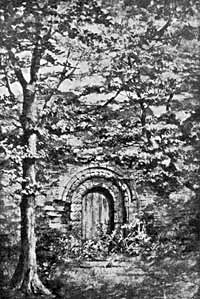
Ruined chapel, Haughton.
It has been truly said by John Ruskin, there are few places of more interest to after generations than the habitations of worthy men; and among the descendants of the humble baker of the City of London who have passed their lives at Haughton there afe such men, who have played a conspicuous and a self-sacrificing part in the national history. During the time that Haughton was the principal home of the family it witnessed their rise from simple gentlefolks to one of the very highest positions in the kingdom. In the midst of pleasant grounds the tower of Haughton once stood conspicuous, but of which almost every vestige has long since disappeared, leaving nothing to tell that here stood the dwelling-place of “the good lord of Haughton”; that this was the home of Sir John Holles, the first Earl of Clare; of Denzil Holles, his son, one of the most prominent men in the time of the Commonwealth; of Lady Arabella, Sir John’s daughter, whom the great Earl of Strafford chose as his wife; or that this is the place where so many exciting dramatic events have been enacted; except the ancient chapel, the burial-place of the family, which is roofless, and in a state of ruin—thinking of these events, one fancies there is a look of melancholy in the very grounds, and in the slow, murmuring river,—that they are sadly musing on their departed greatness.
< Previous | Contents | Next >
1 Collins’ Historical Account
of the Holles Family.
2 This is the last
interment Collins speaks of as taking place at Haughton. Gervase Holles,
in 1658, when
he wrote of
this chapel being in a ruinous state, attributes it to the “zeal of the present
puritanical lady in her new-fangled religion.” As John, second Earl of Clare,
held the estates at that time, the allusion would doubtless be to his countess.
If Gervase Holles’ account is correct, the chapel must have been put into
repair during the seventeenth century. We have, however, the testimony of
one who visited this building near the end of the eighteenth century that
it had again been allowed to fall to ruin. In Thoroton's Nottinghamshire
it is said: “On the outside of this chapel, amid some rubbish and nettles,
lies the figure of a lady, much mutilated; this lump of stone, which once
was
sheltered within this little sanctuary, and for ages perhaps carefully preserved,
lies now buffeted by the weather in a comfortless and solitary abode. It
had a cherub on either side of its head.” It is somewhat singular that the
figure which is thus described as being “buffeted by the weather” is still
there; the only respect in which his description is at variance with its
present state being that it now lies inside the roofless chapel, where
also is the font, moss-grown and half covered with rubbish, which would almost
certainly be used at the baptism of Denzil Holles (on the day of the duel),
probably the worthiest, as well as the most eminent, member of this great
family.