< Previous | Contents | Next >
OLLERTON
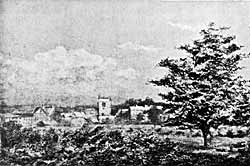
Ollerton from the skirts of the forest.
A cheerful aspect is given to the landscape by the bright red roofs of this quiet little town; the church too, on elevated ground, is fortunately placed. On a summer evening when all around is peaceful, how pleasant it is to listen across this wide open space to those sweet chimes! It has been happily said that the sound of fine bells is "the music nighest bordering upon heaven." Would that there were more such means of refinement.
The river Maun, springing from near Fountain Dale, and among the hills near Annesley, passes through Mansfield, with its fine old forest name, then flows by Clipston Park, near the Kings' House, and through Edwinstowe to Ollerton, where drowsily gliding along, it turns the mill wheel, probably on the same spot where six hundred years ago " Robert de Marcham held a watermill," and when he had " bond men in Allerton."1
During the eighteenth and the early part of the nineteenth centuries, when travelling about the country was almost exclusively done by means of post-horses or mail-coaches, Ollerton, lying on one of the main roads, had a share in the prosperous business, as the two important houses of entertainment still bear witness. But with the institution of railways all this was changed, although within about fifty years "The Hop Pole" still retained many of its characteristics as a roadside coaching-house. It was of the class of houses of entertainment that Charles Dickens describes so well; the landlord, civil and obliging, ready at the door to usher his visitors into the house, where in well and even elegantly furnished rooms was to be found an abundance of means of comfort for the weary traveller. Those who have visited the house at that time remember with pleasure the landlord's smiling welcome, the bright fire on the hearth, the well-made furniture of the period of the early Georges, the quaint coloured prints of the national sport, fox hunting, and Reynard's head and brush conspicuously displayed over the mantelpiece, and (most gratifying of all after an appetising walk through the forest) the repast, which was excellent and well served. Who can forget the bedrooms, too, with the old-fashioned faded paper-hangings; and especially the room where two massive four-posters, with curtains drawn, suggested reminiscences of Mr. Pickwick's dilemma at Ipswich?
The loss of the posting business must have been a severe blow to the town. The cultivation of hops also, which was formerly extensively carried on, has been abandoned. The weekly market, too, has ceased to exist, yet there is a well-to-do look about Ollerton, as may be seen by the superior class of dwellings covered with vines and other creeping plants.
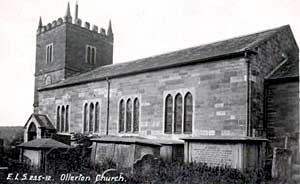
Ollerton church, c.1910.
Although scarcely any attempt has been made at the architectural adornment of the church, yet the effect of the interior is agreeable, for the walls are pleasant in colour, and there is a look of comfort which in buildings of this character is often not sufficiently considered. The church clock was placed in the tower by subscription of the inhabitants and neighbours in 1875, at which time Mr. Cecil Foljambe gave a peal of six hemispherical bells (cast by Messrs. Thwaites and Reed, of Rosoman Street, Clerkenwell), on which the clock strikes the quarters, the larger and older bell being used for the hours.
The stained glass in the east window to the memory of Mrs. Cecil Foljambe, first wife of Mr. Cecil Foljambe of Cockglode, afterwards Earl of Liverpool, painted by him, is a charming piece of colour, and good in design. Mr. Cecil Foljambe also filled a south window with stained glass to the memory of the Hon. Mrs. Savile Henry Lumley, his predecessor at Cockglode.
In the Heralds Visitation of Nottinghamshire, made in 1662, some shields of arms in stained glass are mentioned as being in these windows, from which they have long since disappeared—that of Hastings, &c., in the east window of the north aisle, and in a south window a shield quarterly, I, argent three greyhound whelps courant in pale sable (? Whelpdale), quartering three other coats.
From the churchyard are fine views over the skirts of the forest (which are almost covered with gorse and bracken), of Cockglode, and in the direction of Bilhagh Grove. At Ollerton Corner, near the junction of the old Blyth Road and the Worksop highway, are a number of well-grown beeches, planted in four parallel lines of nearly half a mile in length, forming three fine avenues. When this arrangement of the trees was made the entrance to Thoresby Park from Ollerton and the south was here, and afterwards when Earl Manvers obtained part of Birkland and Bilhagh (by exchange with the Duke of Portland as mentioned elsewhere), he altered the approach to the park to its present position through the Buck Gates, and had the entrance to this fine avenue planted up.
There may also be seen from the churchyard, on the Rufford Road, a little picturesque old-fashioned building, used as a grocer's shop, with a garden adjoining the river Maun, which has an interest to lovers of the forest. It was the residence of W. J. Sterland, whose work on The Birds of Sherwood Forest is a production of considerable merit. In this little shop he carried on business as a grocer, and in his leisure hours gathered together material for his book, a great part of which was originally published in The Field. He had the good fortune to attract the attention of Sir William Jardine, who encouraged and aided him in his studies. In a few personal remarks in the introduction to this volume, he says: " My home was within ten minutes' walk of the forest, and as I could there roam about with unrestrained freedom, it was my favourite resort. Boyhood increased my attachment to the wild scenes, and kindled a taste for natural history, which to the present day has been one of the resources of my purest earthly pleasures. It became my delight to watch the habits of the animals and birds I met with in my rambles, until there were few that were not familiar to me. . . . With what delight have I watched on a summer's eve the glowworms light their lamps literally by thousands, until almost every blade of grass and frond or fern bore its tiny beacon fire! Delighted have I sat,
"'To listen as the night winds crept From leaf to leaf.'
And as darkness shrouded everything from view, I have derived an inexpressible pleasure from the various sounds which fell upon the ear. The long-continued whirr of the night-jar would alternate with the hoot of the white or the screech of the tawny owl, or the wild cry of the stone plover would ring out clear as it passed overhead, while in some seasons, but not always, the nightingale would make the woods echo with her song."
Probably the most notable event in the history of Ollerton may be found in its connection with the family who derive their name from the village of Markham, about five miles from the former place, where they were settled before the Norman Conquest; and of whom Camden, in his Britannia, says, " they were very famous heretofore both for antiquity and valour." And although, as the editor states, many of the leisure hours of the Rev. David Markham, for a period of twenty years, have been occupied in gathering together material for the story of the lives of his ancestors, it has been labour well spent, for there was a spirit of ambition in the Markhams which urged them on to the achievement of great deeds; several members of the family have filled important positions in the Church, the State, and the Law. The history of such a family, which may be said to be one of the most ancient in the kingdom, cannot fail to produce may interesting particulars regarding the manners and customs of the times with which it deals, and from this work, which is now very rarely to be met with, the principal part of the information regarding the Markhams is derived.
After the battle of Hastings, when England was parcelled out among the followers of the Conqueror, West Markham became the fee of Roger de Busli, who already held numerous estates in Nottinghamshire. Under de Busli it was held by Claron, whose family had been long resident there; and it was Claron's successors who adopted as their surname the place of their abode—"de Marcham." Claron was succeeded in the landed possessions by his son Roger. There is little further known of these men in that early age, except that they were in possession of the lands, and that a "de-Marcham" also held a Manor in " East Marcham" in the reign of Henry the First.
The first man of note mentioned by the historian is Sir Alexander de Marcham, who was born about 1130, and distinguished himself in the wars during the reign of Stephen. In the time of Henry the Second he was appointed constable of Nottingham Castle, which he held during the reign of Richard the First, and that of John.
Richard de Marcham, living in the time of Henry the Third, shared with the family of Roland de Sutton in right of his mother all the vast possessions of the Lexington family ; they being found the next heirs of the Bishop of Lincoln, who outlived his brothers. Richard de Marcham thus, besides other lands, held of the King in capite half a knight's fee and the culture and wood in Knesale, also in Stratham three cultures of John de Eyville. Richard de Marcham left three sons, Robert, who succeeded him, Richard, and William.
The eldest son of Richard de Marcham had no sons, but three daughters Cecily married first Sir John Bekering, and had a son Thomas, whose grandson had to wife the daughter and co-heir of Sir John de Lowdham, whose sister Margaret married Thomas Foljambe. Sir Thomas Bekering had a daughter Millicent, who married secondly Sir John Markham, the elder judge. Bertha became the wife of William de Longvilliers, and Agnes was married to William de Sancta Cruce.
The wife of Sir Robert de Marcham was Sarah, daughter and co-heir of Jordan de Snitterton, in the county of Derby.
William de Marcham, the third son of Richard and Cecilia de Lexington, was an eminent Churchman. He was nominated to the see of Wells. The bishop was highly esteemed by all ranks of the people, both for his piety and his power of working miracles. In the year 1290 he was appointed Lord Treasurer by Edward the First. He died in the year 1302. After his death he was selected by Pope Boniface the Eighth as worthy to be enrolled in the Calendar of Saints. This sanctified station, however, he was doomed never to attain.
Sir John Markham, the Lord of East Markham, who lived in the reigns of the first three Edwards, was eminent as a lawyer and attained the office of King's Sergeant.
Sir Robert Markham was also a lawyer of eminence, and became King's Sergeant. He married Isabel, daughter and heir of Sir John de Caunton, of Caunton, arid by her had one son, named Sir John, who, following in the steps of his father and grandfather, also became Sergeant-at-law. He was entrusted to draw up the instrument for deposing Richard the Second, and appointed one of the Commission to receive the crown he resigned in favour of Henry of Bolingbroke.
< Previous | Contents | Next >
1 Thoroton's Nottinghamshire.