< Previous | Contents | Next >
THE PARLIAMENT OAK
"What years are thine, not mine to guess!
The stars look youthful, thou being by;
Youthful the sun's glad-heartedness; Witless
of time the unageing sky!"William Watson.
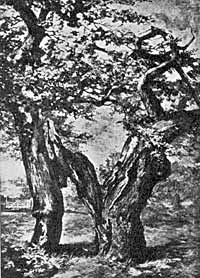
Parliament Oak.
WELL may it be said of these old oaks, "You seem as 'twere immortal, and we mortal," for still, on the return of summer, does this tree, one of the most ancient in the forest, give signs of vigorous life;1 although, since it was in its prime, every other tree and shrub, all neighbouring life has "gone, like the hour that can return no more."
It has been stated, with some probability of truth, that King John, while hunting in the forest, was informed by a messenger of a revolt of the Welsh, and of an insurrection in the north of England; that he hastily summoned a parliament to meet under this tree, and that it owes its name to that incident. Another account connects it with Edward I., who, when on his way to Scotland, in 1290, summoned a parliament to meet at Clipston. The proceedings opened on St. Michael's Day, but there is no authority for stating that any ceremonial assembly took place here, although the name may have been given to the oak in consequence of some informal meeting under its branches.
Standing on high ground, as it does, on the borders of Derbyshire, the prospect from the Parliament Oak is more varied and extensive than is generally found in Nottinghamshire. On one side it is bounded by the hills near Bolsover Castle and Welbeck, while in the valley beneath may be seen the red roofs and the church of the ancient village of Warsop. Looking towards the south-east from near this tree, in former times would be noticed "The Kings' House" at Clipston, with the vivarium, so often named in the royal accounts. Beyond, in the same direction, are the woods of Rufford Abbey, and in the east the spire of Edwinstowe Church rises gracefully from among the old oaks.
The boundary of Clipston Park was formerly at this tree, which stood in the park fence, but in the time of Edward III. an attempt appears to have been made to extend its limit considerably further in the direction of Warsop, for in that reign, John de Warsop, who was lord of the manor, presented a petition to the King and Council, complaining of an inclosure within the park of his wood of Warsop, to his great disinheritance and the impoverishment of his tenants, who ought to have commonage there.2
During the Civil War, in October, 1645, the King's forces lay between Welbeck and Blyth, and had their rendezvous at Warsop. In a letter, Sir John Cell writes: "On Saturday last a party of the Yorkshire horse fell upon some of the King's in Warsopp, and took some prisoners and horse, but the certain number I yet know not. . . . The King himself continues still about Newark, and makes a show of taking up his winter quarters there. He hath appointed the country people to come into Newark this day to be healed of the King's evil, and either he will remove just against that time, as formerly he did, or else he will make a long stay in these parts. ... At this instant I have intelligence that most of the King's horse are gone to Tuxford in the Clay."
Major Rooke, the antiquary, who resided in a picturesque house on the way to Mansfield from this place, more than a hundred years ago gave to the Society of Antiquaries an account of several Roman Camps which had been discovered in this locality. He also brought to light the remains of two extensive Roman Villas, about half a mile from Mansfield-Woodhouse. The buildings had been erected near to each other, and, he believed, occupied by some Roman officer of distinction. The smaller dwelling he names the "villa rustica," or farmhouse, belonging to the large "villa urbana." There were indications found that this site had been selected for the enjoyment of the pleasures of the chase.
Major Rooke relates that Mr. Wylde, of Nettleworth, who died in 1780, at the age of eighty-two, well remembered one continuous wood between Mansfield and Nottingham.
"On Thursday, 11th February, 1646-7, on the road between Mansfield and Nottingham, . . . the General of the Parliamentary army, Sir Thomas Fairfax, went and met the King," Charles I., "who stopped his horse; Sir Thomas alighted, and kissed the King's hand ; and afterwards mounted, and discoursed with the King as they passed towards Nottingham."3
In Groves's History of Mansfield, it is stated that from Major Rooke's house "Thoroton Gould eloped with the daughter of the last Earl of Sussex, and, riding over the border, was married to her by the blacksmith of Gretna Green. The lady succeeded to the title of Baroness Grey de Ruthyn on the death of her father." Their son was the Lord Grey de Ruthyn named in Moore's Life of Byron as being tenant of Newstead during Lord Byron's minority, and their descendants are found in the most eminent families of the kingdom, among others may be named the late Duchess of Norfolk. The Goulds were people of some note, whose house in Mansfield-Woodhouse may still be recognised by the monogram of the family entwined into the ironwork of the entrance gates. Edward Thoroton Gould, who married this lady, was an officer in the 4th Regiment of Foot, which early in 1775 was stationed in the American Colonies. He was wounded and taken prisoner in an attack upon the bridge at Concord, near Lexington, one of the first actions during the American War of Independence.
Another account states that the elopement took place from an inn at Barnet, but as Major Rooke and the Goulds were near neighbours, there seems some probability that Sherwood Forest may have been the scene of this romantic episode.
In a list of officials of Sherwood Forest, published in 1801, the name of E. T. Gould occurs as one of the verderers.
< Previous | Contents | Next >
1 In 1896 the Parliament Oak bore a large
crop of acorns.
2 Stapleton's History of Kings' Clipston.
3 Carlyle's Letters of Oliver Cromwell.