< Previous | Contents | Next >
RUFFORD
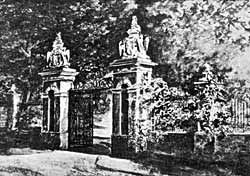
The entrance gates, Rufford Abbey.
IT has been said that in Nottinghamshire the land lying to the west side of the river Idle has always been famous for woods and pleasant waters, insomuch that there alone have been founded well-nigh as many monasteries as in the whole of the county besides, for in it were the Abbeys of Rufford and Welbeck, and the Priories of Worksop, Wallingwells, Blyth, and Mattersey, which are not far short of all the rest.1
Gilbert de Gant, whose grandson was the founder of this Abbey, was the son of Baldwin, Earl of Flanders; he came with William the Conqueror, his uncle, into England, and took to wife Alice de Montaforte, and had two sons of this marriage, Walter and Robert; WaltetT'the eldest, married Matilda, daughter of Earl Stephen of Brittany, and had issue Gilbert, who married Roesia, Countess of Lincoln, through which marriage, in right of his wife, he became Earl of Lincoln. It was he who, in this beautiful, though secluded part of the country within the borders of Sherwood Forest, formerly known as Rugford, Roughford, or Rumford, in the middle of the twelfth century founded an abbey for a colony of Cistercian monks from Rievaulx in Yorkshire, who, by the rules of their order, were constrained to fix their abode in solitary places. Rufford Abbey was dedicated to the Virgin. There is a legend that the dress of the monks, composed of a white cassock with a narrow scapulary or hood, was assumed at the wish of the Virgin herself, and communicated to St. Bernard in a dream. Although, when on their journeys abroad, they wore an overdress of black fastened at the waist to protect the white cassock from dirt, they were called white monks; and on their first establishment lived under very strict regulations. Silence was to be observed, except to the Abbot and Priors, and they were enjoined to devise extraordinary afflictions for their bodies, to fast, and to prostrate themselves before visitors.
Although during the reign of the Plantagenet kings the Forest laws were severe, and strictly administered, it may be safely assumed that the abbot and monks of Rufford were in high favour so far as the forest was concerned; for Henry the Second, by deed, "granted and confirmed to God and St. Mary, and to the church at Rufford, and to the abbot and monks serving God there, for the health of his soul, and the souls of his wife and children, and of King Henry his grandfather, all those gifts which the Earl of Lincoln made to them. All the lands of Rufforthe, woods, meadows, pastures, waters, milnes, ways and paths. And that they shall have their own proper woodward to keep their wood, as Gilbert de Gant had in the time of King Henry our grandfather, and that they may freely take from the same forest what shall be needful to them for their own use. And that no man give, nor take, nor sell, without their license anything, as it was in the time of King Henry our grandfather."
In addition to the liberality of the founder, another member of a noble family, John de Vesci, gave to the Abbot, Thomas de Stayngrene, and the Cistercian monks serving God at Rufford, the whole lordship of the manor of Rotherham, and the advowson of half part of the church at that place. About the same time Christiana, wife of Gerard de Furnival, gave lands in Rotherham to the Abbot of Rufford.
But great changes have occurred in the neighbourhood since Rufford Abbey was in its glory. There is not much resemblance to an old forest in the trees growing about the abbey. Almost every old oak has been cut down in the neighbourhood. Nor is there anything to show the wayfarer that at the junction of the road from Edwinstowe to Rufford with the highway from Ollerton to Mansfield, formerly might be found the King's Stand, where probably the Stuart Kings have frequently watched the progress of the chase. King James the First, and King Charles, were fond of hunting in Sherwood Forest, and were frequent visitors at Rufford.
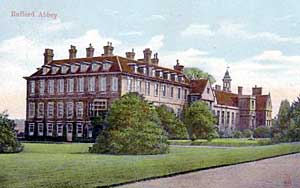
Rufford Abbey from the north-west, c. 1905.
From the Abbey gateway, which, though of modern design, is in excellent taste, there may be seen at the lower extremity of an avenue of limes and other trees, all that now remains of the old monastic buildings, for in the seventeenth century many alterations were made, and without doubt much of the old fabric would be sacrificed to make room for modern requirements. If those parts of the Abbey which have been destroyed were as fine specimens of mediaeval work as the refectory (or possibly it is the under croft, beneath the refectory), which yet stands, one cannot help a feeling of regret at their destruction, especially as, in addition to the beauty of the architecture, there is a special interest in such houses where historic events have taken place.
Near such a building as this, with its old associations, formal gardening seems to be most appropriate, for there is a certain look of antiquity in the quaint forms the trees are made to assume, reminding one of the garden of Levens, which is said to have been laid out in the time of James the First. But the pleasant walk under the great trees near the water carries the imagination back to the time when the Abbey as a religious house was in its glory, for no more fitting place could be found for the meditation of the monks. In those old times a life of ease with few worldly cares must have been their lot; and these pious men appear to have lived to a ripe old age, if one may judge from the average period of about twenty-three years during which each abbot held the office.
But the great change in religion which took place during the sixteenth century penetrated even here. At the dissolution of the monasteries, the monks of Rufford, with Thomas Doncaster, their abbot, were expelled: the Abbey of Rufford, with all the buildings and lands belonging to it; a thousand acres of land, three water mills, and the whole of the fishing were by indenture devised to Sir John Markham for twenty-one years. But in the following year, in consideration of an Act of Parliament passed at Dublin in the twenty-eighth year of Henry VIII., when the castles, lordships, honours, manors, hundreds, and lands of George, Earl of Shrewsbury and Waterford in that kingdom were settled on the crown, King Henry being unwilling to diminish the state, honour and dignity of the said Earl, granted to him the site of Rufford, Eakring, Bilsthorpe, Warsop, Walesby, Ollerton, Wellow, Elmton, Maplebeck, Boughton, Kelham, and the lordship of Rotherham, with certain lands there, the rectory, and the patronage of the vicarage of Rotherham, and all lands whereof Thomas Doncaster was seized in right of the monastery of Rufford.2
Rufford became the occasional residence of the sixth Earl of Shrewsbury. It was here that his ambitious Countess (Bess of Hardwick) brought about a match between the Earl of Lennox, younger brother of Darnley, and her daughter Elizabeth Cavendish. The Countess of Shrewsbury had recently failed in an attempt to bring about a marriage between this daughter and a son of the Duchess of Suffolk, and hearing that the Countess of Lennox and her son were leaving London for Scotland, and would pass through Nottinghamshire on their way, she pressingly invited them to break their journey at Rufford, even going herself so far as Newark for the purpose. The invitation was accepted, for Lady Lenox was weary with the journey; and while she remained at Rufford kept her room, amused by the conversation of the Countess of Shrewsbury. In the meantime the two young people found pleasure in each other's society. On Lady Lenox's recovery she discovered that the mischief was done, and the marriage took place shortly after in the chapel of Rufford Abbey.
< Previous | Contents | Next >
1 Thoroton's Nottinghamshire. 365. 2 White's Dukery Records.