< Previous | Contents | Next >
Sherwood Forest and Rufford Abbey
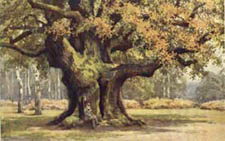
The Major Oak, Sherwood Forest.
In summer-time, for a sight of rich woodland scenery there is nothing to be compared to a drive through Birkland and Bilhagh, as one part of Sherwood Forest is called. Here we have the monarch of the forest, the Major Oak, with other lesser giants within easy access. Passing the pretty villages of Edwinstowe—Saxon, as its name denotes – and Ollerton, once the residence of a branch of the Markham family, by the beautifully-situated residence of Mr. George Savile Foljambe, at Cockglode, we come to Rufford Abbey, the home of Lord Savile, G.C.B., an eminent diplomatist, who has rendered great service to his country. The mansion is on the site of a Cistercian abbey, founded in 1148, in honour of the Virgin Mary, by Gilbert de Gaunt, Earl of Lincoln. At the dissolution of the monasteries the estate was granted on lease to Sir John Markham, but subsequently came into the possession of the Earl of Shrewsbury, and was the occasional residence of the famous ‘Bess of Hardwick.’ James I. was entertained there from September 19 to 22, 1616, and it received several visits from Charles I. From the Shrewsburys the estate passed by marriage to the Saviles, with which noble family it still remains.
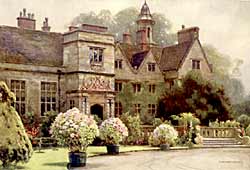 The west front of Rufford Abbey in the early 20th
century.
The west front of Rufford Abbey in the early 20th
century. The mansion has some beautiful apartments—notably the state rooms and picture-gallery—and contains a choice collection of pictures, tapestry, and articles of vertu. There are numerous references to the abbey in the State Papers, but no entries of general interest. Accounts of the eminent members of the Savile family are given in biographical books, and in the ‘Lives of Nottinghamshire Worthies.’