
ABOUT NOTTINGHAMSHIRE: ITS PLACES AND ITS PEOPLE, by CORNELIUS BROWN, F.R.S.L., author of "LIVES OF NOTTS. WORTHIES" and other works.
CHAPTER XLVII. SOME MINOR VILLAGES AND THEIR CURIOSITIES [continued]
WINKBURN PARK AND HALL—AN ANCIENT CHURCH—MEMORIALS OF THE BURNELL FAMILY—ELIZABETH COUNTESS OF RUTLAND AND HER WlNKBURN CORRESPONDENCE— NOTTS. LADIES AND THE VIRGINALS—DIFFERENCES WITH QUEEN ELIZABETH.
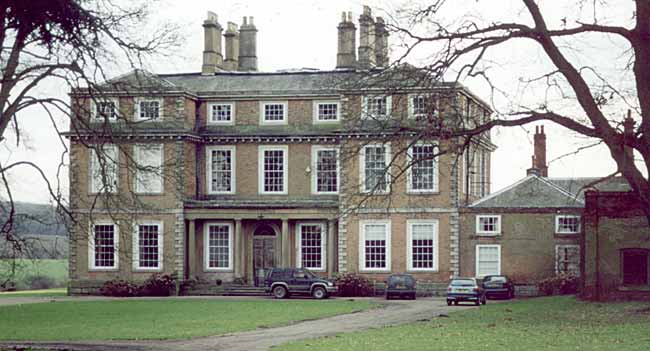
Winkburn Hall dates from the late 17th century; the attic storey was added in the late 18th century (photo: Andrew Nicholson, 2003).
We pass on therefore without further delay to Winkburn, and the drive through the park is again one of unusual beauty. The country is well wooded and undulating, and the scenery is very picturesque. Winkburn lies in a pretty valley, watered by the river Winkle, the central points of interest being the venerable church, and the hall dating from the last century, which are side by side, forming a happy combination of the ancient and the modern. The mansion of, brick, the abode of Col. Burnell, J.P., has a pleasing elevation, and the park and grounds which it overlooks are of considerable extent. The winding footpath to the church is through a maze of trees, and we are beneath a leafy canopy nearly all the way from the street to the sacred edifice. With the sun glinting between the leaves, and the birds singing in chorus overhead, the road is pleasant enough, and an abrupt turn in it brings us face to face with the ancient structure, thickly covered from floor to roof with a garment of clinging ivy. The south doorway is clearly Norman, and the distinctive characteristics of the architecture of the period may be seen in the arches and in the low tower; the walls of which are very strong and massive. Within the church are the high backed pews so familiar half a century ago, and a large oak pulpit with its wooden canopy stands near the middle of the nave. Only a narrow passage separates the north side of the church from the hall, and there is a small doorway through which entrance can be effected. The sacred edifice possesses many features of interest, and several memorials to departed worthies who have worshipped within its walls. Some time in the twelfth century both church and town of Winkburn were given to the Knights Hospitallers of St. John of Jerusalem, one of the military orders of the religious who were introduced into this country about A.D. 1100. The Hospitallers took their name from a Hospital built in Jerusalem for the use of pilgrims coming to the Holy Land, and their duty was to provide for such pilgrims, and to protect them from injuries and insults upon the road. They followed the rule of St. Austin, and wore a black habit with, a white cross. Rich gifts were made to them, and they became in course of time a very wealthy and powerful body. There was no preceptory in this county, but several in Lincolnshire and Yorkshire, including one at Eagle, close to the borders of Notts. To these institutions the revenues of land, given by benefactors, were devoted, the proceeds of Winkburn going to a preceptory at Newland in Yorkshire. The Knights retained possession until the seizure of monastic property by Henry VIII., when Winkburn reverted to the crown, and was granted by Edward VI. to William Burnell, Esq., and Constance, his wife, with whose descendants it still remains. By the side of the south wall of the chancel is the tomb of this gentleman, having on the upper slab an incised figure in the garb of a civilian, with hands crossed, a Latin inscription stating that he died September 23rd, 1570, aged 56 years, and the Burnell coat of arms—a lion rampant crowned, within a bordure.
In 1588 the manor appears to have been occupied by Elizabeth, Countess of Rutland, as there are in the Belvoir Manuscripts numerous letters from her ladyship dated from Winkburn. John, Earl of Rutland, died in March, 1587-8, and it is probable that the house would be taken for a while by the widow, as affording a peaceful seclusion from the troubles and anxieties of public life at the Court of Queen Elizabeth. The first of the Winkburn letters relates to legal business connected with the Earl's will, and the arrangements for the education of her children. Her daughter she places with the Countess of Bedford, and her son was at Queen's College, Cambridge, where she despatched for his use bedding and furniture by the Newark carrier. Sir George Chaworth writes to her from, Wiverton on September 24th stating "I am without a pair of virginals, and cannot as yet get any good. I shall be greatly beholden if you will sell or lend me an old pair which stand at Belvoir." The virginal was the precursor of the piano, and the term is said, though on doubtful authority, to have been given to the clavicembalo in England, in honour of the Virgin Queen, who showed much fondness for playing on a small form of spinet she possessed, strung with metal strings. "Queen Elizabeth's Virginal Book" has been preserved, and contains a number of compositions by Tallis, Byrd, Giles Farnaby, and Dr. Bull. During the second half of the sixteenth century the virginal was cultivated by all English ladies, and it is not surprising therefore, to find Sir George Chaworth wishing to procure one for the use of the fair dames at Wiverton. We need not summarise all the interesting documents bearing date at Winkburn which appear in this correspondence, or mention the distinguished guests who visited the noble countess in her retreat, but there are two or three relating to the reception of her daughter Bridget at Court, which are worth quoting as showing the sharp oversight which Queen Elizabeth exercised over the affairs of all the ladies around her. The Lady Bridget was received into the Queen's service in July 1589, to the great gratification of her mother, and one Mary Harding writes in November that her Ladyship is well thought of by her Majesty, and is endeavouring to follow the Courtly order in all points. In the fullness of her heart the countess writes from Winkburn, December 8th:—
"Onto her Majesty I am most highly bounden, acknowledging her Highness the very fountain from whence only cometh all my good"; and she loyally presents her humble duty "as from her who desireth not to lyve but to do her Majesty service, and never wisheth more happiness than the conteynewance of her Highness's favour."
But affairs of the heart upset the friendly and cordial feeling between Sovereign and subject. The Lady Bridget contracted a secret marriage without Elizabeth's consent, and so brought down upon herself and her mother the full weight of the Royal displeasure. An official letter says "the gentleman is lyk to be imprisoned, and my Lady Bridget must also be comytted, only her Majesty vouchsafeth this grace, that she shall not be sent to a prison, but comyttsd forthwith to custody of some lady, but where is not resolved. What more may follow God knoweth, for her Majesty is highly offended and principally against your Ladyship without whom she assureth herself this would never have been done and letteth not to say that your Ladyship was bold to do it." But by degrees the Royal wrath abated so that no further ill consequences than a brief commitment ensued. Meanwhile the countess left Winkburn to return to Belvoir, and so passed beyond the locality with which this present article deals.
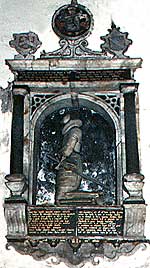 Monument to William Burnell (photo: Andrew Nicholson,
1988).
Monument to William Burnell (photo: Andrew Nicholson,
1988).After the temporary occupation of Winkburn by the Duchess as tenant, the owners resumed possession of their estate, the head of the family resident at the hall being William Burnell, Esq., to whom there is a fine monument on the south side of the east window. The gentleman is represented in the costume of the period with wide ruffs, and a sword by his side, kneeling on a cushion and his hands clasped as in prayer. The inscription beneath runs as follows:—
Here lieth William Burnell, Esquire, interred,
On whom the Almighty blessings great conferred;
The wealth he was possessed of did he spend
Like a good steward to a lawful end;
Of smaller means a greater house none kept
So great a time; few great ones him outstepped.
He married of the Cordalls family,
Elizabeth by name, which lady
Had sons William, Edward, John, Lawrence,
Frances, Robert—seven their number was;
Four daughters also, all of them made spouses
Before his death to men of worthy houses;
One to a knight, to three squires the other three,
To his great comfort did he placed see:
Elizabeth to Cave, Knight; Dorothy
Was married to a Squire of Strelly;
To Markham, Esquire, leave did he give,
And unto Wombwell, an Esquire, Olive.
He left remaining after him his wife
And six children when he left this life.
Obiit 2 April, Ano. Dom. 1609.
Ano etatis suae 61.
Two other striking memorials remain to be noticed. One is a fine marble monument to D'Arcy Burnell, Esq., who died in 1774, aged 46. It is surmounted by life sized figures of an angel with a torch that has been extinguished, and a lady gazing sorrowfully at the portrait of her lost lord. Another interesting memorial is a beautiful brass on the north wall to Hugh Darcy Pegge Burnell, Col., commanding 7th Queen's Own Hussars, born 16th July, 1836, died 18th December, 1883, erected in loving memory by the officers and non-commissioned officers who served with him in the regiment. On the brass is inscribed Dettengen, Peninsular, Waterloo, and Lucknow, with the monogram of the regiment above and the arms of the Burnell family below.