
Victorian Bulwell
When the pits opened and the "King Billy" had a thatched roof
LOCAL NOTES AND QUERIES BY JOHN GRANBY
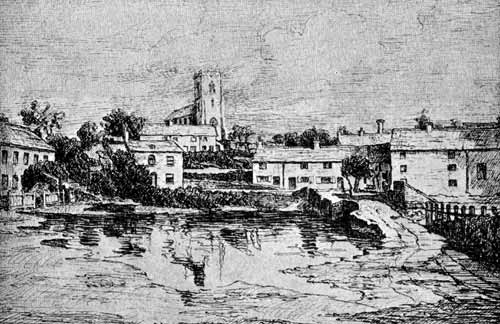 |
| How Bulwell has changed. This is a photographic reproduction of Bulwell Church and surrounds as seen from Bulwell Market-place in 1870. |
IN 1820, when the Rev. Alfred Padley, curate of Bulwell, had inherited Bulwell Hall Estate and added other property to it the village was on the eve of great changes. With 3,157 inhabitants, Bulwell had doubled its population since the beginning of the century, and the Rev. Padley owned most of the land.
White's directory of 1844 records that at this time Ruddington was receiving a yearly rental of £20 from ten acres of land in Bulwell and expended the income upon Sunday doles of bread for the poor of that parish. The directory mentions only one lace factory and one bleacher, but collieries had by then been opened. Foremost among them were the Cinderhill pits, which were being sunk from 1841-46, harbingers of the coal workings in Bulwell itself. The neighbourhood was soon covered with collieries and blast furnaces.
Writing in 1853 Wylie observed that the fast growing Bulwell, still a sequestered village, contained 496 houses, and that whilst a few of their occupants were yet employed in agriculture, most of them were engaged as framework-knitters or in making bobbin lace. Enclosures had been made but there remained 140 acres unenclosed, and Bulwell Forest achieved popularity as the scene of the annual review of the Notts. Yeomanry Cavalry. There were at that time, he said, three bleachworks and three corn mills at work in Bulwell. and he suggested that the village owed its increase and prosperity to its proximity to Nottingham and the River Leen.
BULWELL STONE
When the Leen reached the village after passing Papplewick Moor on its way to Bulwell Spring, it followed a series of corn mills, bleachworks and twist mills, to Bulwell Green and village, wrote Fyfe in 1856. More bleach bordered Bulwell on the Basford side.
At Bulwell, said Bailey in the same year, "we enter upon the great Magnesian limestone formation...." The Bulwell stone is coarse and granular, and through its use for common architectural purposes "such as garden walls, the rag-stone is a familiar local sight."
At Bulwell in 1863 was born one of the most celebrated medical practitioners, of his time. "The village may well be proud of having given birth to Dr. Samuel Wright." wrote the annalist, but readers must be referred to the pages in his "Handbook to Newstead Abbey" for details of Dr. Wright.
About 1840 the manufacture of gloves was added to Bulwell's industries, and at one time provided employment for about 700 operatives, but Mr. Beardall states that this ceased in 1864 owing partly to changing methods of manufacture and also because of a disastrous strike.
THE INCREASED POPULATION
The old church was pulled down and its successor was erected on a new site close by in 1882. St. John's was not built until thirty years later, by which time the population had increased from about 3,800 to roughly 9,000.
Ald. Mellors related that a plan of the Bulwell Hall Estate when it was sold in 1864 showed the Clay Field in long narrow strips reaching from Coventry-road to a brook at the top. The Sand Fields, Dob Park Field and Broomhaill Fields occupied the space between Highbury Vale-road and the Forest, and even at that date were cultivated as open fields in strips belonging to many owners.
This form of agriculture was a survival of a custom to which successive generations of Bulwell folk had clung tor a thousand years or more.
Floods added to the discomfort, especially when the swollen Leen burst its banks, as it did upon one occasion when pools ten feet deep were created, cottages ruined, and a deposit of tons of slimy mud had to be scraped from the surface about the market place.
Sanitary conditions were grossly neglected: sickness abounded: the death rate was high, and many of the streets narrow and ill-lighted thoroughfares were deeply scarred with ridges and ruts and were very dangerous.
ILLICIT COCKFIGHTS
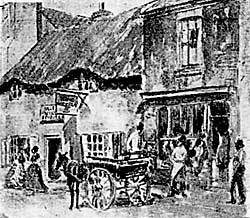
Many people know the "King Billy" in Bulwell Main-street—correctly named King William IV—but this is a watercolour of the same place in 1850, complete with thatched roof..
Bulwell had been tenacious of its its customs. When Ald. Mellors wrote, in 1912, it still retained its medieval manorial courts, though these were much shorn of their former powers and were proclaimed in the old forms at the door of the Hall.
Older residents may recall the Gu[...]ing and Plough Monday celebrations Christmastide. which lasted well into the "seventies," and the annual invasion of thirsty Irish harvesters with their illicit cockfights in a disused limekilns.
As late as 1912 the ancient custom known as Borough English and as the Junior Right, by which copyhold properly left by an intestate proprietor descended to younger son instead of to the eldest and as is usual was locally observed. This custom became obsolete under the Estates Act of 1925, but the Danes who introduced it a thousand years ago were evidently of opinion that the youngest child needed the protection.
John Matthews, who visited Bulwell in 1867, said as much as he could in favour of Bulwell, which he described as "A handsome and well built village, mainly inhabited stokingers and miners, and in no interesting or picturesque," but then its amenities have improved in every way.