
"18th October. The accounts from all sides is that all is quiet."
This ends the account of the fortifying of Clumber against the Nottingham roughs, who fortunately never turned up and I think I should now return to the description of Clumber. I cannot do better than to quote Throsby, in his additions to Thoroton's History of Nottinghamshire, in his description of the Park as it appeared to him one May day:
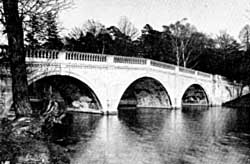
THE BRIDGE AT CLUMBER.
"The Duke of Newcastle's dwelling in this place is truly magnificent, although the building is neither lofty nor very extensive. From the new bridge which spans an apparent endless stream which waters Clumber, there appears a harmonious whole of grandeur; the proud chested Swans, which sail gently in numbers to and fro in the space between the bridge and the house, happily corresponding in complexion with everything of art in view; blended with the various natural tints of foliage which surround you (if I may be allowed the expression) paradises the mind . . . .
"Within the Park the country opens out with splendour, rich in effect and delightful to the eye. The fir and woody scenery around were warmed with patches of broom and gourse, then in golden hue, left, it may be presumed, for ornament. The Hills, or rather rising grounds, are beautifully clothed with woody scenery, the lawns are as smooth on the surface as a calm water scene."
Although written over a century ago, this describes the Clumber of to-day very well, only the "endless stream" has become a lake three miles long; Italian terraces have been made from the house to the water-side, a large marble fountain standing half way; and, in summer, the bright flowers, with the water splashing and playing in the fountains, added to the reflections of the trees and rhododendrons on the other side, makes it a truly beautiful scene, and worthy of Throsby's enthusiastic description.

RUBENS'S WIFE. AFTER THE PICTURE BY RUBENS.
In 1879, Clumber was the scene of a terrible fire; the entire centre of the house was completely gutted; many valuable pictures, pieces of china, and furniture being destroyed. As many as seventy pictures were burnt, including a very fine Albrecht Durer and a Romney of Lady Middleton. Amongst the china was a very beautiful pale blue Sevres service given by the King of Naples to a Duke of Newcastle; but it is useless to go on with this sad list, and one consolation should be, that had it not been for the pluck and devotion of the housekeeper (Mrs. Conden) a great deal more would have been lost. The fire caused a great change with regard to the centre of the house; many small rooms, some eighteen in number, were entirely knocked in, and a large Hall has replaced them, to the great improvement of the house. The four wings remain as they were, and in them are all the principal reception rooms.
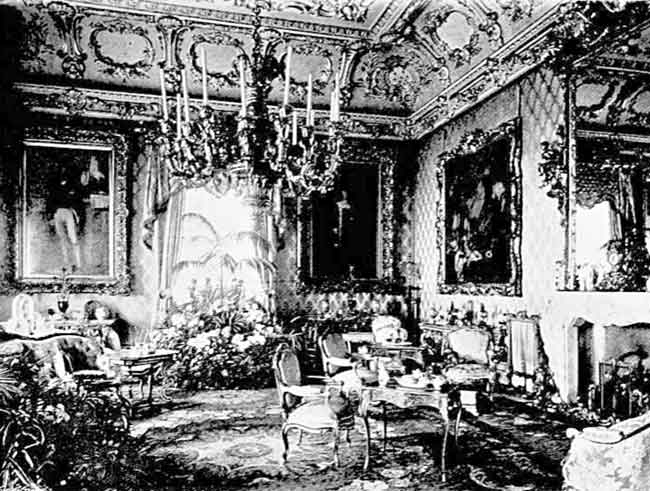
THE STATE DRAWING-ROOM.
Perhaps the curious stranger would in his mind's eye like to go through them. We will start with the State Drawing-room which is on our right as we come in at the west front. It is entirely decorated in cream, gold, and pale blue; the gilt carvings over the windows formerly decorated the Doge's palace in Venice, and are very fine. The pictures include that exquisite Van Dyck, "Rinaldo and Armida," which drew forth such universal admiration in the recent Van Dyck Exhibition at Burlington House; a very fine "Crowning of the Virgin," by Caracci; and two magnificent full-length portraits by Lawrence of the fourth Duke and his wife. The china is a very remarkable collection, three unique Chelsea Vases being included, two of them alone being valued at £20,000. The Sevres, Dresden, Worcester, and Crown Derby examples are also worthy of being mentioned with these.