Brinsley
From waste to coalfield.
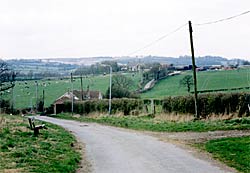
View down Hall Lane, Brinsley. Brinsley Hall is in the centre of the photograph (photo: A Nicholson, 2005).
BRINSLEY has come down the ages as a small hamlet sequestered amid marsh and waste between Sherwood Forest on its eastern side and the Derbyshire border on its west. The old form of its name was Brunnesley; in Domesday it appears as Brunnesleia, but both spellings indicate that a Saxon called Brune (or Brown) established a settlement here. The fact throws no light upon its history, for Bruns were relatively almost as common then, as Browns are now, but it may be assumed that more than a thousand years have elapsed since this pioneer and his followers arrived and finding workable ground ami woodland, waste and marsh, with the Erewash stream hard by, felled and drained and cleared an inconsiderable area of somewhat intractable soil.
At the time of the Norman Conquest it was still small and of little significance. Its taxable value in 1066 was but 6s. 8d., and even that dwindled to 4s. within the next two decades. Its last Saxon owner was a Brun, who had a manor here which he lost to William Peverel, who installed as his "man" one Ailric, who was also tenant of lands in Trowell and elsewhere, of which he had, formerly been owner. There was no church, for the population did not warrant one. Domesday mentions only one person, a villein, in addition to Ailric, with land enough for two ploughs between them, and there were only two acres of meadow, with a woodland three-quarters of a mile long and half-a-mile wide, into which the pigs were turned to feed. The rest of Brinsley was waste.
The Brunnesleys.
There are almost no records of Norman Brinsley, but under the Plantagenets the veil of obscurity is somewhat lifted. The overlordship of the Peverels would cease in 1154 when the last of that line fled from King Henry's wrath and his estates were seized by the Crown. Still pertaining to the forfeited fee the manor came to be held by a family which took its name and had tenure by the feudal service of finding a man, a horse and a sack with a prick or goad at their own charge for 40 days whenever the king was at war with Wales.
Whether the Brunnesleys were originally Bruns is uncertain, but although descendants of the Brun of 1066 seem to have dwelt hereabouts, tenants of lands formerly their own, it is not until the end of the 12th century that the Brunnesleys appear as the local lords, Geoffrey do Brunnesley being found in 1193 to be a large landholder in Trowell and Brinsley. Two centuries later Robert Brown obtained the manor upon his marriage to its heiress, Joan de Brunnesley, and it is thought that he and his descendants assumed her family name and continued the Brunnesley tradition.
By the middle of the 13th century more of the waste had been reduced to culture, for it was then discovered that the Brunnesley of that time had alienated "10 bovates and more''—some 300a. at least—without licene, a course he had no right to take, as he held the land from the king. It was a common offence and was doubtless adjusted by payment of a fine, for the family continued to hold the manor until the close of the 16th century. Robert de Muscamp (Muskham) paid half a mark as an "oblation" in 1250 to retain the five bovates of land he had acquired; Henry de Estheut paid 15s. for his interest in a mill; a Thomas Tubb 6s. for his 12 acres, and others were mulcted in penalties, while Sempringham Priory, to which the residue of the alienated property had been granted, appears to have been left undisturbed. The mill alluded to, was a water-mill and the lord of the manor had been sharing it out with interlopers,
Sheep farming.
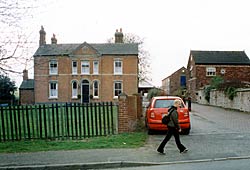
Manor Farm, Brinsley (photo: A Nicholson, 2005).
Sheep-farming for wool had invaded Brinsley by 1281, for in that year Margery, widow of Gilbert de Brunnesley, the late lord of the manor, gave a bond to Robert Scot, a woolstapler of Nottingham to deliver to him half a sack of clean wool from her farm here by a specified date. The village was growing and in 1303 Roger de Brunnesley had licence to have "a chapel in Brinsley in the parish of Greasley." Until that date the inhabitants had parished at Greasley, whose church was two miles away and difficult of access in bad weather, but henceforward they would probably be allowed to worship in this chapel except upon special occasions when all had to attend the mother church. Thirteen years later Eastwood and Brinsley answered for a whole vill, and Richard de Grey and Roger de Brinsley were the lords thereof. Under Edward III trouble came.
The mill was found to be worth "nothing beyond 5s. a year because it cannot grind well for lack of repairs"; part of demesne land lay untilled because of the poverty of the soil and even at a rental of 3d. per acre tenants were not forthcoming. That was in 1345 and four years later came the devastating Black Death, which made matters worse.
William de “Grafton” was then holding " by courtesy of England " by inheritance of his deceased wife, a meadow called "Thregermedu” of the Peverel Fee, for which he paid 3s. a year and did homage. The family had come to stay and, adding to their possessions, were among the principal owners for many generations, their inheritance ultimately descending to the Middletons of Wandesley. John del Ker and Thos. de Selston were among others who had interests here about that time.
The reign of Edward III was marked by lawless disorders in many villages and Brinsley would be shocked in 1359 when Sir Nicholas Goushill who had won renown in France under the Black Prince, committed burglary and ravished and abducted the wife of Sir John Bozon of Screveton who was then here. He refused to give her up and was outlawed, but presently received a pardon. There was an Alice de Brinsley whose husband, John Cut, was also "put to the horn," and her lands were seized beyond recovery.
Early mining.
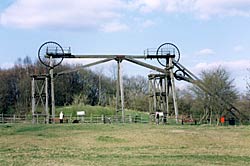
The tandem headstocks on the site of Brinsley Colliery date from 1872. The coal reserves at Brinsley were exhausted by 1930 (photo: A Nicholson, 2003).
In 1392 the vicar of Greasley was granted licence to bestow upon Beauvale Priory a gift of messuages, lands and rents, part of which lay in Brinsley and the rest in neighbouring villages. In 1400 the priory, by an exchange of lands with Thomas Samon, obtained "divers messuages, lands, coals, &c., in Selston, Underwood, Risshall in Selston, and in Brynnesley and Brynnesley Asshe." This is the earliest known reference to coal-getting here, assuming that the reference to coal applied to Brinsley, which is probable. Coal was then becoming more generally used, and there must have been a considerable outcrop.
The Geological Survey states that "the outcrop of top hard coal, stretching visibly from, Eastwood, may be seen (1909) forming the floor of the quarry of the Stone Road Brick Works at Brinsley," but it was not until late in the 18th century that collieries were established in this vicinity though there had been workings at Selston in mediaeval time. It may have been because of this industry that the village was able to send as many as 14 men to the military muster in the time of Henry VIII.
The Brunnesley interest ended early in the 17th century, when Gilbert Brinsley sold the manor to Gilbert Millington, and the manor-house and demesne to Patrick Cocke and others. During the Civil War, Millington was a prominent Parliamentarian, and when the war was over he sat as one of the regicides who condemned the king to death. At the Restoration he was similarly condemned, but making abject submission, he saved his life, but not liberty, and died after seven years' captivity. Wm. Cocke, on the other hand, fought for Charles, preserved his estate in 1660 by a fine of £195, and in 1659 participated in Sir George Booth's rebellion; and escaped further penalty by the coming of the Restoration.
Modern prosperity.
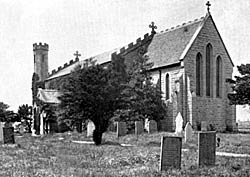
St James' church, Brinsley, c.1900.
The subsequent history of Brinsley has been uneventful. In 1669 the village blacksmith, Robert Horsley, issued copper tokens to overcome the prevalent shortage of small change, and in 1733 the Duke of Newcastle fifteen farms brought in a total rental of only £145. Most, of the local soil was still waste: it was not until 1775 that the enclosure took place and the land was developed; about that time the coal industry was expanding and New Brinsley came into being the making of the canal expediting this progress. In 1838 a chapel-of-ease was erected, which was enlarged in 1877. In 1861 Brinsley became an ecclesiastical parish and in 1896 it was created a civil parish, carved out of Greasley. A century ago Brinsley was "a neat village" with a population of 1,139 now, thanks to its collieries and brickyards, the number of its inhabitants has nearly doubled. It was at the pit here that D.H. Lawrence's father went to work at the age of seven, and that distinguished author introduced local scenes into his "Sons and Lovers" where the village appears as Selby.