
Kingshaugh
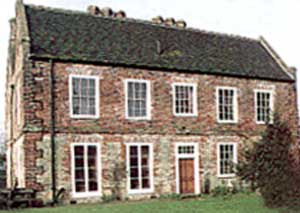 Kingshaugh house is a double-pile brick building
dating from the 17th century. Masonry footings to three of the external
walls may possibly be medieval in origin. (A. Nicholson,
2001)
Kingshaugh house is a double-pile brick building
dating from the 17th century. Masonry footings to three of the external
walls may possibly be medieval in origin. (A. Nicholson,
2001)To the south of the Lincoln Road, about a mile-and-a-half from East Markham, stands a fairly large farmhouse, occupying a site which is historic, and therefore of considerable interest. The present structure is probably not more than 200 years old, but a portion of the foundation and south wall appear to be ancient. The house has a picturesque appearance; it is separated from the road by a field, and between the field and the terrace on which the house stands is a stream which formerly formed part of the moat which surrounded the house. Before the road was made the land to the north was a morass, which would form a protection of no little importance. To the front of the house, which faces south, is an old fashioned garden and lawn, and kitchen garden beyond, bounded on the south-east by a broad ditch, which is evidently a portion of the original moat. To the east is a belt of lofty trees, from which hang several bunches of mistletoe.
This ancient site is known by the name of "Kingshaugh," which means "the King’s enclosure." King John enclosed here a portion of the royal forest of Sherwood, and made a park where lie could hunt deer, etc. The extent of the park is thus described in an inquisition temp. Edward I. in the Dukery Records:– The markes and boundes that goeth about the the desmayne wood of our Lord the King and the ground of Kingshaghe lying at the north side at a dike between Darlington and Kingshaghe and unto the way that is betwixt Dunham and Tuxford and so going to the dike that extendeth to the field of Markham and so to the Mannoure of Kingshaghe where it began and it is disafforested etc."
The word is also spelt ‘‘Kingshaw’’ and ‘‘Kingsey.’’ It was a part of the Berwick of Darlton, one of the four belonging to the manor of Dunham-on-Trent, which was one of the five manors in Notts. owned by the King.
Thoroton states :—"The men of Derleton and Ragnall, 2nd Henry III. (1226), had pasture for their cattle in the wood of Kingshaugh, as they were wont in the times of King Henry II. and King John, until the said King John made the houses be built, and the wood enclosed, and a park made thereof, which was in the time of King Richard I, his brother, against whom, when he was Earl John, he made war in this place.
The Itinerary of John records several visits to Kingshaugh, namely, Friday, June 8th to Tuesday, the 12th, 1212, when he visited Tickhill, Doncaster, and Rothwell, and again on August 27th and 28th in the same year. An entry of an order in the Patent Rolls is dated from Kingshaugh, August 28th, 1212, and he was there again March 28th, 1215. No doubt he paid other visits, and the tun of wine, which was ordered to be sent from Nottingham to Dunham, in 1205, was very probably consumed at Kingshaugh. The Close Rolls have an interesting entry to the effect that, on April 1st, 1215, the King orders the Barons of the Exchequer to refund Brian de Insular, the custodian one mark, "what he spent on one chalice, and one vestment, and an altar ornament, in our chapel at Kingshagh." It looks as if these gifts had been specially provided for the occasion of his visit on March 28th of that year.
In 1229 Baldwin (or Brian) de Insular had a grant of Haie of Kingshaugh to him and his heirs. It was given by Henry III. to Simon de Mounteford, Earl of Leister, and Elianor, the Countess, the King’s sister, who would no doubt forfeit it on taking the part of the Barons against the King. In 1244 Roger de Ros gave an account of the issues of Kingshawe. In 1258 Galfr de Langley had it. In 1323 Isabella, who had been the wife of John de Castre, had the King’s (Edward II.) pardon for the transgression which she made in acquiring together with her said husband the manor of Kingshaugh. She terminated the matter by paying 40 sols, by which gift she acquired the Manor. Edward III. (i.e. before 1377) committed "to Roger Truelove the custody of the land and holdings with their belongings at Kingshagh in co. Notts., which had belonged to Margaret Castre, deceased, which were to be held until the lawful age of the heir, and then restored. In an Inquisitio post mortem, date Richard II. (1382) ‘‘William de Creese and Margaret his wife to settle their Manor of Kingshaugh on themselves for life, with remainder to John de Bolingbrok, Katherine his wife, and the heirs of his body, successive remainders in tail to Richard, William, John, Thomas, Roger, sons of the grantors, remainder to John de Oxen, Joan his wife, and the heirs of their bodies, remainder to the said Margaret and her heirs, retaining land in East Markham." The next owners as far as we know were the Merings. William Mering, of Mering, had possession in 1522; he died 25th December, 1537, and was succeeded by his son John. John Mering in his Will, proved 13th April, 1543, leaves to William Mering, his eldest son, for care of younger sons under twenty years of age at time of death, a charge in the Manor of Kingshay and Darlton, and other towns, the yearly value of xx1i. He also leaves to his wife Katherine, for term of life, the Manor of Kingshay, which was assigned to her for her juncture in marriage. He leaves to the reparation of Darlton Church 6/8. To St. Nicholas altar viewes according to indentures, and the heir of Mering to see the ordering of them with the church minister of Darlton. An inquisition states :— "John Mering esqr held 34½ acres and ½ rood of land and the close containing 2½ acres in Darlton of the King."
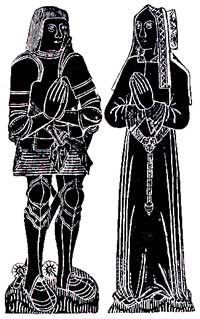
Brasses in Darlton church: probably Sir William Mering and his wife.
John Mering died 21st March, 1543. In Darlton Church are two brasses of a man in armour and a lady, in excellent preservation, names unknown. Thoroton mentions them as having been seen by him, but without inscription. The armour and dress are said to be those worn c.1510. If the father of the aforesaid William Mering, and grandfather of John, died at Kingshaugh, his death would about coincide with the date ascribed to the apparel represented on the brasses, and as at that period there was no other distinguished person residing in the parish of Darlton, we may reasonably assume that the brasses were originally placed on his tomb. The matrices have long ago disappeared, but the brasses happily remain.
In 1545 "Richard Nevill, gent, John Havet, yeoman, and Thomas Nicholls, yeoman, suffered a recovery of the manor of Kingshawe and lands in Darlton, Dreyton, Tuxford, and Newark, and called William Mering sqr," (the eldest son of John).
In 1565 "Augustine Erle suffered a recovery of the manor of Kingshawe, with the appurtenances; and called William Mering, knight." In an inquisition taken on the death of Sir William Mering (1585), it is stated that he possessed the manors of Mering, Thorney, Carcolston, Kingshaw, Sutton-upon-Trent, and messuages and lands in twenty-three other places. It would appear that the manor was held of the King by lease until it was purchased outright by Augustine Erle, eldest son of the aforesaid owner. The State Papers record that it became the property of Mr. Earl in 1604. The entry in the Warrant Book in the Record Office, is as follows:
"Augustine Earl, in consideration for the fine of £xlvi xiis. iiid., the Manor of Kinsgey Co Notts, value xiiis. iiiid. term his heirs and assigns, date 20 Feb 1604." Thoroton states Kingshawe "is now [1678] the inheritance of Sir Richard Earl, under age, grandchild of Sir Richard Earle of Stragglethorpe," and great grandson of the last named Augustine Earl. In 1697 Sir Richard, fourth Baronet, died unmarried, aged twenty-five, and left his estate to his mother’s brother, William Welby of Denton. Kingshaugh was held by the Welby family until 1916, when it was purchased by the present owner, Mr. G. W. Watson, of North Clifton.
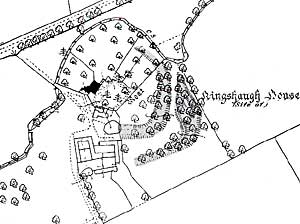
Kingshaugh depicted on the 1st Edition 25" to the mile Ordnance Survey map of 1885. Two of the defensive ditches are shaded.
The following is taken from the Victoria History of the co. of Notts., Vol. I., p. 301, written by Mr. William Stevenson:
Ancient Earthwork. Camp at Kingshaugh, Darlton. 2½ miles NE of Tuxford is a system of earth-works embracing an area of about 7 acres. The northern boundary is a small stream flowing eastwards towards the river Trent, about 3 miles distant. The inner work is a broad ditch, which originally appears to have enclosed an irregular circle, the extant half being on the east. On the same side is an outer vallum and ditch, the latter broadening and again narrowing towards the entrance, the widest part containing a mound for the additional defence of the narrow passage by which access was gained to the interior. In mediaeval times these defences were adapted to the old Kingshaugh House.
Source
- Rev. Howard Chadwick, History of Dunham-on-Trent with Ragnall, Darlton, Wimpton, Kingshaugh etc. 1924.
The Retford Cooperative Society owned the site in the 1960s and 1970s and the 17th century house was allowed to seriously decay over this period. Happily, Aubrey and Kathryn Eliott purchased the property in the late 1980s and have restored the house to its former glory.
Location: |
6 miles south-east of Retford |
OS Grid Reference: |
SK 765 734 |
Civil Parish: |
Darlton |