
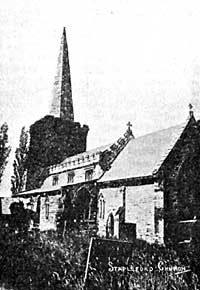
STAPLEFORD CHURCH. By permission of Mr. S. Poole.
The Parish Church.—Your Church is a venerable building. The interior is very restful, and especially so is that beautiful eastern window. The old Church, built by your Saxon forefathers, would naturally fall into decay, but apparently the Normans did not replace it with a new one. Mr. Harry Gill, who as an architect has carefully examined the present building, and has written a paper thereon, has fixed the date of the lower part of the tower at 1250, the parapets and spire being added during the 15th century, other parts at 1300, and others later still. The main part is in the "Early English"and decorated styles. On that spot your forefathers have worshipped God for a thousand years. The spire, finger-like, has pointed men towards heaven, and has said, "Remember God." Certain parts of the Church, and that old "Angelus" bell, which used to ring at sundown, show the change in the mode of worship that took place 850 years ago, when what is called the Reformation occurred. That spiritual earthquake was accompanied by many wrong things with regard to persecution and to property; but it was after all one of the greatest deliverances of the minds of men from Roman priestly rule that ever occurred. Remember that although God dwells not in buildings, but in man—for a good man is a temple of God—yet that old Church is a sacred building, devoted to a special purpose, the worship of God, and belonging to the parish of Stapleford. Treasure it and care for its welfare.
In 1790 Throsby visited Stapleford, and says, "The village is very populous. . . . There is a meeting-house for Mr. Westley's people. . . . The Chapel has a spire with three bells; five there has been. This Church or Chapel appears, as all should do, decent and respectable. It was beautified, as it is called, in 1785."
Of the Wesleyan Chapel, the Rev. John Wesley laid the foundation stone in 1782. That great and good man saved the nation in more ways than one. Various churches and chapels now adorn the village. Of all of them it is true in regard to object and work:—
These temples of His grace,
How beautiful they stand,
The honour of our native place,
The bulwarks of our land.
For they all are helpful in their measure to lead us according to our varied powers and tastes to be more like God, to know and value truth, to practice works of charity, and to build up character. These are the most important objects of life. There is no divinely-appointed mode and form of worship or form of creed. We must, therefore, follow our conscience guided by the Word of God, and must be very tolerant and charitable to those who differ from us.
In the 14th century Margareta de Stapleford, an heiress, married one of the family of Teverey, of Long Eaton, and for several generations the Tevereys were lords of the soil in Stapleford. They do not seem to have taken an active part in public affairs. There are several monuments to them in the Church, the oldest being an incised floor stone at the chancel step, and the latest the tomb which carries the effigies of Gervase Teverey and his wife, with a group of their children beneath. These effigies have been separated from the super-structure that originally formed part of this tomb, and which still remains in its original site against the south w&ll of the Church. The Tevereys died out through failure in the male line. A seat in the south side of the nave is still allotted to the family that occupies the Manor House.
The Old Manor House.— The house that Robert de Heriz lived in when he became lord of the manor would be a timber building, For centuries it was the seat of the government of the parish, where the law was administered. George Jackson, who was lord of the manor in 1689, built the present house, an Elizabethan mansion. The old hovels of the herdsmen stood in the lane adjoining the garden wall exactly opposite the stocks, the view of which doubtless was intended as a hint for their good. By the side of the pinfold the stocks stood, and perhaps a pillory, which held the head, arms, and legs of the culprit, who had to perforce submit to rotten eggs and stones being thrown at him. "Five shillings and costs "at the County Hall has taken the place of the stocks. The money part of the penalty for wrong-doing is now paid in Nottingham, but there is another part of the penalty, which consists of guilt of conscience, pain of body, injury to character, and loss of reputation, which has to be borne in Stapleford.
The Church House.—The little old house by the cross is worthy of notice. Mr. Harry Gill, in "The Village in the Olden Times." gives a view of Stapleford Cross and the house behind it, as "the small house that formerly stood in the Churchyard, where the Church ales were brewed, and where stores, etc., were kept for the Village Fair, held annually in the Churchyard or within the Church itself."
Here the Churchwardens in the good old times brewed the ale that was to be used at the village gatherings, or the feast of St. Luke, or any other holiday; and as the object was to promote some local charity, such as the relief of the poor, such gatherings were popular. The Rev. P. H. Ditchfield in "English Villages," says:—"Sometimes they (the feasts) were held at Whitsuntide also, sometimes four times a year, and sometimes as often as money was wanted or a feast desired. An arbour of boughs was erected in the Churchyard on these occasions, called Robin Hood's Bower, where fair hands collected the money for the ale, and "all went merry as a marriage bell"—rather too merry sometimes, for the ale was strong, and the villagers liked it, and the ballad singer was so merry, and the company so hearty—and was it not all for a good cause, the support of the poor ? The character of these festivals deteriorated so much, until at last Church ales were prohibited altogether on account of the excess to which they gave rise."
It, however, took a thousand years for us to learn that life might be enjoyed without intoxicants, and to hear the voice of every animal and bird, tree and flower, saying "Water is best."
The Black Death.—In 1349 there occurred the most awful pestilence that ever afflicted mankind. "The Black Death" was so called because black spots covered the body of the victim, and in 48 hours terminated his sufferings It came from Asia, by way of the Mediterranean, as well as by the Baltic, and when it arrived in England, it found an awful neglect of sanitary precautions, for fever and leprosy had long been feeding on the nuisances and neglect everywhere abounding. Of the three or four millions of people then living in England one half of them perished, and it took two hundred years to regain the lost ground. In London, where the Charter House now stands, fifty thousand corpses are said to have been interred. More than half the priests in Yorkshire perished In Bristol and Norwich the living could scarcely bury the dead. The harvests rotted, the fields were uncultivated, the cattle were neglected, labour could not be had; wages, and the cost of food went up, the value of land went down, and the whole social state of the country was disorganized. There is no record of how many people in Stapleford fell victims; all we know is that several of the owners of property in Stapleford perished, and there is one curious case recorded by Thoroton. Richard de Heriz, and Elizabeth his wife, passed the Manor of Stapleford, subject to a reservation, to Richard de Boughton; but he was or became a priest, so Richard de Heriz gave the Manor to Richard, the brother of his first wife, but both husband and wife died in the pestilence. Richard de Heriz then conveyed the Manor to William de Wakebrigge and others, to give to the Priory of Newstead, to make and found chantries : that is chapels or altars at which prayers might be offered for the benefit of his soul. I should think that he had a touch of the plague, and thought he was going to die, but did not.
Now he had a married sister, Idonea, the wife of John del Purmery, who had both sons and daughters, and she seems to have thought that if she could get the Manor, Richard's soul might be safely left to God without praying for; so she gave Richard no rest, and got her friends to do the same, and in three days they prevailed and persuaded him to revoke the gift, and to settle it on her son Robert. Now the arrangement was for Robert to marry Cecily, the sister of Elizabeth de Heriz, so that both families would be provided for, but the proverbial " slip 'twixt cup and lip "occurred, for Robert died, and the manor reverted to the thoughtful mother, Mrs Idonen, who enjoyed it for her life, and when she died she thought two bovats (query thirty acres) would be sufficient to give to the Priory. Perhaps she was right, for 200 years afterwards King Henry VIII. confiscated the whole of the property of the Priory, gave part to Sir John Byron, and gave or sold for a very small sum the tythes of Stapleford, which again 200 years afterwards were redeemed by the allotment to the owners of a large slice of the parish of Stapleford.
Tythes.—Good men in the olden times gave one-tenth of their income to God for the promotion of religion and for the poor and otherwise. Then came in a law that compelled them to pay whether they wished or not, so I doubt not there was for many hundreds of years a tythe barn standing in Stapleford, and to this barn must be brought every tenth lamb or calf, or sheaf, or cock of hay, &c., or the value in money. Two parts out of five of the tythes of Stapleford were, about the year 1108, given to Lenton Priory, whose Prior, I suppose, in some way either supplied or controlled the priest, and these tythes were for five marks per annum, in 1259 transferred from Lenton to Newstead Priory.* Possibly the other parts went to the support of the parish priest, and to the repair of the Church, and to the relief of the poor.
Under an Act of Parliament passed in 1771 "for dividing and enclosing the open fields, meadows, commons, and common pastures, within the liberties of Stapleford and Bramcote," there was allotted to
|
A. |
R. |
P. |
Humphrey Hudson for tythes |
28 |
0 |
3 |
To Foljambe's Charity for impropriate tithes ... |
82 |
2 |
85 |
To the Vicar of Bramcote |
1 |
1 |
25 |
To Henry Hudson, in right of Elizabeth, his wife |
29 |
1 |
35 |
To the Rev. W. Chambers, D.D. ..... |
163 |
8 |
15 |
And to 37 other owners |
539 |
0 |
18 |
And to 15 owners in Bramcote ... |
230 |
1 |
5 |
These apparently included many old enclosures, but unfortunately nothing was allotted to the poor, or for education, or for gardens or recreation. What an advantage it would have been if there had been ten acres on which you could romp and play as you pleased. That award was, I believe, the end of tythes in Stapleford.
Derby Road.—It may interest you to know that the road from Nottingham to Derby which runs through the parish was in 1301 described as the King's highway, which is called "Derbigate'' (a.) In 1759 an Art was passed for repairing and widening it. This was amended by four other Acts (b.)