
TOTON.
Toton is said to derive its name from the tun, or farmstead of Torolf (" Place Names of Notts.") In Domesday book it is called Tovetune, and Tolvestune, and in the following centuries Toueton, Towton, etc. The manor of Tovetune, comprising 3 carucates (? 360 acres) of land assessed, belonged to Aldene, the Saxon, but in or after 1066 it was taken from him, and given to William Peverel, the lord of Nottingham Castle, and in 1086 his man, Warner, had 4 sochmen, or ordinary tenants, 16 villeins or bondsmen—who instead of paying rent cultivated on certain days Warner's Manor farm— and 3 bordars. who were lower serfs. There was a church, which apparently was what we call Attenborough Church, and there was a priest, jointly presented by the lords of the manors in Toton and Chilwell. There were two mills, doubtless on the Erewash, rendering 8/-; also 100 acres of meadow, and a little plantation of willows. The value before, and after, the Conquest was 60/-.
When Lenton Priory was founded (1108-8) William Peverel was lord of Toton, and Robert, son of Warner, held under him, and gave two parts of the tithe of his demesne in Toton to the priory.
Manor. The ownership of Toton having by the default of one of the Peverels been forfeited to the Crown, Henry de Grey in 1212 appears as having a Knight's fee here, as well as in five, or more, other places. He was then in the king's service beyond the sea, and is described by Thoroton as " undoubtedly a great man."
The Lord John de Grey in 1271-2 held the manor of Radeclyve (Ratcliffe-on-Soar) by barony pertaining to Toueton, and when he died there had to be an Inquisition held on each side of the river Trent, for there was a different officer responsible to the king on "this side," to that "beyond Trent." In Tofueton the manor having been forfeited to the king, was held direct from him by the service of a knight going with the king in his army to war. The report states that there was then a certain new dovehouse worth nothing. Sixteen oxgangs of land, held in demesne (equal to "house farm") each containing nine acres, were worth yearly 5/-each oxgang. Four freeholders held eleven oxgangs, and rendered yearly 11/6, doing suit of court every three weeks. Two mills were worth yearly £4. There were bondsmen who held thirty-seven oxgangs of land, with a park, each oxgang worth 5/- with the works of the bondsmen. Pasture was worth £5 yearly. The advowson of the church of Adingbur belonged to the manor, and was worth 20 marcs. (Inq. p. 132).
The Lord John Grey named was Sheriff of Notts. and Derbyshire, Governor of Nottingham Castle, and nephew of the famous Archbishop of York. His son, Reginald, held the like offices, and founded the Nottingham White Friary in 1276, in what is now called Friar Lane.
A singular transaction is recorded of Henry de Grey in 1301, when he gave a bond for £10,000, which was to be void if he did not sell nor alienate the manors of Toueton, and Estwayt (Eastwood) but leave them to his son Richard. This he carried out, for Richard in 1330 claimed the right to amend the price and quality of bread and ale in Toueton.
The high position of the Grey family is seen in the fact that when the "Order of the Garter" was founded, Lord John Grey was made a Knight of the Order, as was afterwards his grandson, Richard.
The King in 1283 assigned " to our most dear Mother, Eleanor, Queen of England,'' among other properties, the Knight's fee of Henry de Grey in Tawynton and Redeclyve. The manor of Toueton was in 1305 stated to be worth £40 yearly clear.
Henry de Gray held in Toueton in 1308, a capital messuage, worth yearly 3/4, equal to over 20 times more, now. The report says, " There are 60 acres of arable land, worth yearly 30/-, price of the acre 6d. and 20 acres of meadow, worth yearly 53/4, price of the acre 2/8. There is a water mill, worth yearly 30/-." The names are given of seven tenants, and their holdings, and rentals. Thus, "Richard le Daye holds 1 messuage, 1 oxgang of land, and renders yearly 12/-" at St. Martin and Pentecost. (Probably this man was an ancester of the present parish clerk). There were then twelve bondsmen holding land, and paying rent, showing how money at this date had superseded service, and six cottars, holding cottages without land, and paying 1/- or 2/- a year rent. (Inq. 224). The report of this Inquisition gives a good idea of the village and society six hundred years ago.
The Rectorial Tithes of Toton parish were in 1339 granted by the Grey family to Felley Priory (near Annesley), which also acquired the tithes of the other parts of the parish, and on the dissolution of the monasteries the tithes were granted to the Foljambe family.
The Court Rolls of the old Manor of Toveton in 1294-6, 1380, 1394, 1401-4, 1413-20. etc., are among the mass of papers at Wollaton Hall.
One of the bloodiest battles ever fought in England was at Towton Field, on March 29th. 1461, between the houses of York and Lancaster, when the latter lost, and 35,000 men were slain. One of our historians in error places the battle in our Toton—but it was at Towton, near Tadcaster, where one of the smallest churches in England stands on the battlefield as a memorial.
Edward Grey, who was Lord Lisle, about 1480, must have been an excitable man, for he sent a servant from his house at Toton to Wollaton Hall, to warn Sir Henre Willughby not to go to the Sessions at Nottingham on the next day, at his peril. There the Lourd Gray with 100 persones entered arrayed with jakkes, briganders, trussyng cotes, etc. On another occasion the servant of "Lourd Gray" appeared at Wollaton on horseback with a long speyr (spear) and bid Sir H. Willoby come out. and then rode to Bramcote hills where 40 or 50 of the men lay in bushment; and for the fear of this "My Lady Moder toke such sekenes that she is not lik to recover," etc. These matters are deposed to and recorded in Wollaton Hall MSS. p. 118, but it looks like a storm in a teapot, for the next item but one recorded is an agreement between the parties for the marriage of a young Willoughby to Miss Grey. The Manor house alluded to was on the site of the house now occupied by Mr. Bates.
A kindly Vicar. There was a singular controversy between the Rev. Gervase Dodson, Vicar of Adenboroughe, in 1632 and his parishioners, about the buying of bread and wine for the Holy Communion, and it was referred to Sir John Stanhope, kt., who was then lord of Toton. The parishioners were accustomed at Easter to pay dues, 8d. if a farmer, 5d.-if a cottager, and 2d. for a communicant, for their offerings, and the provisions for the Sacrament, and nothing else. The Vicar said this was too small an allowance. The arbitrator was very sagacious, for he had all "the parishioners, being togither assembled at the chappie in Toton," and required them "in all curtesy to fetch my (the Vicar's) fewell coales, woode, or any other comodityes, and to doe for me all neighbourly kindnesses, wch they all did farely pmise, and so I consented to continue the pvision for the Sacrament according unto their antiente custome."
Query. A chapel in Toton 300 years ago. Where was it? There was also in 1675 a licensed victualler's house in Toton.
The Manor of Toton was in 1501 granted by Queen Elizabeth to Richard Whalley, to whom there is a fine monument in Screveton church, near Bingham.
After various transfers the Manor was sold to the Warrens, who "inclosed the fields, and sold some of the anciente inclosure lying towards the Trent side, to William Sacheveral, of Barton, Esq.. with the ferry."
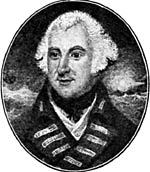
Sir John Borlase Warren.
The Right Hon. Admiral Sir JOHN BORLASE WARREN was owner of the Toton estate. He lived at Stapleford, where he was born. As Admiral of the Fleet he was engaged in various actions in which he was generally successful, and received the thanks of both Houses of Parliament. He was M.A., D.C.L., F.S.A., J.P., M.P., Knight Grand Cross of the Order of the Bath, Privy Councillor, Special Embassy to Russia. He was ever active, daring, and skilful. He was kind, affable, and much esteemed. In Attenborough church is a small tablet recording his decease in 1822, at the age of sixty-nine, when on a visit to Greenwich Hospital, where he died, but he was buried in the family vault at Stretton Audley, in Oxfordshire. Sir John married, in 1780, Caroline, daughter of General Sir John Clavering. The way in Sir John popped the matrimonial question to his future wife was original, and I believe has not been published. They were together at a party, at the house of a mutual friend", when Sir John on a piece of writing paper drew the figure of a heart, within which he wrote the words in French, "S'il est digne de vous et vous 1'accepterem, vous ze rendrez le plus heureux des hommes." ("If it is worthy of you, and you will accept it, you will make me the happiest of men.") Folding up the paper, he passed it across the table to Miss Clavering, who verbally replied, "Then you shall be happy." She survived her husband 18 years, and died in 1840.