
Owthorpe Hall: an historic house
By John Potter Briscoe
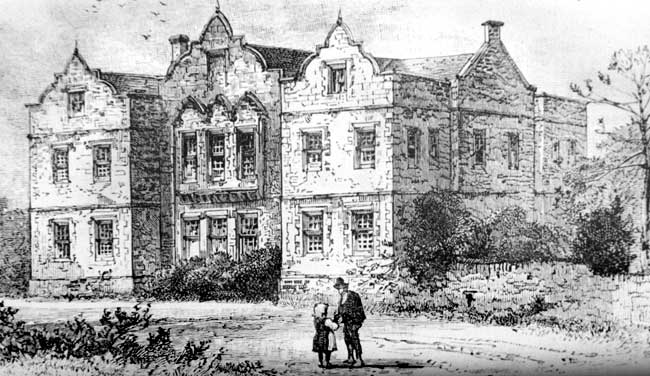
A nineteenth century view of Owthorpe Hall.
THIS home of Colonel Hutchinson was situated on rising ground in the vale of Belvoir, near the Fosse way, at a distance of two miles from Langar, and seven miles from Belvoir Castle. The Rev. Julius Hutchinson, a descendant of the great Parliamentarian, visited the ancestral home about 1775. He described it as standing to the east of the village and its church. The house was "large, handsome, lofty, and convenient, possessing all the grace that size and symmetry could give it. The entrance was by a flight of handsome steps into a large hall, occupying entirely the centre of the house, lighted at the entrance by two large windows, but at the further end by one much larger, in the expanse of which was carried up a staircase that seemed to be perfectly in the air. On one side of the hall was a long table, on the other a large fire-place: both suited to ancient hospitality. On the right hand side of the hall were three handsome rooms for the entertainment of guests. The sides of the staircase and gallery were hung with pictures, and both served as an orchestra either to the hall or to a large room over part of it, which was a ball-room. To the left of the hall were the rooms commonly occupied by the family. All parts were built so substantially, and so well secured, that neither fire nor thieves could penetrate from room to room, nor from one flight of stairs to another, if ever so little resisted." Thus much for the structure.
The environments were these. "The western side of the house was covered by the offices, a small village, and a church, interspersed with many trees. The south, which was the front of entrance, looked over a large extent of grass grounds which were the demesne, and were bounded by hills covered with woods which Colonel Hutchinson had planted. On the eastern side, the entertaining rooms opened on to a terrace, which encircled a very large bowling-green or level lawn; next to this had been a flower garden, and next to that a shrubbery, now become a wood, through which vistas were cut to let in a view of Langar, the seat of Lord Howe, at two miles, and of Belvoir Castle, at seven miles distance. At the further end of this small wood was a spot (of about ten acres), which appeared to have been a morass, and through which ran a rivulet. This spot Colonel Hutchinson had dug into a great number of canals, and planted the ground between them, leaving room for walks, so that the whole formed at once a wilderness or bower, reservoirs for fish, and a decoy for wild fowl. To the north, at some hundreds yards distance, was a lake of water, which, filling the space between the two quarters of woodland, appeared, as viewed from the large window of the hall, like a moderate river, and beyond this the eye rested on the wolds or high wilds which accompany the fosse-way towards Newark."
"The whole had been deserted near forty years, but resisted the ravages of time so well as to discover the masterly hand by which it had been planned and executed."
That the Hutchinsons were highly respected by the villagers admits of no doubt. The descendant whose words we have used, writes upon this phase in this language:—"The most extraordinary and gratifying circumstance was the veneration for the family which still subsisted, and which, at the period when the last possessor had by his will offered this and all his estates in Nottinghamshire to be sold, and the produce given to strangers, induced the tenants to offer a large advance of their rents, and a good share of the money necessary for purchasing the estates, in order to enable the remains of the family to come and reside again among them. It was too late ! The Steward had contracted with the executors and re-sold the most disirable part, whereof the timber of Colonel Hutchinson's planting was valued at many thousand pounds."
"Round the wide world in banishment we roam,
Forced from our pleasing fields and native home:
Did we for these barbarians plant and sow,
On these, on these our happy fields bestow?
Good heavens ! what dire effects from civil discord flow."
(Dryden's translation of Virgil's first Eclogue.)
Owthorpe Hall came into the possession of the Hutchinsons by purchase. After a time Sir Thomas Hutchinson, who was High Sheriff of Notts, in 18 James I. became the owner of the entire Manor. Charles Hutchinson, brother of John, acquired the house from Lucy Hutchinson, and took up his residence here. In 1773 the estate passed into the possession of Sir George Smith Bromley, Bart. In 1776 the Rev. Julius Hutchinson visited Owthorpe and removed a few pictures and works, all that remained to him of those possessions. Several years afterwards the Hall was demolished. About 1797 the Hall was occupied by Mr. Renshaw. The house, about this time, was large and formed "a square, with handsome, lofty, and convenient apartments;" and was subsequently tenanted by Miss Renshaw, who lived here in great retirement. Mrs. Musters tells us that "the ornamental stone vases from the garden were removed to Stoke, and still stand on the pavement under the windows there." Stoke, it should be remembered was the Notts. seat of the owners of Owthorpe.