
In 1645, a petition to the Parliament's Committee was agreed upon by "The Hall," asking for power to fell and take ten ash trees, standing near the Trent, belonging to Sir Gervase Clifton, to make rails to fence the Trent closes which were destroyed for safety of the garrison at the bridge; and also to appropriate Mr. Draper's timber at Flintham, or some other delinquent's wood, towards the repair of the bridge which was pulled in pieces by the enemy. (Bailey, ii., p. 730.)
The Hall Book, under date October 13, 1646, states that the Governor, on an application from the Corporation, gave a licence for a portion of the works at the Trent Bridge to be taken down.
We learn from Sir Richard Kaye's MSS., preserved in the Bromley House Library, Nottingham, that the arches were covered with timber. They sprung from stone piers.
The great flood of 1683, which arose throughout the whole valley of the river, owing to the breaking up of an extraordinary frost accompanied by heavy falls of snow, destroyed and carried away a considerable portion of the bridge.
The bridge proper at this time consisted of fifteen arches built of stone and brick; the first eleven had originally a span of twenty-live feet at their widest points, making an extreme waterway of 275 feet; the remaining arches, made for the passage of flood waters, varying from eighteen to twenty-five feet. The piers were broad and massive, and rested upon oak piles. The extreme length of the structure, measured from the north abutment to the London Road, was about 668 feet. The original width was about twelve feet, but the bridge was widened at various times so that at the time of its removal it varied from eighteen feet and a half to twenty-one feet and a half between the parapets, there being no footpaths.
A committee was constituted by the Corporation on the 12th March, 1682-3, to obtain contracts for rebuilding the bridges which had been destroyed or damaged during the late wars, and materially injured by recent floods; and, at the same time, another committee was appointed to cut down and sell wood out of the Coppice to bear the expense of the undertaking. The "Hall Book" for the following year shows that though the work had been commenced, it had not progressed very favourably, owing to the negligence or indolence of the workmen, for it was ordered on the 2nd April, that "a person should be appointed, at a salary of eight shillings a week, to keep account of all labourers employed about building the Trent bridges. The river was diverted from its course during these operations and brought through a newchannel northward of the former bed. (Bailey, p. 1009.)
The bridge being much out of repair about 1725, Sir Thomas Parkyns, Bart., of Bunney, undertook the superintendence of the work of restoration. "The Hall" voted him the sum of ten pounds as a testimonial of the services which they considered he had rendered to the town by so doing. (Bailey, p. 1146.)
A toll-house was set up about 1724 by the King and Parliament for the repairs of the bridge. (Parkyns' Queries and Reasons, &c, 3rd ed., 1724, p. 9.) Leland (Itinerary, p. 113) alludes to this ''great bridge," with "arches of stone." Toll was exacted for several years after the erection of the toll-house, as we gather from The Life of William Hutton, (edited by Mr. Llewellyn Jewitt, F.S.A., p. 36), &c, that "John Taylor, the toll-man, knew him (Samuel Hutton) about 1746."
The east side of the Trent bridge, the wharf and houses, belonged to the Chamberlains about 1740-9, and the west side to the bridge-masters. (Deering MSS. in Bromley House Library, p. 11.)
The great floods of February, 1795, do not appear to have caused much damage to the Trent bridge. The bridge being so narrow at the southern end that two carriages could scarcely pass, the Corporation, in 1806, ordered the eastern parapet to be rebuilt and the arches to be lengthened, which rendered it tolerably commodious. (Blackner's History of Nottingham, 1815, p. 19.) In 1810, a range of buildings which stood at the eastern side of the northern end was taken down, and that end of the bridge was widened, as well as the bridge over what is known as the Old Trent. The watch-house was at the same time taken down. (Blackner, p. 19.)
In repairing the foundations in the summer of 1817, the workmen employed by Mr. Joseph Soar saw a great quantity of Gothic stone-work in the bed of the river. (Sutton's Date Book of Nottingham, p. 402.)
On September 19, 1818, three young men threw a young man, named John Timms, over the parapet, for which crime they were tried before Sir W. D. Best, March 20, 1822, and hanged two days later on Gallows Hill.
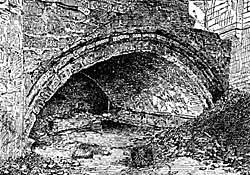 |
| Remains of the Old Trent Bridge. |
Advantage was taken of the extremely protracted drought of the summer of 1826 to examine and reconsolidate the bridge. One of the piers on the eastern side was entirely rebuilt, the others were repaired, and the bridge was so altered that the water should run through six arches instead of three. (White's History, &c, of Nottinghamshire, p. 190.) The remains of the ancient chapel on the bridge were seen again. They consisted (as we have stated) of beautifully-wrought mullions of windows, resembling those in the Church of St. Mary, and other carved work. (Sutton, p. 401.) Fragments of the old chapel were brought to light in 1831, together with part of a padlock and chain, and several fragments of stone windows. (Orange, pp. 88-9.)
The right of the Corporation of Nottingham to exact toll at the Trent bridge was tried in 1840 before Chief Justice Tindal and a special jury. The action was brought to recover a toll of fourpence from a common carrier. On the part of the plaintiff, various ancient charters were put in, and parole evidence given of the payment of toll for upwards of forty years, and as to the bridge being kept in repair by the Corporation. The jury gave a verdict for the plaintiff. (Bailey, p. 417.)
Her late Majesty, Queen Victoria, passed over the old Trent bridge on her way from Chatsworth to Belvoir in 1843; to commemorate which event the Royal Arms were carved on one of the abutments of the new bridge.
The bridge ledgers show that scarcely a twelvemonth passed during the last twenty years of the existence of the last bridge without considerable sums being expended in the repair of the structure. We learn from the same source that in 1850 the abutments of the bridge were repaired with one hundred piles, shod with iron. About the year 1851, it was discovered that one of the dry arches near the south bank had sunk, which caused the Town Council to adopt measures for securing it. (Wylie's Nottingham Handbook, p. 57.)
In consequence of the defective state of the old bridge. Sir William Cubitt, in 1853, prepared plans for a new structure, which, however, were never carried out. Further repairs of the original fabric were consequently made at different times, down to the year 1867, when, the inconvenience having become very serious, it was decided by the Town Council that a new bridge should be erected, and in November of that year the borough engineer, Mr. M. O. Tarbotton, F.G.S., was instructed to prepare plans. This was accordingly done, the estimated cost of the new bridge being about £31,000. In September of the following year the first sod was turned on the south side of the river; the "memorial stone "was laid with great ceremony by the Mayor, Mr. Alderman John Barber, on the 15th July, 1869; and on the 25th of July, 1871, the new Trent Bridge was opened for traffic, in commemoration of which event a medal was struck. In the following October began the work of demolishing the old structure, which, in a few months, gave way to the present beautiful and graceful piece of pontine engineering; but relics of the old bridge were suffered to remain near the County Police Station as a reminder of other days. These are depicted on page 16 of this book.
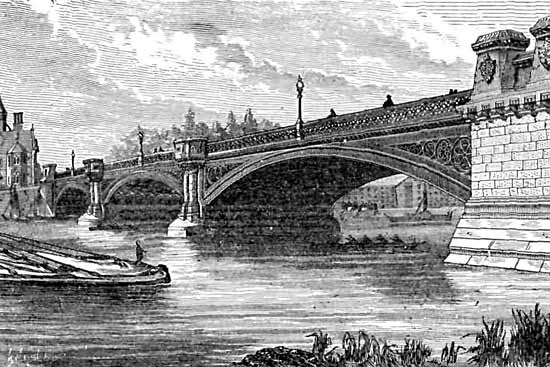 |
| Present Trent Bridge. |