
The Byron Vault at Hucknall Torkard
By A E L Lowe
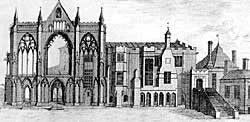
Newstead Abbey in the early 18th century.
EVELYN Philip Shirley, in his Noble and Gentle Men of England, writes "the antiquity of the Byrons, is proved by their ancestor Ralph de Buron occurring as a considerable landowner in capite in Domesday, in the counties of Nottingham and Derby. Horestan Castle in the latter county was at a very early period their principal seat; but in the reign of John, by the marriage of Robert de Buron and Cecilia de Clayton, the lordship of Clayton, in Lancashire, became the residence of the family." Sir Richard Byron, who died in 1398, acquired lands in this county through his marriage with one of the co-heiresses of William de Colwick, lord of Colwick, near Nottingham, and from that period down to about the middle of the seventeenth century, the Byrons possessed the manor of Colwick, and occasionally made it their place of residence. Sir Nicholas Byron, who was created one of the Knights of the Bath at the marriage of Prince Arthur, eldest son of King Henry the Seventh, in 1501, died three years later and was buried in the chancel at Colwick, which for some time later continued to be the burying-place of the family. He was father of Sir John Byron, who held the offices of Steward of Manchester and Rochdale, and Lieutenant of the Forest of Sherwood, and who had a grant from King Henry the Eighth, by letters patent, dated May the 28th, 1540, of the site and demesne of the then recently dissolved Priory of Newstead, together with Bulwell Wood and certain other lands that had belonged to the monastery. A portion of the conventual buildings at Newstead was converted into a mansion which became the chief seat of the family, and another mansion was subsequently erected, probably by this same Sir John Byron, at Bulwell Wood. Sir John Byron, who was known by the soubriquet of "little Sir John with the great beard" but who, oddly enough is represented upon his monument in Colwick Church with a smooth-shaved face, died in 1576. He had been twice married, and by his second wife, who was a daughter of William Constantyne, of Blackley, in Lancashire, and widow of George Halgh, of Halgh, in that county, he had an only son, Sir John Byron, who was born before the marriage of his parents, but who was permitted to succeed to the family estates. This last-named Sir John, who bore the arms of Byron quarterly with those of Colwick, within a sable bordure to denote his illegitimacy, received the honour of knighthood three years after his father's death, and dying himself in 1609, was buried in the chancel at Colwick. By Dame Alice, his wife, daughter of Sir Nicholas Strelley, of Strelley, he left a numerous issue. His two elder sons, Nicholas and Anthony, having both died without issue in their father's lifetime, the estates devolved upon the third son, another Sir John Byron, who married Margaret, daughter of Sir William Fitz Williams, sometime Lord Deputy of Ireland. That lady became demented, and a touching story of her husband's devotion to her and of their deaths, which occurred on the same day, is related by Mrs. Hutchinson, in her Memoirs of Col. Hutchinson. They had twin sons, the elder of whom, another Sir John Byron, succeeded to the estates on his father's decease in 1623, but died within two years, having had issue, by Anne, his wife, daughter of Sir Richard Molyneux, of Sefton, in Lancashire, eleven sons (several of whom died young) and one daughter. Sir John was buried at Colwick, and was the last representative of his family whose remains were interred at that place. In the unhappy civil contentions of this period, the Byrons warmly espoused the cause of King Charles, they were "all passionately the King's," as Mrs. Hutchinson puts it, and sparing nothing in their devotion and loyalty the fortunes of the family became seriously impaired; the result being that several estates, including Colwick, were sold in payment of debts contracted in supporting the King in his struggle with the Parliament. On the death of the last-named, Sir John Byron, in 1625, the estates had devolved upon his eldest son, Sir John Byron, who, in reward for his loyalty and valiant services, was raised to the peerage October the 24th, 1643, as Baron Byron of Rochdale, with limitation, in default of his own male issue, to each of his brothers. So long as Colwick remained in the possession of the Byrons, the chancel of Colwick Church seems to have been invariably chosen as the family burial-place, at all events down to the year 1638, when the first burial of one of the family at Hucknall Torkard is recorded in the parish registers. What lead to the abandonment of the ancient family burial-place at this particular period is doubtful, for Colwick was not disposed of at that time though very possibly the sale of the manor may have been in contemplation, and thus another place was chosen. Why Hucknall Torkard should have been selected is another matter for conjecture, for although Bulwell Wood Hall, one of the family seats, was in that parish, Newstead Abbey, which was the principal scat of the Byrons, was at some little distance, and the churches of Papplewick and Linby were both nearer, and apparently more conveniently situated. Newstead itself, like the sites of many of the more important monastic establishments, was then an extra-parochial liberty, possessed of no parish church, and there was thus no reason why any particular church should have been chosen by the family as their burial-place. It has been suggested that the fact of Hucknall having been one of the manors held by Ralph de Buron at the time of the Doomsday survey may have influenced the choice, but the more probable explanation is, that as the Byrons held the impropriate rectory of Hucknall Torkard they might thus lay claim to a right of sepulture in the chancel, which could only have been accorded them by permission elsewhere. It seems reasonable to suppose, therefore, that it was from this circumstance that Hucknall Torkard, was selected in preference to either of the other churches that have been named.
The earliest burial of a member of this noble family recorded in the parish registers is that of "Cicile ladie Byron," who was buried at Hucknall Torkard June the 6th, 1638. She was the first wife of Sir John (afterwards first Lord Byron), and left no issue. Anne, daughter of Sir Richard ( afterwards second Lord Byron ) was buried there, April the yth, 1640; and a year later "Mrs. Byron", presumably one of her sisters, was buried, May the icth. "Mistress Cicele Byron, daughter of Richard Byron, Esq.," was buried at Hucknall Torkard, May the 5th, 1645. In 1655-6 Gilbert Byron, a younger brother of the first and second Lords Byron, was buried here March the 16th. John, first Lord Byron, had died in Paris, where he had retired after the death of King Charles, in 1652, and leaving no issue the title had devolved upon his brother Richard, who thus became second Lord Byron. The burials of three of the daughters of this nobleman before his accession to the peerage, have already been mentioned, and he himself was buried in the same vault on the 6th of October, 1679. There is a large mural monument to his memory on the north side of the chancel in Hucknall Church. This monument, which is of an oval form, is profusely ornamented with sculptured drapery, foliage, cherubs' heads, and emblems of mortality, in white marble and has on the upper part the arms of Byron with some quarterings, now almost effaced. Beneath the armorial bearings is the following inscription:—
"Beneath in a voult
is interred the Body of Richard Lord Byron
who with the rest of his Family, being 7 Brothers,
Faithfully served King Charles the First in the civil war'
who suffered much for their Loyalty
and lost all their present Fortunes.
Yet it pleased God so to bless the humble endeavvurs
of the sd. Richard Lord Byron, that he re-purchased part of their ancient inheritance
which he left to his posterity,
with a Laudable Memory for his great piety and curity
he departed this Life upon the 4th day of October
An: Dom: 1679, in the 74th year of his age
In the same Voult is interred the Lady Elizabeth
his first wife, Daughter of George Russell, Esq,
by whom he had ten Children;
and ye Lady Elizabeth his second Wife, Daughter
to Sir George Booth, Knight and Barronet,
who appointed this Monument
to be erected
to the memory of her dear Husband
and for her great piety & goodness
acquired a name better than yt
of Sons and Daughters."
No record is to be found of the burial of either of these two ladies above-named, both of whom are distinctly stated to have been interred in the vault. With reference to the former it is stated in some of the accounts of the funeral of Lord Byron, the poet, in 1824, that amongst the coffins then remaining in the vault was an old lead coffin having this inscription upon it: "Here lieth the Body of Lady Elizabeth Byron, first wife of Lord Richard Byron, who died 22 March, 1617." How far this inscription is authentic is a matter of doubt. Unless the inscription was placed upon her coffin some years after her decease, which scarcely seems probable, this lady could not have been described as the first wife of Richard, Lord Byron. Then again the date must be incorrect, for in 1617 Lord Byron was himself only about eleven years of age, and this lady was the mother of his ten children. It is possible that the date may have been 1657, for the numeral 5 was frequently so written about that period that it might be mistaken for 1 by a casual observer. The parish registers do not, unfortunately, throw any light upon the subject.