
Shire (County) Hall, Nottingham
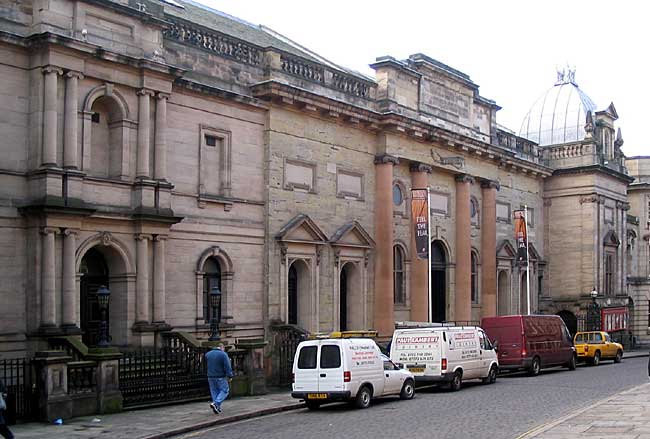
The facade of Shire Hall dates from 1770-2 and is by James Gandon; the building was extended and remodelled by T C Hine (1876-9).
In 1449 King Henry VI granted Nottingham a charter by which the town was separated completely from the administration of the shire, and thus became a county as well as a town. Two buildings, however, were exempted from the change: the castle and a “messuage called the King’s Hall, wherein is our gaol for our Counties of Nottingham and Derby”. Shire Hall remained part of the county of Nottinghamshire until the 1974 local government re-organisation. It was the building in which assizes, the quarter sessions and the county court were held; here, by the suffrages of the freeholders, the knights of the shire were chosen to serve the county in parliament. Coroners of the shire were also elected here, as well as the verderers of the forest of Sherwood.
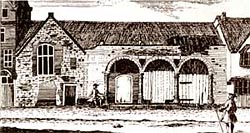
The dilapidated County (Shire) Hall on High Pavement in the mid-18th century.
The building was, however, much neglected over the years and in 1724 calamity struck:
“On Friday last [17 March, 1724] Sir Littleton Powis, Judge of the Assize, came in here, being met as usual by the High Sherriff, attended by a good number of gentlemen on horseback, though a very rainy day.
On Saturday was a Commission day for the County of the Town but there was no business worth mentioning.
On Monday morning after his lordship had gone into the County Hall, and a great crowd of people being in there, a tracing or two that supported the floor broke and fell in and several people fell in with it into the cellar underneath, some of whom were a little bruised; but one Fillingham was pretty much hurt, and skin and flesh of one leg being stript up from the bone and thought to be in danger. This occasioned a great consternation in Court some apprehending the whole Hall might fall, others crying out fire &c, which made several people get out of the windows.The Judge being also terribly frightened, cried out ‘A plot, A plot’ but the consternation being soon over, the Court proceeded to business: however his Lordship told the Grand Jury and gentlemen he would lay a fine of £2,000 on the County for not providing a better Hall, not doubting if they built a new one, or got the old one well repaired, but on their Petition His Majesty would remit the fine.”
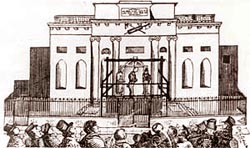
Hanging at Shire Hall in 1864.
This incident led to lively debates on the merits of rebuilding Shire Hall on the High Pavement site or, alternatively, building on a new site in the Market place. However, it was not until 1768 that the gentlemen and freeholders of the County met at the Swan Inn in Mansfield and resolved that it was necessary to build a new County Hall. They signed a petition to the next session of parliament for obtaining an Act of Parliament for that purpose; the Act was obtained in 1769 and provided for the raising of £2500. The rebuilding of Shire Hall commenced after the Lent Assizes of 1770: the architect was James Gandon and the builder was Joseph Pickford of Derby.
The building now contains The Galleries of Justice, an award-winning museum depicting the story of crime and punishment from courtroom to prison cell.
“The County-hall stands higher up the street [from the Town
Hall], on the same side, near St. Mary's church. The front is
a plain building of stone, heavy and prison like. It was built
in 1770, on the site of an old wretched building called Shire-Hall.
Behind this building is the County Prison. From some of the apartments
of this place, you have fine bird’s-eye views of some parts
of the town down the descending rock. In many instances you see
the tops of chimnies of one house on a level with the entrance
into another, which to strangers, who inhabit, or live in towns
seated on a plain, is attracting. In one place or two it is almost
perpendicular, I was shewn one of these precipices, I judge 70
feet deep, where a man jumped from his prison to the bottom to
gain his liberty.” |
Further reading
- Geoffrey Oldfield, The Lacemarket, Nottingham, Nottingham Civic Society
- Ken Brand, The Shire Hall and Old County Goal, Nottingham, Nottingham Civic Society
- John Throsby, Thoroton's History of Nottingham, 1790
- John Beckett, The Book of Nottingham, Barracuda Books, 1990.