
Screveton
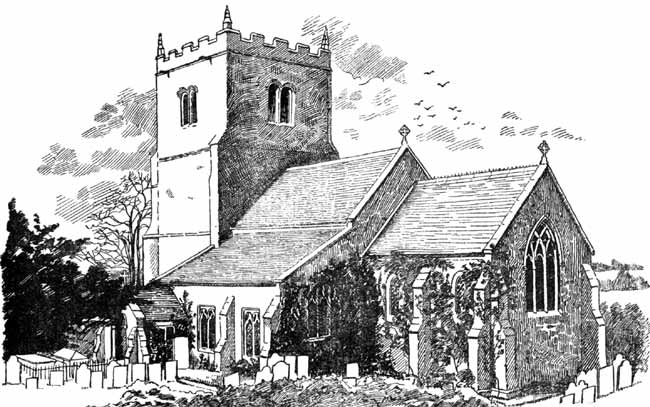 Screveton church.
From Car Colston a short drive brought the party to Screveton, a village little visited, lying, as it does, like Car Colston, off the main road, but full of interest from its association with the Whalleys, one of the most remarkable of Nottinghamshire families. At the Church they were received by the rector, the Rev. W. E. Bury. The Church, which is dedicated to St. Wilfrid, is interesting from the variety of its styles of architecture. It consists of a nave, with north and south aisles, south porch, western tower, and chancel, on each side of which was formerly a chapel. There are evidences of an earlier Church on the same site, the principal being the respond at the east end of the south arcade of the nave, and the beautiful Norman (transition) Font, dating about 1170, pointing to a Church of some importance as early as the middle of the 12th century. As regards the present one, the chancel was built probably soon after A.D. 1200, but was much altered at some distant period, when the eastern wall was rebuilt, the chapels removed, and the arches of communication built up. The north aisle was built next—about the middle of the thirteenth century—and has some sixteenth century insertions at the east and west ends. Early in the fourteenth century the arcades of the nave were rebuilt, and the south aisle, if not at the same time, soon after, and later on the east window of this aisle was inserted. Between the latter and the adjoining window of the south aible, a piscine was recently discovered, in perfect preservation. The tower was the last addition, late in the sixteenth century.
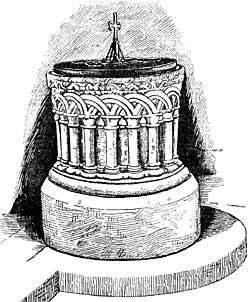 Font: Screveton church.
Remains of some of the original fittings were found, e.g., a chancel stall end—after which those recently erected have been modelled— and a beautifully-carved "miserere," which has been introduced as the seat of the priest's stall on the north side. There is, too, a good specimen of the parish chest, probably three hundred years old, of somewhat unusual length. There are in the church several slabs to the Thoroton family, one of them dating back to 1751. In the south-east corner is an incised effigy, which the villagers have defaced by adding their names. In the tower (formerly in the chancel) is a large monument in the Renaissance style, consisting of an altar tomb, surmounted by the recumbent effigy of a gentleman in a complete suit of plate armour, with head resting upon helmet bearing the crest of the Whalley family—a whale's head erased—and having a whale at his feet. Along the edge of the slab sustaining the effigy, the following inscription is carved in relief:—
Here lyeth Richard Whallaye, esquire, who lived at the age of 84 years, and e'ded this life the 23 of Nove'ber, 1583.
This Richard Whallaye had no less than five and twenty children, and spent the latter part of his life at the family seat of Screveton, known as Kirketon Hall. His last wife, Barbara, erected the monument, one of the finest in the county, to his memory. Whallaye was a steward of the Lord Protector Somerset, in the time of Edward VI., and shared in the vicissitudes of his patron. Amongst his descendants was Richard Whalley, who took to the old home at Kirketon, his second wife Frances, daughter of Sir Henry Cromwell, and aunt of Oliver Cromwell. Whether the Protector ever visited his aunt at Screveton we know not, but early in the great struggle between King and Parliament, he enlisted in his service one of his cousins from the village. This was Major General Edward Whalley, "Aunt Fanny's second son," who took an active part in the Civil Wars, rose to a high position in the council of the Parliamentary party, and was entrusted with the guardianship of the King at Hampton Court. At the Restoration he fled with his son-in-law Goffe, first to Vevay, in Switzerland, and then to America, where he died in a cellar at Hadley, in the year 1678. A very full account of his romantic career, and that of another extraordinary man, the Jesuit, Henry Garnet, one of the Gunpowder Plot conspirators, executed 1606, whom tradition asserts to have been a Whalley, was given in the Nottinghamshire Guardian in 1887, in the series which described most of the historic places in the county under the title of "About Notts.: Its Places and its People," by Mr. Cornelius Brown.