
Thoroton, Aslockton and Whatton
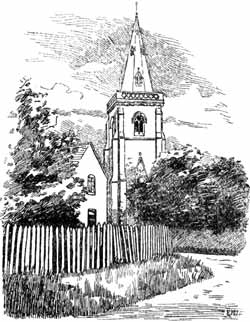
Thoroton Church.
After a pleasant time at Hawksworth the drive was resumed to Thoroton, where the party was received by the Rev. T. W. Swann. In the west wall of the tower of the Church is a fine decorated canopy or niche bearing figures of Saints on either side, whose heads have been ruthlessly demolished, and under the canopy is a pedestal on which a figure or more, probably three figures, once stood. The corbel heads at the top of the tower are very curious, as also are the gargoyles, the mouths being awry, and Mr. Phillimore drew attention to a curious and ludicrous error in White's "Nottinghamshire Directory" some years ago, in which it was stated that here were to be seen monuments of the Ryemouth family.
Although there are only two bells, there is room for a third, the tradition being that one was removed to the neighbouring parish of Orston. There is no evidence in support of the statement which probably arose from provision being made for the addition of another bell. There are at the present time, as Mr. Phillimore informed the party, no traces of the Thoroton family in the parish, and he imagined that there would have been none in Thoroton's time, or he would have mentioned them, seeing that he had given so much space to a description of this village, and the neighbouring parish of Car Colston in both of which he was personally interested. Mr. Phillimore conducted the party to the vestry, and showed them the only monument in the church—that to the Barrett family, dated 1776. He also called special attention to the very ancient font, on which are traces of the lock and hasp with which the lid anciently was fastened down, so as to prevent the villagers having access to it.
Passing out of the Church by the unusually narrow doorway the party first inspected a piece of a Norman arch, built into the eastern wall of the vestry externally. It is well preserved, and implies the existence of an earlier Church than the present one. On the north-west side of the churchyard stands the old plain looking manor house, and, by the kindness of the tenant, the members of the society entered it for the purpose of looking at a foot-stone, dated 1686, in the floor of the pantry. The Vicar, who had not known of the existence of the stone until a few hours previously, promised to look up the date in the Church register. This has since been done, but Mr. Swann states that the register throws no light upon this question.
The Church and manor house were left for the hall, though time did not permit of anything like a thorough exploration. The party then went on to the dovecote which stands in a meadow adjoining the well-kept lawn. The dovecote dates back to mediaeval times, and Mr. Phillimore pronounced it a very fine specimen. Inside it is honeycombed with nests, and is a sight well worth seeing. Mr. Phillimore pointed out that anciently there must have been in the centre a ladder arrangement which revolved on a central spindle, from which the pigeon holes might be reached.
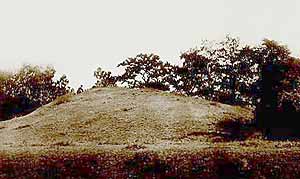
Cramner's Mound, Aslockton.
From Thoroton the party proceeded to Aslockton, the birth place of Archbishop Cranmer [1489—1554] where is the mound which is believed to have stood in the garden of the Cranmer family. It is still known as "Cranmer's Mound," and that it formed part of the pleasure grounds of the lord of the manor is most probable when we remember that such elevations were in high repute in the sixteenth century. Sir Francis Bacon, writing on the formation of a garden, says, "At the end of both the side grounds I would have a mound of some pretty height to look abroad into the fields." There is also a walk to Orston, known as "Cranmer's Walk."
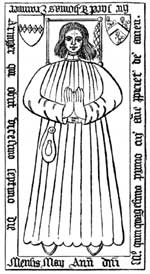 Incised slab in memory of Thomas Cramner.
More direct and tangible evidence of the famous martyr's association with the district was seen at Whatton, where, after luncheon at "The Griffin," the beautiful Church dedicated to St. John of Beverley, was visited. Here there is an incised slab, to the memory of the Archbishop's father, who died in 1501, bearing a still legible inscription, also the arms of Cranmer and Aslockton, and the figure of a man with flowing hair and gown with a purse by his side. There is also a stone tomb with the figure of a cross-legged knight in armour, in the chapel, at the east end of the north isle near the Cranmer slab (Sir Richard de Whatton, temp. Edward II.), and an alabaster tomb at the east end of the south aisle to Sir Hugh de Newmarch (temp. Henry IV.). Under an arch in the north aisle is the effigy of a priest (Robert de Whatton), with curled hair, whose head rests on a double cushion. There also is preserved what remains of the village cross, said to closely resemble the very beautiful cross at Monasterboice, county Louth, Ireland. The tomb to Sir Richard de Whatton and Robert de Whatton have beautiful brasses near stating that they were repaired by Hugh de Heriz Whatton, John Swift Whatton, M.A., and Arundell Blount William Whatton in 1892. As the party were passing the manor house on their way to Langar, Mr. Montagu Hall, of Whatton Manor, who had given the members of the society valuable information in and outside the Church, showed them an old sword and spear head, which were found in a field at Aslockton, in January, 1893.