
Blyth
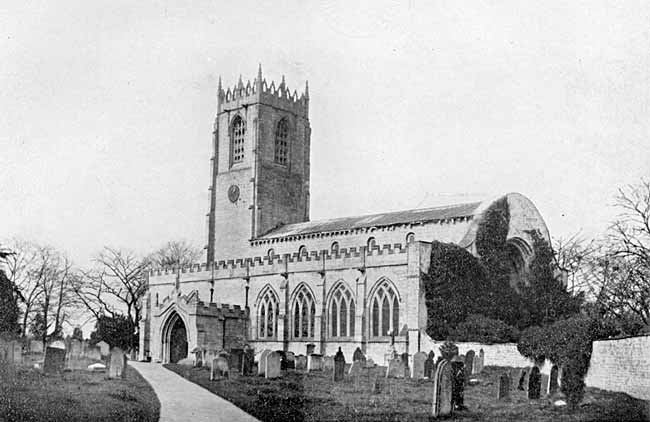 Blyth church from the south-east.
After luncheon at the Lion Hotel, a start was made about 2 p.m. for the Priory Church of Blyth, where an interesting paper was read by Mr. W. Stevenson on the civil and ecclesiastical history of the place. This paper will be found printed at length in the appendix to this volume.
The Church of Blyth Priory originally consisted of a short, aisleless, apsidal choir; with short north and south transepts, also without aisles, and a nave of bays with north and south aisles; rude, plain, and uniform from end to end. Over the crossing of the transepts there would be a low lantern tower supported by semi-circular arches, of which the westernmost still remain. The date of this early church is 1088, of which the present nave and north aisle formed a part; and there is an indication in the lower part of the north wall, that the original setting out of bays was square instead of oblong.
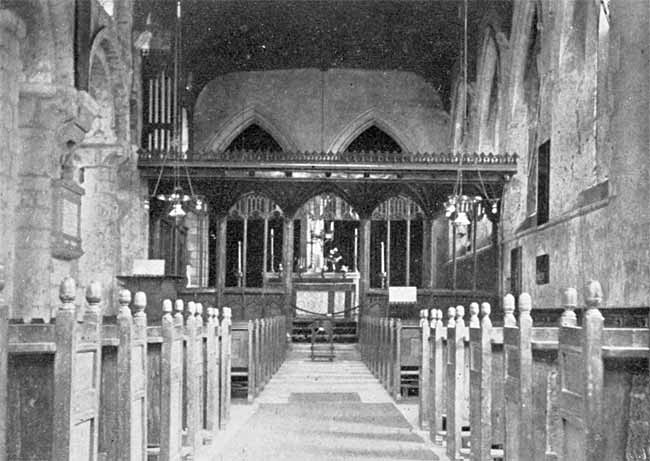
Interior of Blyth church, south aisle, looking east.
About a hundred years later (1180) a large south porch was added; and about two hundred years later (1290) the south aisle was widened with a wooden roof only, and the early south porch taken down and rebuilt. It seems a mistake to speak of it as of the same date as the widened aisle. The noble outer doorway and the entrance doorway to the church still remain unaltered. About 1230 A.D. the original flat wooden ceiling was replaced by a quadripartite stone vault, and about 1287 a new south aisle was erected, somewhat wider than the nave and nearly three times wider than the original aisle. The eastern wall of this aisle was the western wall of the Norman transept, and gives us its dimensions. It was pierced with two richly moulded arches on octagonal pillars, but the transepts having been destroyed, these arches are now blocked up. The object of this extension was to give the parishioners a church of their own. Wm. de Flechem, A.D. 1256, was vicar for forty years, and had a long dispute with the priory about vicarial tithes, which was settled by deed of endowment, 1287 A.D. The early unribbed Norman vaulting of the north aisle was left undisturbed. Towards the end of the fifteenth century another alteration was made in the fabric, when a stately western tower was begun and erected slowly in stages. The period occupied in its erection may be fairly indicated by the following bequests. In 1476 Thomas Chamberlain left 6s. 8d. "fabricae ecclesiae," and in 1509 Richard Adamson left 3s. 4d. "Campanae in eadem ecclesia. There are many examples of these western towers of fifteenth century and early sixteenth century date, notably Malmesbury, Furness, Wymondham, Shrewsbury, Bolton, Fountains, and others. Some time or other after the Dissolution the northern triforium was spoilt by the insertion of square-headed three-light windows of a Debased type; the lean-to roof of the north aisle being at the same time lowered and made nearly flat. The original arrangement may be seen in the easternmost secularized bay, now standing in the Hall grounds. As in many other places the grantees pulled down the whole eastern limb and transepts, and, selling the materials, left only those portions of the fabric standing to which the parishioners could lay claim. The blank wall at the east end of the church has been built up into the archway which gave entrance to the mediaeval monastic choir, and was probably the work of the monks, undertaken with a view to privacy of life and worship; though it may be as late as the Dissolution. An entry in Mr. Edward Mellish's account book of work done by him about 1684 speaks of his "repairing the church end"; and this entry led the late Mr. Raine to attribute erroneously the destruction of the conventual buildings to Mr. Edward Mellish himself; in whose day the Abbey House was certainly rebuilt, and a clean sweep made of the conventual remains; but the actual destruction of the conventual portion came a hundred years earlier. Of the fittings in the Church, the old transverse screens, with painted figures of saints,* are to be seen, and at the west end there are also a few seventeenth century pews. The screen now placed under the extreme archway is in all probability a good deal further east than it was originally. The screen in the south aisle was formerly as now, the rood screen of the parish church.
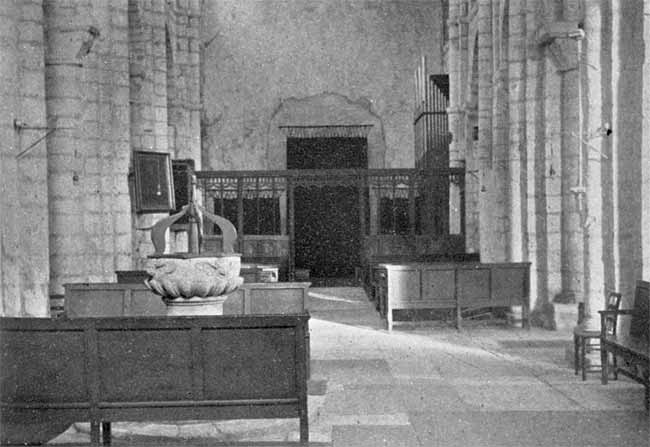
Interior of Blyth church, nave, looking east.
Among the monuments in the church are the fragments of a tomb with the recumbent effigy of a knight of the period of Richard I. In the reign of Henry VIII. the priory was of the annual value of £125, and it was granted to Gervase Clifton; but the rectory church remained in the hands of the King until he made it over to Trinity College, Cambridge.
Externally the western tower is a striking feature of the church. It is a hundred feet high, and is crowned with an elaborate open parapet with central and angular pinnacles, between which are open panels under canopies that are crocketed. The neighbouring church of Tickhill has a similar parapet. The western door is very beautiful. Here we have a rich ogee canopy, set in a panelled recess ; and over this is placed a tall three-light window flanked with niches. The transitional porch, as we have previously stated, seems to have been taken down and reconstructed somewhat south of its original position. The external arch has three orders of moulding ; the abaci are square; and the nail-head ornament runs round to the outer and inner arches. The battlement and pinnacles are of later date. The south wall is pierced with five three-light windows. The tracery is poor, and the mullions are without cusping. There is a small round-headed transitional door in the bay furthest to the west. This, like the porch itself, has no doubt been rebuilt on the widening of the aisle. The wall has an embattled parapet, but its pinnacles are gone. The original Norman single-lights without moulding inside and out are still retained, and the lights of the Norman clerestory are shafted within and of one square order without.
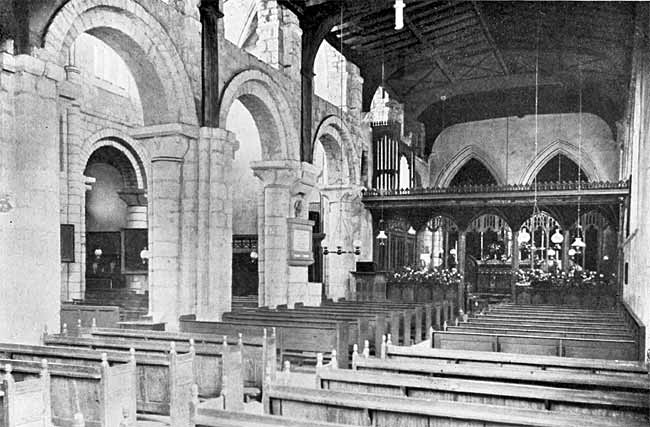
Interior of Blyth church from the south aisle looking north-east.
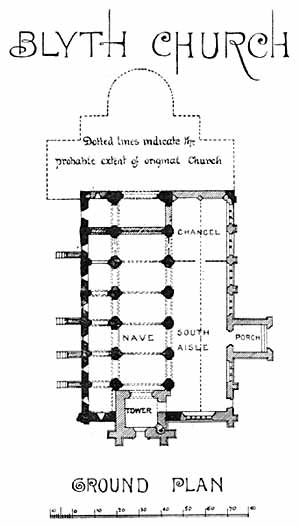
In Mr. Charles Clement Hodges' splendid and somewhat rare monograph of Blyth Priory, for only fifty copies were printed, the following dimensions of the church are given:— The Norman church as originally built; length internally about 158 feet; width of nave and aisles 44 feet 8 inches; length of transept about 74 feet; height of nave to wall plate 45 feet; breadth of nave 24 feet, 41/2 inches; of south aisle 26 feet 9 inches; of north aisle 10 feet 71/2 inches. Internal length of nave from west door to east wall 93 feet; ditto to lantern arch 122 feet. Height of tower 101 feet, 4 inches.
* Five of these figures may be identified, viz.: St. Stephen, St. Edmund, St. Kuphemia with a sword through her breasts, St. Barbara with a tower, St. Ursula sheltering under the folds of her garment some of her fellow martyrs.