
Referring to the monastery itself, being on the great highway, it became a place of hospitality of the first order, and the town was well supplied with inns or hostelries. Our early archbishops made important gifts to enable the priory to grant hospitality to travellers. Timber was given by a neighbouring lord, from the woods of Harworth, to make apartments for poor travellers. The domestic buildings embraced a guest hall for the entertainment of strangers.
In the Records of Durham is a bill or account paid by Robert de Insula, Bishop of Durham, and Richard Claxton, prior of Durham, in October, 1274, as follows:
s. |
d. |
||
For Bread |
10 |
- |
0 |
For Ale and Wine |
33 |
- |
5 |
For Kitchen Food |
27 |
- |
5½ |
For Provender, Hay, and Litter for their horses |
18 |
- | 9 |
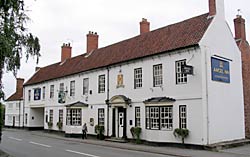 The Angel Inn, Blyth (photo: A Nicholson, 2005).
Total £4 9s. 7½d., an enormous sum at that time, which shows the magnitude of the retinues of great ecclesiastics. The late historian of the town pictures this scene at the Angel Inn—an hostelry still in existence ; but I have not been able to trace his authority. Adjoining this hostelry of the "Angel" is the bridge which carries the ancient road over the river. It was formerly called the "Rood bridge," from having a cross upon it, and on it was a wayside chapel served by the monks of the priory, to which it would prove a source of revenue. Beyond the bridge is the suburb called "Norney," which means the northern bank of the water; the terminal "ey" is the Anglo-Saxon "ea," for water, or an island, or the bank of some water. It gives the terminal to the site of the neighbouring priory of Mattersey, which was formerly an island in the waters of the Idle. It is again present in Haxey, for we are in the lake or watery district, peculiar to the lower reaches of the Trent valley—the district of the " drowned lands."
A mile and a half N.W. of this town is "Whitewater Common," which represents the site of the only natural lake, figured in the early maps of the county. It was drained at no great distance of time, and now represents a fertile area of land. In the neighbourhood of this old lake was the site authorised by King Richard I., in 1170, for the holding of tournaments—one of four sites—and the only one north of Trent, or in the north part of the kingdom. These feats of arms were no doubt associated with the castle of Tickhill; but they were within the borders of this county, and termed "the tournaments of Blyth."
I recently came across a very interesting note pertaining to this town and district, in the published Calendars of the Patent Rolls. It constitutes a picture that might easily be enlarged upon. The text is as follows:—January 26, 1335, King Edward III. at Roxburgh—" protection for two years for brother John le Marechal, a hermit, staying at the chapel of St. Michael by Blyth, about the making of a causeway between Blyth and Mattersey, who is dependant upon Charity for the sustenance of himself and the men working at the causeway and bridge, and who is going to divers parts of the realm to collect alms." The above is no doubt the origin of the present road from this town or priory to Mattersey town and priory.
The hospitable priory of Blyth, after an existence of 437 years, was dissolved along with the lesser monasteries in 1536, and its revenues, along with the rectorial property of the town church, fell into the hands of King Henry VI11. The rectorial estate is now the property of Trinity College, Cambridge. If this lost property could be restored to the church it would transform one of the poorest vicarages into one of the richest rectories of the county.
The late author of the "History of Blyth" remarked that he could trace no pensions being granted by the king to the prior and monks of Blyth, and that he could scarcely conceive that his majesty would turn out the old community penniless upon the world. I am afraid that this latter view must be taken, for I have found an ominous note, once repeated, in the handwriting of Thomas Cromwell, Vicar-General of the King, to this effect:—"Remember the prior of Blyth" no doubt when in council with the King. These notes occur in the Calendars of State Papers of the period, and can only imply that some offence, real or alleged, had been committed by the expiring corporation against his majesty, the new pope of the English church.
In preparing this short paper I have departed from the beaten track of adhering to the somewhat worn subject of architectural details, deeming it more interesting to you to lightly touch upon the salient points of the history, civil and ecclesiastical, physical and topographical, of this deeply interesting corner of our ancient county. In doing this I sincerely hope I have not courted your displeasure.