
Autumn Excursion, 1902
North Muskham
BY Mr Harold Bailey, A.R.I.B.A.
THE second of the Society’s excursions for this year was arranged for Thursday, the 4th September, when some fifty members and their friends visited the district which lies to the north of Newark. A contingent left Nottingham by train shortly after 8 am. for the former town, where the party was increased to the above number.
From Newark, the section of the Great North Road, known as Smeaton’s Flood road, which extends from the bridge over the river Devon at Newark, to the wooden structure across the Trent near South Muskham, was traversed. In past days this portion of the road was subject to such frequent inundations that great inconvenience was caused to the traffic—a serious matter when some ninety, coaches a day passed along the thoroughfare, besides numerous stage waggons, and ordinary private vehicles. In the year 1770 it was decided to raise this section so as to render it independent of floods. This was accomplished by carrying the road for more than a mile on brick arches, at a cost of £12,000, John Smeaton, the engineer of the Eddystone Lighthouse, having the direction of the work.
A drive of four miles brought the party to the Church of St. Wilfrid, North Muskham. Here Mr. Harold Bailey, A.R.I.B.A., of Newark, read the following paper, which he had kindly prepared for the occasion.
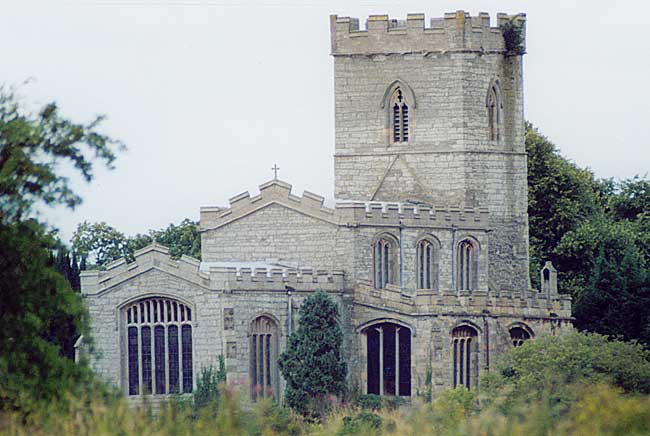
St Wilfrid's church, North Muskham (© A P Nicholson, 2003).
In the Church of St. Wilfrid, North Muskham, we have an unrestored church of fine proportions. I have been unable to consult any documents relating to the church, but its history appears to be as follows:— The earliest part of the fabric remaining is of the transitional or semi-Norman period, as may be seen in the wall piers east and west of the north arcade. Probably an earlier church was of this period, and consisted of a nave, chancel, and north aisle; the tower appears to be of the 14th century; the lower window on the west side has been interfered with by a modern doorway below it. The line of the 14th century roof, originally on the nave is clearly indicated by the drip-mould remaining, and a gallery blocks the fine arch between the tower and nave.
The north aisle was probably re-built in the 15th century, and the south aisle, porch, clerestory and nave roof then added. The aisle roofs appear to be of a later date, though there are 15th century timbers in them; the chancel arch and the remains of the screen are also 15th century work. The stairway to the rood-loft is still seen, and the position of the rood-beam may still be traced. The cornice to the screen, the pulpit, and the altar rails are of 16th century date.
The chancel appears to have been re-built about the 16th century, when the plain windows without cusps, in various parts of the church, were added. It will be noticed that in the north window wooden mullions have been inserted, probably 100 years or so ago, to replace the former stone ones, which had perished.
It is interesting to note how inferior the mouldings are in the later windows, compared with those of the 15th century. It will be seen that a member is here lost in the later moulding, though the mouldings at a short distance appear the same.
The chancel roof is modern. In the chancel is a 15th century piscina, with the front cut away, in the south wall.
The small north doorway is filled up.
The font bears the date 1662.
A little 15th century oak panelling remains in the seat near the chancel, and some interesting fragments of glass still survive in the windows.
The following extract is from the Rev. Arthur Sutton’s account of the church:—
“The buttresses of the north aisle should be noticed, as each of them is enriched with an ornamental panel, containing a coat of arms and the rebus of Barton (a bear and a tun), a family of wool-staplers, who no doubt built this aisle, as they did the greater part of Holme Church, Holme having been a hamlet of this parish till the Trent changed its course in 1600, when it was made into a separate parish.”
On the pyramidal sides of a pediment of alabaster, mounted on a stone plinth in the chance!, is the following inscription in Old English text :—
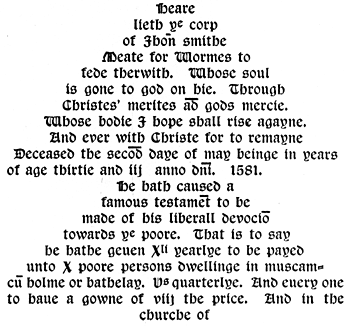
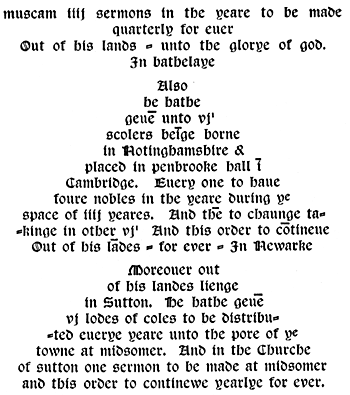
It is stated by Dr. Thoroton that owing to a flood, which occurred about the year 1600, the Trent changed its course, and thereby the hamlet of Holme became separated from the parish of North Muskham. At that period Sir Thomas Barton, the descendent of a wealthy merchant of the staple in Lancashire, owned a large house and a great amount of property at Holme, and North Muskham Church doubtless benefited by his wealth. The Barton coat of arms with impalements and rebus, viz., a bear and a tun, is to be seen in various places in this church, both on glass and in stone. One characteristic of this unrestored church is the survival of old-fashioned “box” pews; of these three are in the chance!, one of which belongs to the Duke of Newcastle and the other two to Mr. T. L. K. Edge, of Strelley. One he holds as joint lay-rector, the other was acquired by purchase for the sum of 120 in the year 1842. The Ecclesiastical Commissioners, as representatives of the Prebendary of North Muskham, were joint lay-rectors of the parish, and, as holders of some of the land awarded in lieu of rectorial tithes at the enclosure, in the latter part of the 18th century, were liable for half the cost of the maintenance of the chancel. This property, together with its liability, was purchased by the late Mr. James T. Edge some fifty yeas ago.
(1) This number appears to have been altered on the monument from vj. to xvj., the figures being re-cut, but six is the number mentioned in the actual will, which is dated 17 Apr 1581, and which gives to the “six poor scholars” . . . “twenty six shillings and eightpence yearly unto every one of them at four times in the year, viz: at the Feast of St John Baptist, which time being the day of my nativity, I wish that every scholar shall make an especial Epistle with certain verses to be set the same day upon my tomb in remembrance of me for ever, the Feast of St Michael the Archangel and the Feast of the Nativity of our Lord commonly called Xmas and the Feast of the Annunciation of our Lady six shillings and eight pence to every one of the said poor scholars for ever.” In this will he also refers to his brother, William Smith, buried in the church of Newark, with these words on a stone placed over him, “God hath the soul of William Smith,” with the year of his age, which was 31.