
A Vale of Belvoir Cavalier Family
by William Stevenson.
Ye gallants of the martial vale
By Belvoir's lordly towers,
Give heed unto the threatening gale
That o'er the country lowers:
It comes, a cloud on sombre wing,
It heralds war is nigh, So bare your swords for
Charles the King,
And raise his standard high:
He cries you, "Aid me in the strife,"
And prays you will not fail,
For, truth to tell, his very life
Hangs trembling in the scale.
* * * * *
'Tis done; the King's great cause is lost!
God rest the fallen brave, And shield
his scattered host, now tossed
Upon the heaving wave.
 |
THE subject of this monograph is the old time Golding family, of Colston Bassett, in South Notts., and the period singled out is one fruitful in events, viz.: the great Civil War.
Mrs. Chaworth Musters, in her charming romance, "A Cavalier Stronghold in the Vale of Belvoir," gives prominence to Wiverton Hall and John, Lord Chaworth, its owner at that time; and Mrs. Lucy Hutchinson, in the memoirs of her brave husband, has rendered Owthorpe an historic shrine; but these writers have not said all that is known about the neighbouring lord of Colston Bassett, Edward Golding, Esq. Of our county gentry, who, two centuries and a half ago, from the force of circumstances, had to take sides between the king and his divine rights on the one hand, and the people, with their aspirations for liberty, on the other, it would be hard to point out any of whom we know so little; and yet this little counts for so much.
The paternal grandfather of Edward Golding, Esq., hailed from Eye, in Suffolk. Poslingford seems to have been the cradle of the family, an ancient one, still in evidence in the eastern counties, in Kent, and in Ireland. This first of the Notts, family, himself an Edward Golding, was steward, in Queen Elizabeth's day, to Sir Thomas Kitson, then lord of Colston Bassett. By some strange turn in the wheel of fortune the steward became the master, and the lord of the manor, and founded here a county family which flourished for nearly a century and a half. In 1614 there was a visitation of the county by Sir Richard St. George, Norroy king-at-arms,1 from which it appears that Edward Golding, Esq., had issue, by his wife Marabel, daughter of of Aldham, a son,
Edward Golding, Esq., who had for wife Mary, daughter of Richard Godfrey, of Hendringham, co. Norfolk. This second Edward, as Thoroton informs us, enclosed most of the open fields of the lordship, and sold a portion of the estate to Francis Hacker, Esq., who built a house or residence there.2 He had issue Edward Golding, Esq., the cavalier of whom we write. He took to wife Ellinor, daughter of John Throgmorton, of Cawton, co. Warwick. The issue of this union was John Golding, son and heir, Frances, and Mary Golding, daughters, and further olive branches after the date of the above visitation.
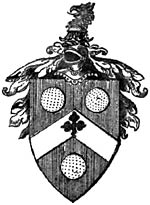
The arms of the Nottinghamshire Goldings were "Gules on a chevron argent, between three bezants, a trefoil sable."3 Crest, a Griffin's head erased gules, and collared or.
These arms, impaling Throgmorton, were carved in stone over the entrance of Colston Bassett hall, from which we may presume that this residence, alluded to in "The Gentleman's Magazine," of 1795, was erected in the days of King James, or the so-called "happy days of Charles I."4
In 1624, the last year of the reign of King James, Edward Golding, Esq., was the Sheriff of the county of Nottingham, from which we can gauge his standing, on the accession of King Charles.
In 1633 James Shirley, the dramatist, dedicated "A contention for honour and riches" to his honoured friend, Edward Golding, Esq., of Colston, Notts.
The Goldings appear to have been a family of strong religious convictions, for they never changed their faith during the storm of the Reformation, from which there can be little doubt they suffered persecution.5 With the accession of Charles, in 1625, more favourable times ensued, so far as the court was concerned, for the king married, in Henrietta Maria, a Roman Catholic, who brought with her a train of Roman priests from Paris.
The position of Edward Golding, Esq., among the county gentry of the Roman party, was one of such importance as to attract not only the notice of the king, but more especially of the queen. The king, for state reasons, could not openly acknowledge the services of his Papal subjects; but there were secret agencies at work, and the nature of Mr. Golding's services took the form of collecting money from his co-religionists in the county, and transmitting it to Ireland for the cause of the king amongst the Roman Catholics.
At the breaking out of the Civil War in 1642, Edward Golding could not have been less in age than fifty, and his son, John Golding, must have been about thirty years old.
On that historic Monday of August 22nd, when King Charles unfurled his standard of war at Nottingham, Edward Golding, Esq., and his son, John, who mustered with the cavaliers, might have been seen with their loyal tenantry, transformed into men-at-arms, crossing the narrow stone bridges of the Trent and river Leen, with the endless stream collected from the south of the kingdom, at the call of their king.
We can fill in the picture of their taking part in the changing scenes in the old town, upon which every eye in the kingdom, and, indeed, in Europe, was centred, for it was the opening act of a tragedy in which Death played the title role.
In the stirring events of the nine days following, we lose sight of our heroes; but they were unquestionably at Derby with the king and his marching army on September 1st, and a few days later at Chester, where the king, on the 27th of that month (having broken with the Puritan members of his Parliament, could openly acknowledge the services of his Roman Catholic subjects), conferred upon Edward Golding, Esq., for faithful services, the honour of Knighthood and Baronetcy. It is clear from this that Sir Edward Golding, Bart., as we must now call him, had rendered services to the king of great value.
(1) Harl. Soc. pub. vol. 4, p. 107.
(2) His son, Colonel Hacker, in the Parliamentary army, said to have
been born at East Bridgford, Notts., a contemporary of Edward Golding,
Esq., the cavalier, resided at Colston Bassett. He was captain of the
guard on the scaffold at the execution of King Charles. On the accession
of the second Charles he was arrested and executed as a regicide, his
Colston Bassett and other property escheating to the crown.
(3) Authorities
differ as to the tincture of the trefoil in the Golding Arms. Dr. Thoroton
does not appear to give any description of these Arms
in his text, though the shield is given in his plates; where the trefoil
is apparently marked gules (Plate of Arms, page 8, line 4, No. 95;
and Throsby's 1790 Edition, Plate iv., No. 95). In the Notts. Visitation
of 1614 (Harl: M.S.), the trefoil is given as sable; and Burke's Armoury
(1878) gives the same. In Captain A. E. Lawson Lowe's "The Armoury
of Nottinghamshire" the trefoil is described as vert. (The Reliquary,
vol. xvi., p. 109.)
(4) The Hall of the Goldings was pulled down in the early
part of the eighteenth century, and a modern house now occupies its site.
(5) This could possibly be proved by records preserved in York Cathedral.
We know that numbers were condemned to rot in York prison, and that three
laymen and one priest were executed in James' reign.