
The monuments in Laxton church
By William Stevenson
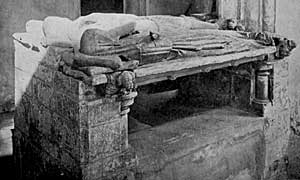
Everingham tomb, Laxton.
THIS ancient church possesses some of the most interesting tombs and effigies in the county, but owing to the mutilated condition in which we find them, their identification is not an easy matter.
The tomb in the north arcade of the chancel,1 upon which three effigies repose, is of exceptional form and character, but bears evidence of having been cut down and mutilated at an early date to form a bed for the present figures. There are indications that in its original state it was canopied in its upper part, on similar lines to the tomb of Amyer de Valence in Westminster Abbey, or to the Percy shrine in Beverley Minster. Its architectural details suggest its erection about 1250; but the elaborate figure-corbels, whose original office was clearly that of terminals to hood mouldings, point to a somewhat later date.
A detail, tending to confirm this date, and to connect the tomb with the angel choir at Lincoln, has been made public. This magnificent addition to that Cathedral was conceived, the design made, the funds collected, and the great work begun during the five years Henry de Lexington was Bishop of the See (1253-1258). Before his election as Bishop, he was, for the previous eight years, Dean of Lincoln, and prior to that period Prebendary of North Muskham in Southwell Minster. In the spandrel of one of the clerestory arches of the North arcade is a censing angel, the treatment of which, in the large head, the full features, the blob-shaped curls, the drapery, and the bare feet, corresponds with the angels of the Laxton tomb. The Lincoln work was sufficiently completed to admit of the translation of the body of St. Hugh, the Bishop of Lincoln, in 1280, at which ceremony King Edward and Queen Eleanor were present. A fine photograph of this Lincoln angel swinging a censor is published in the April number of the Architectural Review, p. 150, for the year 1903, and it is shewn, .on a very small scale, in Lincoln, Bell's Cathedral Series, p. 122, published in 1898.
Reverting to the church at Laxton, let us note that the north aisle of the chancel was the chapel and early burial place of the Lords Laxington, or Lexington, inferior lords of Laxton, who moved their residence to Tuxford, where one of their knightly effigies reposes in the north or private chapel of that church. These Lexingtons rose to great eminence in the thirteenth century: of three brothers, one became Bishop of Lincoln, and was buried in his cathedral; another attained to a height fairly on a level with our present Lord Chancellor's; and the third was a great knight. We have historical proof of one of this family founding a chantry at Laxton, and it is fair to presume that the elaborate tomb, apart from the effigies now surmounting it, was erected to a member of this family. On failure of male issue, the Lexington estates passed by marriage to the Lungvillers (or Longvilliers) and Beckering families, whose arms are sculptured on the outer face of the east window of this chapel.
On the north-east corner of the tomb, there are marks which indicate that there was originally an arch of insufficient width to admit of a life-sized effigy; hence the recess, in the early stage of its history, may possibly have been used as an Easter sepulchre. The corbels, elaborately carved, though sadly mutilated, represent at the east end, angels in the act of censing, and at the west end, angels in prayer.
At a comparatively early period in the history of the tomb, its upper part appears to have fallen into decay, or to have been cut down to its present level. If the latter, it was a rough and rude operation, the object of which, as already mentioned, was to form a bed for the three later figures, now reposing upon it, figures whose original place, as indicated by the device upon the shield of the knight, was the south or Everingham chapel.
The ground plan of this tomb is early in character, being narrower at the east than at the west end.
In dealing with the effigies in this church, which are six in number, four male and two female, we must bear in mind that we have proof, that two of the former represent the family of Everingham, the greater lords of the manor, whose burial place was the south chapel of the chancel; and, seeing that the old family of the north chapel (the Lexingtons) had ceased to bury here at the date of the remaining figures, we may conclude that all the figures represent members of the Everinghams.
Of the three knightly figures, now tombless, which lie in the eastern arch of the arcade of the south chapel, the centre one is the oldest. It is much worn, and most of its details have been effaced through long exposure in the churchyard. It is now probably in its original position, for the eastern respond of the arcade is wrought to accommodate a low tomb. The costume of this figure bespeaks it that of Robert de Everingham, knight, the last of the chief lords of Laxton, who held the high hereditary office of chief keeper, or custodian of the royal forests of Nottingham and Derby, officers who gave hospitality to King John and other early kings, when they visited Laxton, as they appear to have done, using it as a hunting and commissariat centre. This Robert was a knight of King Edward I., and died in 1287. He was contemporary with, and perhaps a participant in, the fierce crusade led by Prince Edward, 1270-1274; but it is still an unsettled question whether the role of a crusader is implied by the crossed legs.
In the "expulsion," sculptured on the north triforium of the angel choir, Lincoln, Adam and Eve are figured as cross-legged. In this instance it clearly depicts the figures in the attitude of walking. (Architectural Review, April, 1893, page 152.)
The figure is represented as clad in armour of ring-mail, with its Assyrian-like basinet and camail covering the head and neck. The detail of the ring-armour, which we see in the later effigies, is not shown in the case of this figure, nor is the blazon upon the shield sculptured in relief; from which we may fairly assume that these points were represented by the pictor, or painter, the figure being originally rendered life-like by colour. The long surcoat, similar to that worn by the Crusaders, and the plain character of the sword and belt, may be noted. The material used is yellow Mansfield limestone, and the workmanship is possibly that of one of the sculptors who figured so prominently in mediaeval Nottingham.
Next in order of date follow the figures, already alluded to as on the tomb, on the north side of the chancel. The two in stone are from the same source, and are wrought by one and the same sculptor. The material is opaque white limestone, which has been identified as coming from the quarries of Aubigny, in France, and there can be no doubt about the workmanship being of the same nationality. This limestone is capable of receiving the highest finish, and we have in consequence the minutest detail handed down to us. The figures, which represent a knight and his lady, have been sadly cut away in order to squeeze them into their present position.
In contrast to the effigy assigned to Robert de Everingham, the details of the ring-mail and armour are here minutely given, and, as they are wrought in such a beautiful material, it is questionable whether the two figures were ever heightened by colour. The sword-scabbard of the knight is advanced in ornament; the crossed legs still obtain, although the crusades were considered over; the shield bears the heraldic lion rampant of the Everinghams, without tincture, chequee, or vair, and uncrowned. This figure may be identified as that of Adam de Everingham, who was born 1280, and succeeded his father, represented in the older effigy, who died in 1287.
Robert de Tibbetot, the great lord of Langar, Constable of Nottingham Castle, and keeper of the hay of Bestwood, purchased Adam's wardship from King Edward. It was during his minority that Edward I. and Queen Eleanor, the latter in failing health, tarried five days or more at Laxton Manor, as mentioned in my monograph on the death of this queen in the Transactions of this Society for 1899. At that date (like Dr. Thoroton to the day of his death) I was unaware of this period of minority in the Everingham family, or that it was the cause of King Edward taking to himself the custodianship of his northern forests.
This Adam de Everingham, with his retainers, served in the Scotch War of 1303, the war in which "Wallace bled;" and in 1306 Edward I., then in "the sere and yellow leaf" of age, conferred the Knighthood of the Bath upon him. Like Piers Gaveston and the De Spencers, he was in favour with Edward II., who, in 1309, created him Baron Everingham, of Laxton. Later, however, he was one of the confederated barons in arms against the king, and was taken prisoner at the Battle of Boroughbridge on 16 March, 1322, when he paid a ransom of four hundred marks for his life and limb, equal to something between three and four thousand pounds of our present money. Some years before this date, that is, when he was in full funds, he purchased and brought here these two beautiful figures, the occasion of which must have been the death of his first wife (whose name and parentage are not recorded), for the costume of the male figure will not read later than about 1325, although the Baron himself died in 1336. She was possibly a daughter of Robert de Tibbetot, for it was an object in life with those old barons to wed their children to their wards. Robert had a daughter Eva, married to Robert de Tateshall in 1280 (calendar Close Rolls, Ed. I., 1279-1288, p. 68), but he well might have a younger daughter married to his ward. The costume of the lady is interesting. She wears the wimple of the period—a handkerchief tied round the neck, chest, and chin, and caught up behind the head, over which is the veil, here drawn aside, the ends falling down upon the shoulders, with a retaining band across the forehead. This costume, of nearly seven hundred years ago, is still that of the Roman Catholic nuns.
Baron Everingham had no issue by his first wife, who appears to have died young. His lordship consoled himself with a second wife, whose Christian name only, Margaret, has reached us. By her he had issue a son and heir, Adam, called the younger. This wife possibly survived her husband, and is now represented by the wooden figure on his right hand. She may have been the instrument of all three figures being crowded on the top of the old ruined tomb, or she may have ruined this tomb for the purpose of obtaining space for her own effigy, beside that of her lord. This figure, being wrought in oak, is unique in the county, and nearly so in the country. The material would be from a giant tree in Sherwood, green in leaf when the old Saxon and Norman kings used the forest as their hunting ground.
It is interesting here to record that the church of Radcliffe-on-Trent had a wooden figure, said by Thoroton to represent Stephen de Radcliff. It survived until the opening of the last century, when, on the news of a Wellington victory arriving, it was dragged out of the church, dressed up as Napoleon, and in this state ruthlessly burnt on the altar of patriotism.
It will be noticed that the head-dress of this lady is similar to that of the earlier wife, but the hair is plainer, and there is a shrunken look of care or age on the countenance.
(1) See illustration and ground plan.