
East Leake and Costock
In reference to the chained book at East Leake, Mr. J. Potter Briscoe has supplied the following valuable notes:—
As a result of the great value and scarcity of books in the early days of printing, small libraries were made for religious houses and churches, and the books, assigned to the use of the rank and file of students, were attached to the shelves in which they were placed. Some of these collections remain to our own day. Those readers who care to follow this interesting subject are referred to Mr. William Andrews' paper on "Chained Books in Churches," in his "Curiosities of the Church," 1890.
In compliance with the injunction of Henry VIII., copies of the Scriptures were "set up" in the parish churches of this country. These were chained by the oaken bindings to pillars, desks and pews. Many references are made to these attachments, in church accounts, as at St. Martin's, Leicester:—
| " 1548-9. | Item : pd ij chenes and naylls | |
| for the bybell | vd |
At St. Botolph's, Boston, may "still be seen the staple and a single link of the chain to which, in former days, the Bible was attached."
As in the East Leake instance, the Bible was not the only chained book in our churches. At the present time there are several chained books in situ at St. Mary's, Bridlington. These are Jewel's "Controversial Works," 1611; Heylin's "Ecclesia Vindicata," 1681; Hooker's "Ecclesiastical Politie," 1682; and Comber's "Companion to the Temple," 1684. Other books in various places so attached were '' Foxe's Book of Martyrs;" Jewel's "A replie unto Mr. Hardinge's Answere," 1566; "The paraphrase of Erasmus upon the New Testament;" Jewel's "Defence of the Apologie," 1609; "Book of Homilies," and Jewel's "History of the Reformation." This list might be added to with a little research.
In the church at East Leake is preserved, in the vestry, a curious controversial book of the middle of the seventeenth century, to the binding of which is attached a chain, which formerly prevented its being removed, without force, from the place in the church where it had been fastened for probably two centuries.
The title of this small quarto tome is Katabaptisiai Kataptustoi.
The Dippers dipt.
or,
THE ANABAPTISTS DVCK'D AND PLVNG'D Over Head and Eares, at a Disputation
in Southwark.
TOGETHER WITH A large and full discourse of
|
1. | Originall. |
|
2. | Several sorts. |
|
3. | Peculiar errours. |
| Their | 4. | High attempts against the State. |
|
5. | Capitall punishment : with an application to these times. |
BY DANIEL FEATLEY, D.D.
THE THIRD EDITION. [Quotation of several lines.]
LONDON;
Printed for Nicholas Bourne, at the South entrance of the Royal Exchange:
And Richard Royston, in Ivie Lane. 1645.
The "Epistle Dedicatory" is signed "Yours in the Lord Jesus, Dan: Featley; "and dated" from Prison in the Lo: Peters house in Aldersgate-streete, Jan. 10. 1644," where he was incarcerated as "a spy and intelligencer," in that nobleman's residence." The Greek words at the top of the title page may be rendered literally—"Dippers spat upon."
This book was probably attached to the east face of the (octagonal) centre pillar, with a desk to rest upon. The chain (about seventeen inches long) is made up of S links, and two long and narrow links at the staple end.
The author is also known as Fairclough. An account of his life and literary productions will be found in Anthony a Wood's "Athene Oxoniensis," and the "Dictionary of National Biography," and in other biographical and bibliographical works. He wrote, among other books and pamphlets, "The Romish fisher caught and held in his own net," 1623; "Clavis Mystica," 1636; " Case for the Spectacles,, or a defence of Via Tuta the safe way," 1638; "The Dippers dipt," 1645; "Ancilla Pietatis, or the handmaid to private devotions," 1647. This last book was a manual of devotions, and was in frequent use by Charles I. In the "Dictionary of National Biography," Mr. Gordon Goodwin described "The dippers dipt," as "an amusing treatise," in which the writer "mingles invective with anecdotes of the wickedness of his antagonists and its providential punishment."
The two last-mentioned works passed through several editions—the "Ancilla Pietatis," at least nine, and "The dipper dipt:" seven. Of the edition at East Leake there are three copies in the library of the British Museum.
Featley has been described as the "Knowne Champion of the Protestant religion;" his "Clavis Mystica" as "a collection of sermons, seventy in number, full of puns, quaint conceits, numerous distinctions and diversions;" and his "Dippers dipt," as "a ridiculous book, giving an account of a public dispute in which Featley was engaged on the subject of baptism." In this work the author referred to Milton's "Tractate of Divorce;" and in turn that writer" speaks contemptuously of the author as having written an 'equivocating treatise,' and as 'doing the whole himself with a more prelatical malignance against the present State and Church government.'" A portrait of Featley, who was born in 1582, and died in 1645, appeared in the several editions of "The Dippers dipt."
East Leake and its surrounding neighbourhood are also interesting as being the scene of a Civil War skirmish in the year 1644. The following notes thereon, together with the accompanying map of the district, have been furnished by Mr. Bagnall-Wild :—
"In Bailey's Annals of Nottinghamshire, page 729, we have the following statement: 'At the latter end of the summer the Royalists having placed an ambuscade on the road near Costock, to intercept a convoy, passing under protection of a body of Leicester troops, were defeated with the loss of eight men killed and sixty taken prisoners.' The loss of the Parliamentary forces is not mentioned.
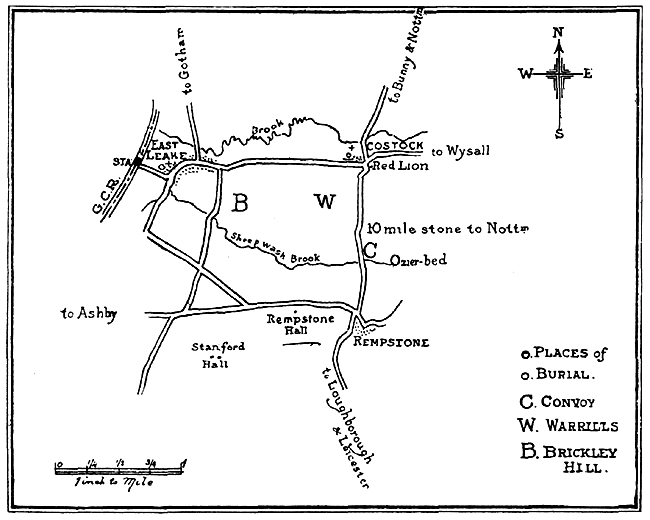
Local tradition says that the attack was made near the little stream between Rempstone and Costock, marked C on the accompanying map; and speaks of the Warrills (Warhills?), marked W in the map, and of Brickley (or Brackley) Hill, marked B, as the scenes of a skirmish; and these conditions coincide with other facts in our possession. We know from information given by Mr. Carver, farmer, of Costock, that in 1857, on a road being made outside the churchyard, five skulls, together with other bones, were found buried at the depth only of 2½ feet from the surface, and that in Dr. Chapman's opinion, they were the bones of men, and that one skull had a round hole, which might have been caused by a bullet. At East Leake there is not only the fact of a cannon ball having been found in one of the buildings, but also the following definite entry under the year 1644 in the church register:—" 1644. ffoure souldiers buryed slaine in a Skirmish in our Lordship September ye 17th between partyes of the King's forces and the Parliament's whereof two were of his Majestyes forces of Ashby de la Zouch Garison, and two of Leicester the Parliaments Garison."
"Thomas Flloer alias Fllower buried September ye 19th dying of his wounds received in the same Skirmish Sepr ye 17th being of Ashby-de-la-Zouch Garison."
As the convoy was advancing from the direction of Leicester, and the Royalists suffered defeat at the hands of the protecting Parliamentary troops, the line of retreat would be by way of the Warrills and Brickley Hill, the fight being renewed at these two points of advantage1 to the Royalists.
From East Leake, a short drive brought the party to Costock, where they were punctually met by the rector, the Rev. C. S. Millard, and conducted to the Church of St. Giles, which stands somewhat back from the main street of the village. Mr. Millard read the following paper relating to the history of his church:—
In the early part of last century, before the year 1848, this church must have presented a very singular, though picturesque appearance. It consisted of a chancel and nave only, both of the same height, or nearly so. There was no tower, no bell gable. It was covered with ivy. The bell (the present one, dated 1600) hung in a sort of box, where the west window now is. The interior was filled partly with pews, traces of which can, still be seen in the chancel walls, and partly with ancient benches. Six of the ancient bench ends still remain.
There was a gallery at the west end, lighted by a small window in the roof. There was no chancel arch, but a dilapidated ancient screen covered with whitewash, with a boarded partition reaching from the top of the screen to the roof, of which I hope to say more presently.
The roof of the chancel and nave was of the same form as the present chancel roof, but lathed and plastered the whole length of the church, and it continued in this state till 1862.
It is one of those singular churches in which nave and chancel are not in the same straight line. The chancel inclines slightly to the north. I think this inclination in so many churches has never been satisfactorily accounted for.
In 1848 the late Rector—the Rev. Edward Wilson— raised funds to enlarge the church by removing the north wall, and adding the present north aisle, from designs by the late Gordon Place, of Nottingham; and the entire church was reseated and refloored.
Mr. Wilson, when raising funds for this work, issued the following statement: "The first church was erected about A.D. 1080. and remained until 1360, when the present church was built upon the foundation walls of the former one. A fair chancel arch was then added, and the ancient chancel arch allowed to remain—a singular, though common practice. The last repair was made in 1656, when the chancel arch was demolished."
I much wish that I knew where Mr. Wilson obtained this information. It is hard to understand what he means when he says two chancel arches—a Norman and a Decorated—were standing at the same time, and that it was "a common practice."
The boarded partition above the screen was not an unusual feature. Similar ones existed till quite lately at Bunny and Wysall. At Bunny there was a chancel arch, but not at Costock or Wysall. Were these partitions post-reformation erections put up by the Churchwardens with the idea of making the church snug, and as convenient for exhibiting the ten Commandments ? or were they Mediaeval? Ten years ago a similar partition was removed from Wenhaston Church, Suffolk, and thrown out into the churchyard, where the rain removed the whitewash and disclosed an ancient painting of the Doom, or Last Judgment. I have a picture of it in my pocket. I have, I believe, heard of a similar instance in a Continental church. At Wenhaston a carved wooden rood, with the figures of the Virgin and S. John on either side, had been fixed on this partition, which, with its painting, formed a sort of background.
There is some reason for thinking there never was an ancient chancel arch here. Sir Gilbert Scott, when he restored the nave and chancel in 1862, searched for foundations, but could find none. There was, when I first came, a piece (a few inches long) of a tie beam, with the same moulding as the present ancient wall plate in the chancel. This was removed when the present chancel arch was built by Scott. I think the partition must have been fixed to this tie beam.
The plaster from the east wall was removed by Mr. Wilson (my predecessor), and a very interesting discovery was made. The wall under the east window was not of limestone rubble, like the rest of the church, but of good freestone ashlar work, on which had been a fresco painting, no doubt to serve as a reredos. Mr. Wilson endeavoured to mark out the outline of the subject in pencil, but nearly all trace of colour and outline had disappeared at the time of his death.
This ashlar work was covered with plaster at the time of the restoration in 1862-3. There is a similar feature at Keyworth, but there it is, as it were, framed by a moulding, which was wanting in this church. I have never heard of any other instances.
In 1862-3 the nave and chancel were restored by Scott, who discovered the very interesting remains of the ancient nave wall plate with its curious dog-tooth ornaments; about four feet of it remains. He has, you may observe, continued the pattern on the new part of the wall-plate. It was covered with whitewash when he discovered it.
The whole of the rafters of the nave were utterly unsound. They appeared to have been made of unseasoned wood. There was a date, I have been told, on one of the beams—possibly the 1656 Mr. Wilson mentions. The roof may have belonged to this period. The rafters of the chancel, on the other hand, though apparently original, were so sound that they have all been retained, a few only requiring new ends. It would have been a truer restoration had the boards of the chancel roof been placed at the back of these rafters, so as to show them, but Scott, at the time, was not aware of their good condition, as they were covered with lath and plaster when he saw the church.
(1) Some maps give Bashcliff as the name of this particular district, lying west of the Loughborough and Leicester Road. The name may mean the "cliff of defeat," or the "cliff of shame."—J. S.