
The south door is a small one, with plain semi-circular head, and over it there is evidence of the former existence of a small window. The east window is square-headed, of three-lights, with plain mullions, over which, on the outside, is a drip-stone, probably belonging to an earlier window.
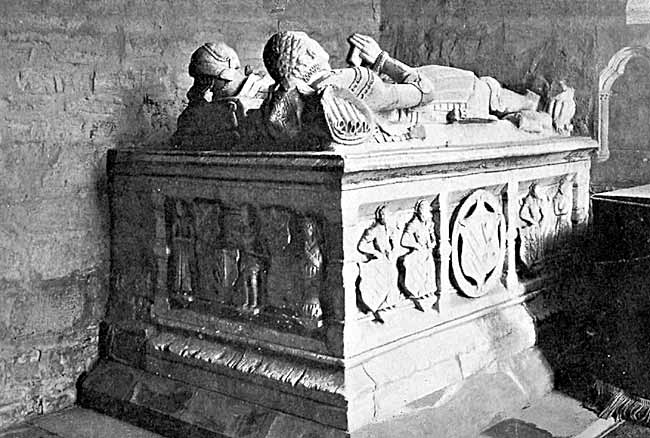
Armstrong monument, Wysall church.
A piscina and aumbrey are to be found in the south wall of the chancel, about 3ft. from each other; and the north-east angle of the chancel is occupied by the alabaster monument of Hugh Armstrong and Mary his wife. He lies with his head on a helmet, carrying the Armstrong crest, a dexter hand, vambraced in armour, bearing a dagger; and with his feet on a dog. The dagger has been broken off. He wears armour, has a ruff and a double chain, which hangs round his shoulders and across his breast, and holds a small book in his clasped hands, on the first and third fingers of each of which are rings. The ring on the digit finger of the right hand bears the initials "H.A." The lady wears a head dress and a long gown. Round the upper edge of one end and one side of the monument, you will find inscribed in most beautiful old English black letter, the following:—
"Here lyeth the bodyes of hugh armstrong esquier and marye his wiff daughter of [henry] sacheverell of Ratcliffe upon sore esquier wch hugh dyed the xxiith dey of december m° d° lxxii and the sayd marye dyed the xxth dey of ma[y m° d° lxv."] The parts within brackets are now obliterated. The following description deals with the more salient characteristics of the monument, together with a few details of special interest.
The side of the monument is divided into three compartments. The central one contains a shield bearing the Armstrong arms, impaling Sacheverell within a circular ribbon, bearing the inscription: "Hughe armestronge esquire, Marye his wyfe daghter of henrie Sacheverell of ratcliff upon sore esquire."
The dexter compartment contains two female figures, each wearing a cap and long gown, which is open and displays an embroidered bodice. Each figure holds a pair of gloves in one hand and a shield in the right. The shield to the left is Raynes impaling Armstrong, and the one to the right Fitzherbert impaling Armstrong.
The sinister compartment contains a similar figure holding a shield bearing the arms of Turville impaling Armstrong, and another female figure with her hands held together in front of her breast in the attitude of prayer.
At the end of the monument are shields bearing Sacheverell and Armstrong respectively, and three figures. The figure to the left is similar to the last figure. The central figure is that Gabriel Armstrong (1631), who is represented in armour, with a long sword and holding a shield bearing Armstrong impaling blank. The figure to the right hand is that of an infant, probably born about 1540, clad in a long outer robe which is turned up and bound with tapes and covers both head and body; and also covering the head and neck an inner garment which may be the chrisom, a white vesture, placed by the priest on the child at its baptism ; and in which the child was also buried, if the mother was not churched before her infant died.
With respect to the furniture of the church, there are some original oak seats to be found at the west end; and you will also find the old Decorated octagonal pulpit there. It was removed at the time of the church restoration 1873, and the present stone one put in its place; a good modern pulpit certainly, but we should most of us prefer to see the older pulpit restored to its ancient place and use.
The ancient font is, I think, early English.
The chancel screen is of the Decorated period, and on the eastern side has four miserere seats, two of which bear signs of modern restoration.
There are some curious holes in this screen, somewhat irregularly placed, though carefully made and ornamented. One theory which has been brought forward about them is that they were used formerly for making and receiving confessions. These holes seem to be conveniently placed for the purpose, and to be of slightly varying heights; but I understand from Mr. Millard that they are not peculiar to Wysall, and the suggested explanation is perhaps the right one.
The roof of the chancel is well worthy of notice. It is the original roof. It is divided into three bays by tie-beams ; above these, and half way up the roof, are collars with plain braces underneath. The easternmost bay is boarded over and painted. The small three-light branched candelabra, which is suspended from the ceiling of the chancel, is of brass, and bears the inscription—"The gift of Elizth West. For the use of the Psalm Singers of Wysall Church 1773."
The church plate consists of a modern cup and paten without any inscription. Out of the pillage that went on here and everywhere else in Edward VI. reign, we are told that the commissioners, on the 8th of May, 1553, handed over to the vicar "a challis of silver and gelte with paten," but, I believe, it is a fact that at the present time there is no pre-Reformation plate to be found in the county.
Our parish churches were so crippled and impoverished by the great pillage of Edward VI. reign that the scanty treasures returned to them here and there seem to have soon disappeared.
The arms connected with Wysall Church are as follows:—armstrong.—Gules, three dexter arms vam-braced in armour, lying fesseways in pale argent, hands proper. sacheverell.—Argent, on a saltire azure, five water bougets or, a mullet pierced for difference. raynes.—Chequy or and gules, on a bend vert a moor's head between two annulets or, a canton ermine. fitz-herbert.—Gules, three lioncels rampant or, over all a label of three points. turvile.—Gules, three chevronels vair. poutrell.—Argent, on a bend azure, three fleurs-de-lis argent. tevery.—Argent two bars azure, the uppermost charged with two cinquefoils, the other with one, or. The arms of Poutrell were in a window, those of Tevery in a tomb in Thoroton's time; both have since disappeared.