
Wollaton Hall, Church, and the Family of Willoughby
by George Fellows.
The Hall.
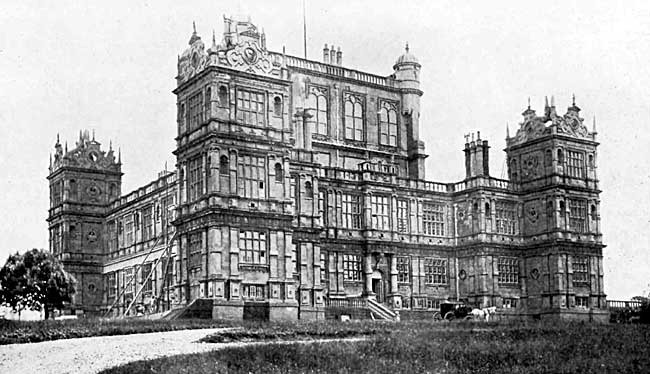
Wollaton Hall.
IN the first volume of the Society's Transactions (1897), the account given of Wollaton Hall and Church was so brief that it is considered some further description should be furnished.
It was on Wednesday, 28 July, 1897, that the members of the Thoroton Society were, by the kind permission of Lord Middleton, afforded the opportunity of inspecting this stately home of one of our oldest Nottinghamshire families—the Willoughbys.
Before proceeding to a description of the house, it may be well to refer to its surroundings.
The hall stands in a park, 790 acres in extent, which lies partly in the county and partly in the city and county of Nottingham, and is completely encompassed by a brick wall, said to be seven miles in circumference. In this wall there are six entrances; the chief entrance lodge, erected by Henry, sixth Baron Middleton, being at Lenton on the side nearest the town of Nottingham, and about one and a half miles distant from the city. The approach to the hall from this entrance is by a magnificent avenue of lime trees. From whatever side, indeed, the house is approached, it is at once evident with what discrimination the site was selected; the elevation being a little over 200 feet above sea level, and the ground falling away from the mansion on every side.
It may here be mentioned that years ago a village named Sutton Passeys, all traces of which have long since disappeared, existed on the Radford side of the park. Mention of this village is found in 1558,1 but Thoroton (1677) tells us it "is now and long hath been totally decayed and only known by the name of Wollaton Parke." According to the Torre Manuscripts, there were two manors here, one held by the Morteyns; the other by the Passeys, by sergeanty of finding a horse and sack in the army of Wales; there was also a church or chapel connected with the place. Many fine oak trees are studded about the park, some of which may very probably have been planted by Sir Francis Willoughby at the time the hall was built, and many of which are, alas, showing signs of their antiquity. Until comparatively recent times, a herd of the British wild white cattle was kept; this has been replaced by herds of both red and fallow deer, in which the present Lord Middleton takes great interest.
Set in such surroundings stands this stately hall, the fine possession of an ancient family and a salient feature in the landscape.
Although there are differences of opinion as to the merits of the hall itself, there can be no dispute as to the claim of Sir Francis Willoughby to the honour of having built and paid for this noble building. John Thorpe, of Padua, is generally credited with being the designer, and Robert Smythson, as his tablet in the church informs us, was the "architector and surveyor," and died in 1614, aged 79; the master craftsmen were, it is said, imported from Italy. Many and interesting must have been the consultations between Sir Francis and these men whilst determining upon the site and the design. The undertaking was entered upon in the year 1580, and the work of building extended over a period of eight years, as stated in an inscription over the garden entrance door, "En has Francisci Willoughbaei aedes rara arte extructas Willoughbaeis relictas. Inchoatae 1580 Finitas 1588."—Deering, p. 227. The stone of which the mansion2 is built was conveyed from the Ancaster quarries, in Lincolnshire, on the back of pack horses, which performed the return journey laden with coal obtained on the estate; so, it is supposed, that the material cost Sir Francis nothing. Nevertheless, it is stated by Cassandra Willoughby, Duchess of Chandos, who wrote an account of the house in 1702, that the whole outlay amounted to no less than £80,000, an enormous sum of money in the days of Queen Elizabeth. Sir Francis originally intended to build his hall in Warwickshire, and went so far as to lay the foundations at Middleton, where traces are still shown in a wood near to Middleton Hall. He chose far better, in setting the house on its present site, as far as position goes.
The building is in the English Renaissance style, and is considered to be a masterpiece of that class of work, the proportions of the central tower and flanking turrets being beautifully designed and balanced. As a rule, the structure elicits exclamations of admiration from those who visit it, albeit some are found to depreciate it as being too ornate.
In 1864, the Rev. Edw. Trollope (subsequently suffragan Bishop of Nottingham), an acknowledged authority on architectural matters, wrote a paper on the hall.3 He says, "there is much for all to admire, but perhaps still more for our professional and more observant members to study." He calls attention to the distinction between the work in the central and other parts of the building, "which differ entirely from each other, in proportion, style, and ornamentation, as though Sir Francis and his architect Smythson" (he quite ignores John Thorpe!) "could come to no compromise as to the style they each wished to adopt." While admitting that the central tower is indispensable, he considers it to be of a weak Gothic character, with poor window tracery, a mean balustrade, etc., and would have preferred that the bartizan corner turrets should have sprung from corbels growing out of the angles. The remainder of the hall finds greater favour with him. He considers the windows excellent, as by their size they supply an abundance of light without detracting from the solidity of the walls; certainly most will admit that the windows here are not so aggressive (if that word may be allowed) as in the case of Hardwick Hall built a few years earlier.
It has been conjectured by some that the central tower was an afterthought, but John Thorpe's original drawings, which still exist in the Soane Museum, set out the ground plan and half the front elevation, showing the tower and inner walls of great thickness; so that such conjecture need scarcely be further considered.
It was a few years previous to the commencement of this great undertaking, that Sir Francis entertained Queen Elizabeth. At that time (21st July, 1575) his house was in the village of Wollaton, close to the church. Traces of this house may still be seen. The queen caused a letter to be sent him in advance, cautioning him to provide some good "beefs and muttons," and to "consider how "his" provision of drink may hold out."
Perhaps the finest views to be obtained of this imposing structure are those of the south front from the steps leading to the rose garden, and those of the north front, with its flight of balustraded steps leading to the door, from the carriage approach. The plate of Wollaton Hall, in Dr. Thoroton's History, would not satisfy either Sir Francis Willoughby or John Thorpe, as it fails to do the beautiful poise of the building justice. It does not represent the building as we see it now in some particulars, more especially with respect to the front door and its approach; but Sir Geoffrey Wyatt was employed to make, during the time of the sixth Lord Middleton, some alterations, and these changes may have been amongst them.
The exterior walls contain numerous niches and circlets, in which are busts or statues of poets, etc. (it is said that there are 198 of these in various positions!). These, together with the carved cornices, give a great richness to the building, and it must be admitted that from whatever point the house may be viewed, it is most imposing and fascinating; massive, without being heavy, especially when a bright sunshine reveals and brings into relief all the details of the building with its fine proportions outlined against the sky.
When the Royal Archaeological Institute visited Nottingham in 1901, a paper on Wollaton Hall was read by J. A. Gotch, Esq., F.S.A. In this he states, "the chief credit for that performance" (i.e., the design) "I am inclined to give to John Thorpe, and I reconcile his claims and those of Robert Smythson by regarding the latter as the chief workman and clerk of the works or surveyor;" he points out that although there are several discrepancies between Thorpe's plans in the Soane Museum and the actual building, the main idea and conception of the scheme are shown in these plans, and the general likeness between them is obvious. Mr. Gotch further refutes the theory, which has been asserted by some, that the central tower was of older date than the flanking towers, He says "a study of the plan and of the building, however, disposes of this suggestion, nor could the lofty hall and the room over it be harmonised with any known treatment of houses prior to the Elizabethan era."
In the interior, the central hall, having its gallery carried on a stone screen and an open-timber roof, is the most noticeable feature. It measures sixty by thirty feet (the exact dimensions shown on John Thorpe's drawings), and is no less than fifty feet in height! In spite of its size and loftiness, and the fact that the windows are some thirty feet above the floor level, it has the feeling of being most habitable, cheerful, and warm. Out of this hall open numerous doors leading to the various apartments; also to the armoury, where are still preserved the weapons that were in readiness to defend the hall against the reform rioters in 1831. The incendiary designs of these ruffians were frustrated by the Wollaton troop of yeomanry, then chiefly composed of Lord Middleton's tenantry, who met and dispersed the mob at a spot where subsequently the Beeston Lodge was erected. Above this central hall is the "Prospect" room, of approximately corresponding dimensions, the access to which is by a narrow stair. There are two double chief staircases; the ceilings of both and the walls of one being decorated with mythological paintings.
The house contains many pictures of value, including works by Snyder and other famous artists, as well as interesting portraits of the Willoughby family, together with coats of arms with numerous quarterings and impalements, showing the many families with which the generations of Willoughbys have, from time to time, allied themselves.
There is an interesting oilpainting by Sibrechts (1695), which hangs in the large hall, representing the place in the days of William and Mary, when the house was apparently surrounded by formally laid out gardens of large extent.
(1) Godfrey's "History of Parish
and Priory of Lenton," p. 99.
(2) Sir Henry Willoughby, great-grandfather of "the builder," had
four wives; the first was a daughter of Sir Robt. Markham, Kt., of Sidebrook,
or Sudbrook, in the parish of Ancaster. This connection may possibly
account for the stone being procured from Ancaster quarries.
(3) Reports and papers read at meetings of Architectural Societies
of York, etc.