
WILLIAM, the son of the former, acquired Alfreton, in Derbyshire, by marriage with Alice, daughter and co-heir of its last lord, and his arms, viz., on a shield azure, two chevrons or, were "almost ever used by Chaworth." They may be seen in the letter of the Barons to the Pope, 1300, and over the hall chimney piece at Annesley, placed there, of course, at a later date, when that property had been acquired through another heiress.
THOMAS, the son of William and Alice de Alfreton, was the last of his name summoned to Parliament by writ, 1296. From this time he and his family became great benefactors to Beauchief Priory, founded by Robert Fitz-Ranulph, lord of Alfreton, great-grandfather of Alice (the heiress). Some writers have identified Robert Fitz-Ranulph with Brito, one of the murderers of Thomas a Becket, but this is "not proven." He gave the church of Edwalton, in Nottinghamshire, to the priory of Beauchief, built to expiate that crime, and this gift probably gave rise to the idea. The advowson1 of this church still remains to his descendant, the present Patricius Chaworth Musters, thirty generations from the founder of Beauchief.
This may be a suitable place in which to insert the "Commendations of Beauchief Abbey," relating to the family of Chaworth.
"Of Roysia, formerly wife of Sir Thomas de Chaworth, our advocate, for whom a full service shall be said in the convent."
"Of the pious memory of Sir Thomas Chaworth, who died 1432."
"Of Thomas Chaworth, Esq., died 1482." "Of Lady Agnes, wife of Sir Laurence de Chaworth." "Of Lady Nichola Chaworth, wife of Sir Thomas, died 1411."
"Of Lady Alice, wife of Sir Wm. Chaworth."2 "Of Lady Alice, wife of Sir Thos. Chaworth. "Of John de Kaworthe, our brother and priest." "Of Robert Fitz-Ranulph, canon and founder of this place, who gave us four churches, namely, Norton, Alfreton, Wymmdeswold, and Edwalton, for whom a solemn service shall be said in the convent, and of Robert de Chaworth (Sept. 9)."
"Of Thomas Chaworth, Knt., who died 1485, of the happy memory of Sir Thomas Chaworth, our advocate, for whom a mass shall be celebrated for ever at the altar of St. Katherine the Virgin. He gave us Grenehill and Wodecotes, with divers parcels of rent and lands in Alfreton."
"Of Sir Thomas de Chaworth the second, died 1348."3
"Of Lady Isabella Chaworth, wife of Sir Thomas and daughter of Sir Thos. Aylesbury."
"Of Sir Thomas Chaworth the third, 1370."4
"Of Sir William Chaworth, 1398.""The jury, 20 Ed. I. found that Thomas de Chaworth had now erected his old weres at Marneham, to the damage of the Town of Nottingham, one Mark, because the boats could not pass as they were wont."—Thoroton.
WILLIAM de Chaworth, eighteen years old at the death of his grandfather, Thomas, about 42 Edward III., married Alice, daughter and heir of Sir John de Caltoft, of East Bridgford, widow of Thomas Heck, and inheritor, with other lands of the manor of WIVERTON, she was aged thirty the 14th of Richard II., 1391.
SIR THOMAS, the son of William Chaworth and Alice de Caltoft, married, first, Nicola (whom we have seen commended at Beauchief Abbey), the daughter of Sir Reginald Braybrook, by whom he had one daughter, the wife of Lord Scroop, of Masham. Secondly, Sir Thomas married Isabel, daughter of Sir Thomas Aylesbury (aunt and heiress of Hugh). "By this match," says Thoroton, "Sir Thomas Chaworth was intitled to the Inheritance of the honourable families of Aylesbury, Pabenham, Engaine, Basset of Weldon, and Kaynes, and better inabled to make the Park at Wiverton, which he had the King's licence to do 24 Henry VI. (1448), who likewise granted him free warren in this place, whereby 'tis very probable that he was the chief builder of that strong House, which from thenceforward was the principal mansion of his worthy successors, and in our times (17th century) made a garrison for the King, which occasioned its ruin, since when, most of it is pulled down and removed except the old uncovered Gate-house, which yet remains a Monument of the magnificence of this Family."
A rough picture of this "strong house," as it stood in 1632, exists in a curiously worked map of Notts, at Grove, in the possession of Mr. Harcourt Vernon. A battlemented square tower stands at the back, and two domed turrets connect a sort of curtain wall. It was towards the end of the 15th century that Alfreton passed away from the Chaworth family by the marriage of Joan, or Johanna, only daughter and heiress of William Chaworth (aged twenty-eight in 1458), with John Ormond. From this time probably Wiverton became the Chaworth residence, and the burying place was Langar instead of Beauchief. The last burial at the latter is dated 1489 (Sir Thomas Chaworth), and the first monument at Langar 1521 (George Chaworth).
The story of the siege at Wiverton will come more fitly under the heading of John, second Viscount Chaworth, in the second part of these notes, but it seems right to record here its building by Sir Thomas about 1448. A moat still exists a few hundred yards to the north, enclosing a raised mound about fifty paces square, where masonry is said to have been found. This may have been the site of an earlier building than that of the 15th century.
Sir Thomas had by his second wife, Isabel de Ayles-bury, five sons and as many daughters. The two elder sons, William and John, married the two co-heiresses of Sir Nicholas Bowet, but their sons dying without male heirs, Johanna, the only daughter of William, succeeded to Alfreton as heiress, and married John Ormond, Esq. In Alfreton. Church, Derbyshire, John Ormond and his wife are commemorated by a brass tablet, from which it appears that John Ormond died 1503, and the said Joan 1507. A lengthy account of Joan's ancestry is given as the "daughter and heir of William Chaworth, Knt."
GEORGE, the third son of Sir Thomas and Isabel de Aylesbury, made a good Nottinghamshire match with Alice, the only daughter of John Annesley, of Annesley, the ninth in descent from Ralph or Ranulph, who, in 1156, gave the church of Felley to the priory of St. Cuthbert, of Radeford, near Worksop. Thoroton calls this Raph or Ralph "Brito," and he was contemporary with Robert Fitz-Ranulph, lord of Alfreton, who founded Beauchief, but, as far as I can make out, had no connection with him; so that even if Ralph Brito were one of the murderers of Thomas a Becket, he was not the expiator of his crime.
Reginald de Annesley "departed from the faith and service of King John," but returned to that of Henry III., and in the fourth year of his reign (1220) "made an House in the Forest of Shirewood at Aneslegh so strong, and built after such a manner, that it was thought it might chance to bring damage to the neighbouring parts."
This, in all probability, was the castle mentioned in the forest perambulation of Charles II.'s time, as "the Old Castle of Annesley," under which ran the boundary of Sherwood Forest. Its site is marked by the name of Castle Hill, standing to the east of the present road from Hucknall to Sutton-in-Ashfield, and a grass-covered low bank may be the remains of a wall. Among the estates possessed by the Annesley family in 18 Edward II. (1325) Crophill Butiller appears, and as this was long before the marriage of George, the third son of Sir Thomas Cha-worth, of Wiverton, with Alice, the heiress of Annesley, it was probably part of their inheritance, and had no connection with the Wiverton estate, which it joins. A curious old house, called The Grange, stood at Cropwell Butler till the last century, and may have been the home of George Chaworth and Alice, his wife, before they succeeded to Annesley and Wiverton.
A tablet in Tithby, the parish church of Cropwell Butler, contains the following inscription:—"Before the midst of this high Aulter, lieth Thomas Chaworth of Cropwell Boteler Squire and Ankaret his wife, son and heir of George Chaworth of Ansley, Squire and Alice his wife, daughter and heir of John Ansley Squire, which
Thomas deceased on Trinity Sunday (called in Glover's pedigree, 'Relique' Sunday) the year of grace MCCCCLXXXV. On whose souls Jesus have mercy."
This tablet has been moved from its original place on the east wall, placed over the chancel door, and painted black, with gilt lettering, but the inscription is quite clear. The church was "restored" in 1824, when this was probably done.
I cannot find the exact dates of the marriage or death of George Chaworth, but his son, THOMAS, who succeeded, died 1485, as we have seen, after marrying Ankaret de Serleby. Her arms are the last quartering on the shield over the hall chimney piece at Annesley.
The only son of Thomas and Ankaret was GEORGE, who married, first, Catherine, daughter of Sir Thomas Babington, of Dethicke (of the family of the conspirator Anthony Babington). He is buried in the north transept of Langar Church, which, from this time for over one hundred years, was used by this family. An altar-tomb (much restored) in the north wall bears:—"By the side of this tomb lyeth George Chaworth late Lord of Wereton and Annesley, son and heir of Thomas Chaworth of Crop-well Butler, father by his first wife of John Chaworth Knight and George Chaworth Esqre of Anne, Dorothy, Elizabeth and Catherine, and father by Elizabeth his 2nd wife of Thomas Chaworth only—which George the father deceased the 22nd day of Septc 1521, and the said Catherine his first wife buried under this tomb deceased the 15th day of Oct. 1517, for whose souls of your Charity say Pater noster & God speed you. Amen."
George Chaworth's second wife had four husbands, according to Glover. She was Elizabeth North, then Peche or Packe, then Masterdon, then Chaworth, and finally married "Sir Griffith now Dun." Thomas, her only son, died without issue, and SIR JOHN succeeded his father,
1521.5 His first wife, the daughter of Sir Wm. Compton and widow of Sir Walter Rodney, left no children. His second, Maria, daughter of Sir Wm. Paston, bore him a large family. Besides the eldest son, George, and William, buried in the Savoy chapel, 1582, there was a daughter, Bridget, bedchamber-woman to Queen Elizabeth, and to Anne of Denmark. She married Sir Wm. Carr, of Sleaford. There is a monument to her memory in Ufford Church.
The will of Sir John Chaworth, proved 1559, Dame Mary, his widow, Sir Gervas Clifton, Knight, and John Manners, Esq., the executors, is too lengthy to give, but is interesting. Sir John was knighted 1533, at the coronation of Queen Anne Bulleyn, and dates his will in "the fift and sext years of the reignes of our sovraigne lord and lady Philippe and Marie by the grace of God King and Queene of England Spayne, france, both Cicilles Jerlem and Ireland. Defenders of the Faith." It is noticeable that the title "Defender of the Faith" was retained by Philip and Mary.
Sir John leaves by will, dated as above (1558, the year he died), "that my dearly beloved wif Dame Marie Chaworth for that she shall be the more able to mayntayne and kepe a substanciall house at Wyverton after my decease which my will and desire is she shall so do, I give unto her one acre of wood to be had and taken within my wods of Ep'ston and Burton Jorce yerly during her life to be taken for firewode and spent at Wyverton." Sir John also expresses a wish that an "honest house be kepte at my house at Wyverton one half yere after my death, so that my household servants resorting thither may have meate and drynke so oft as they com."
Another bequest orders "500 loodes of stones to be gathered in the fieldes of Bingham and Tithbye and to be lade in the lane at Wyverton." Going further away, Sir John leaves to every parish church in Notts., Derbyshire, and Leicestershire "having dyvine service wekely," where he has any land, 6s. 8d., and that quarries of glass, coloured with his arms, shall be set in every one of the churches, that "the people seeing the same may be the rather moved to pray for me."
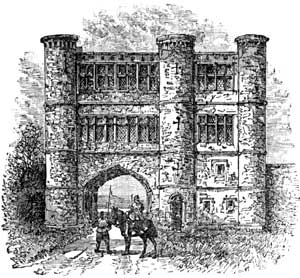
Gatehouse at Wiverton Hall.
Some glass in Annesley Church may date from this time. It was about this time that Leland, in his Itinerary through Nottinghamshire, remarked, "Half a mile or I cam to Langer I cam by Master Sir John Chaworthe a Knightes Manor Place, wherabowt I saw great and mer-velus fair medows. Chaworth Place is caullid Warton Haulle. From Langer by veri fair medows and corne ground to Smithe, a Brokelet that ther devideth Notingghamshire from Leyrcestershire a IIII myles. A II miles beyond Langer I saw, but far of, the Castel of Bever, on a Hy coppid Hill."6
Sir John Chaworth and his wife lie buried under a handsome alabaster tomb in the north transept of Langar Church, and by the curious inscription round it, it would appear that husband and wife died in the same month. Glover gives the translation as follows:—
"Here lyeth Sir John Chaworth . . . who died at Wyverton 3rd Sept. 1558. . . . His 2nd wife Mary daur of Sir Wm Fasten died in the year and month aforesaid, and together with him is here buried, who being joined together in this tomb, I pray may be joined together in Heaven. Thus life gave what death was not able to give."
Perhaps this is only to be taken allegorically, as Dame Mary appears to have proved the will in the following year.
Sir John's son was SIR GEORGE, who married Anna, daughter of Sir William Paston, his cousin (his mother being a Paston); and was knighted by Queen Elizabeth at Greenwich, 1584. He rendered a great service to his family by causing his pedigree to be drawn out and illuminated by Glover, the Somerset Herald, in 1581. It is bound in tooled leather and mounted in silver, and is preserved with great care at Annesley. In the Belvoir MSS. there are many letters from Sir George to members of the Rutland family on public and private matters. In 1577 (July 23—Nottingham), "George Chaworth, Sheriff, Sir Gervase Clifton, John Byron and others acknowledge the receipt of the Queen's Commissions for musters in the County of Nottingham."
In 1581, George Chaworth writes from Wyverton to the Earl of Rutland that "the Mayor and others of Nottingham desire to see you concerning the controversy touching their schoolmaster and other matters." This sounds like modern Education Act difficulties, but the end of the letter puts a different complexion on it, observing "their present, two oxen, will, as I hear, come a day before."
Politics were discussed, much as in these days. Sir George writes to the Earl of Rutland in 1586:—"I enclose the answers of Retford and Nottingham. I lie at your disposition concerning the election of knights for this shire. Sir Thomas Stanhope would willingly supply one place as associate with Sir Thomas Manners or any other."7
In the same year arose the question of an "isolation hospital." Thomas Faireburne writes from Newark to the Earl of Rutland at Ivy Bridge:—"The sickness does not spread in Bottesford. I have been to Sir George Chaworth in the matter, I have kept the suspected persons in one house this five weeks and it remains there only. We cannot learn certainly whether it is the plague or not, but it is very suspicious.....
Six have died. If it spreads any further we mean to build a house for them in the fields, and keep them out of the town."
In the early part of 1588 died John, fourth Earl of Rutland, who had enjoyed the title and estates less than a twelvemonth, leaving a widow and large family, and there was some difficulty in finding executors to undertake the management of his affairs. Sir George Chaworth was one of them, and many letters passed between him and the widow, Elizabeth, daughter of Francis Charlton, of Apley Castle, Salop.
The countess, who describes herself as "a weak and sickly woman," says she has begged her uncle, Mr. John Manners, and her cousin, Sir George Chaworth, to undertake the executorship, but fears they will not, unless Lord Leicester and Lord Burghley move them to do so. Two days after (April 5th, 1588), Sir George asks the countess's interest to continue his cousin at Annesley, George Chaworth (afterwards his heir) in the office of steward of Mansfield and Oswelbeck, so no doubt the affair of the executorship had been settled to the lady's satisfaction.
Sir George was one of the eleven knights who attended the earl's funeral, and Lady Chaworth, with Lady Manners and Mistress Sydenham, were the three gentlewomen who accompanied the countess, and for whom "blacks," five yards long, were provided.
The summer of this year, 1588, was the long-remembered time :
"When that great fleet invincible against us bore in vain,
The richest spoils of Mexico, the stoutest hearts of Spain."
and the collection of arms and the levying of troops occupied the thoughts of the inhabitants of the Vale of Belvoir. Sir George Chaworth, going to Belvoir to look for some armour to furnish thirty of his men, could find none, but discovered a tent, "used by the Earl Harry at St. Quintin," which he thinks will serve, "if hasty occasion should require it." A few days later he writes that the "earnest occasions of her Majesty's affairs" hinder his attendance on the widowed Lady Rutland at Winkburne, her dower house.
In September, 1588, however, when public matters are not quite so urgent, field sports can be thought of, and Sir George mentions that Mr. Zouche, and certain other of his companions, who are bringing their hounds to Wyverton, "are desirous to have the hunt at Belvoir."
The close of Sir George's career came the year after the Armada, when a "forced loan" had impoverished the gentry so much, that in one of his last letters, written from Annesley, December 10th, 1589, he says, this year is "soe fatall, that manie greate persons go to the Fleet and Gatehouse" (debtor's prison). He himself is suffering from a "rewme" (rhume, or cold), and is "in the mercy both of a physician and chirurgion." In January, he asks Lady Rutland to lend him £200 and a litter to go to London to consult the college of physicians, but before starting is bled by Mr. Baker at Annesley. He is next heard of at his sister's (Lady Carr's) house, at Pie Corner, in the city of London, where, on the 22nd of February, 1590 (N.S.), he writes of his "dangerous, though not hopeless condition," and gives some advice to Lady Rutland on business matters. This last letter of a long series ends, "My last request to you is for your favour towards my kinsman in the stewardship of Mansfield, for which, dying or living, I shall account it a special favour done to myself." He died March 4th, ten days later.
In Sir George's numerous letters he never mentions his daughter and heiress, Elizabeth, who married Sir William Cope,8 and conveyed to him the oldest estate ef the Chaworths in Nottinghamshire, Marnham-on-the-Trent.
Sir George was buried in Langar Church, and Thoroton says that on the wall over the tomb of his father, Sir John, was written an inscription, stating that his heiress, Elizabeth, was not five years old at the time of his death, and that his widow married secondly, Sir Nicholas Strange, and thirdly, Sir Anthony Cope, father of Sir William, the eventual husband of her daughter.
By Sir George Chaworth's will, he bequeaths to this daughter, Elizabeth, among other things, a "Jewell sett with little Rubies and Emeralds and a blacke enamyled cheyne part whereof was my mothers." Perhaps this is the long chain represented on the monumental figure of Lady Chaworth in the north transept of Langar Church.
(1) Besides holding the advowson of the
church, Mr. Musters is still lord of the manor of Edwalton and chief landowner.
(2) By her will, dated 1400, Lady Alice leaves to the chapel of St. Laurence
de Wyverton "a vestment of blue, and all the timber lying in the same
chapel and £20 for the fabric." No doubt this was the "good chapel
in the house" spoken of by Thoroton.
(3) This is no doubt the same Sir Thomas whose will, dated 1347, says "I
give my body to be buried in the Church of the Blessed Mary of Beauchief, before
the altar, near the tomb of Sir Thomas my grandfather. My will is that my old
palfrey walk before my body in the name of its master, with its armorial trappings.
Done at Alfreton, 1347."
(4) Is this the "very old man" mentioned by Thoroton as having died
about the 42nd year of Edward III.?
(5) From his brother George, of Rawmarsh, near Rotherham, descended the line
eventually raised to the Irish peerage by Charles I.
(6) Visitors to Belvoir may see this "Hy coppid Hill" represented in
a picture in one of the corridors. The approach to the Castle was made easier
by the father of the present duke, early in the last century.
(7) Sir Thomas Stanhope was no doubt one of the knights of Nottinghamshire,
described by Queen Elizabeth in the well-known distich:—
"Gervase the Gentle,
Stanhope the Stout,
Marnham the Lion,
Sutton the Lout."
(8) Sir William Cope, says Burke, was M.P. for Banbury and for the county of
Oxford in several parliaments. He married, as we have seen, Elizabeth Chaworth,
by whom he had two sons and a daughter. Sir John, the eldest, was the ancestor
of the present Sir Anthony Cope, of Bramshill Park, Hants.