
Holme Pierrepont church
BY Harry Gill
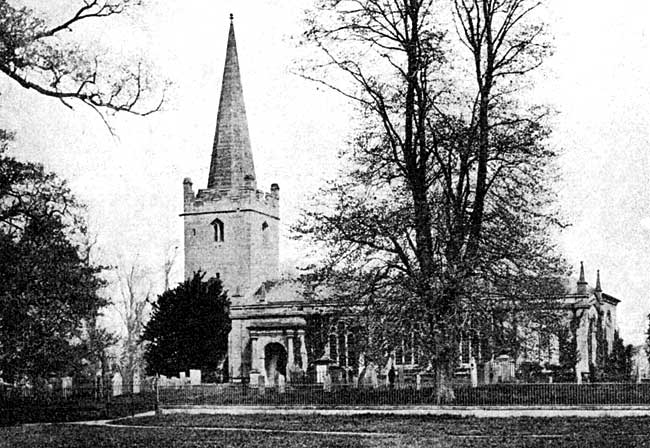
St Edmund's church, Holme Pierrepont (c. 1900).
Shelford was left about 4.30 p.m., and on remounting the hill, Radcliffe-on-Trent was passed, and Holme Pierrepont reached at five o'clock, where the rector, the Rev. Henry Seymour, accompanied by Mrs. Seymour and his daughters, met the visitors at the entrance gate of St. Edmund's Church. Adjacent to the Church stands the Hall, one of the residences of Earl Manvers, amidst some of the finest specimens of old English elm trees to be found near Nottingham. The combination of the old and the modern in the church is conspicuous. Mr. Harry Gill, the author of "The Village Church in the Olden Time," read the following interesting paper.
This church calls for very little architectural description; its picturesque situation and its long connection with the illustrious families of Manvers and Pierrepont being the chief points of interest.
As early as the days of Henry I., the Manor of Holme was in possession of the Manvers family, and the second name was added in the reign of Edward I., when the sole heiress was married to Henry of the Castle of Pierrepont in France.
The church still bears its original dedication to St. Edmund, at one time the most popular patron saint in England, although only three other churches in the county are dedicated to him. Like most of our village churches it has been altered and restored from time to time, until all traces of antiquity have been removed, and the exterior has assumed a very modern appearance.
The steeple at the west end is the most ancient feature. It is in the late Perpendicular style. Judging by the mouldings and the tracery in the belfry lights which are debased and shew evident signs of the coming decline, I should fix the date of erection during the reign of Henry VII.
The remainder of the external work was rebuilt by the Marquis of Dorchester in 1666. This was a time when Gothic architecture had declined and a quasi-classical style was in favour.
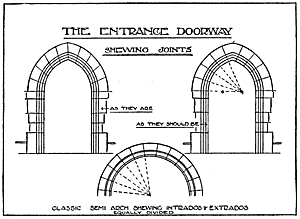
The window tracery is very clumsy, and while the arches internally are pointed in imitation of Gothic, externally they are semi-circular. The porch (now quite hidden by a thick growth of ivy) is quite classical, having on either side Doric columns supporting a semi-circular arch, with a square panel above, containing the heraldic lion of the Pierreponts. All the mouldings and details are based upon Grecian rather than Gothic models, and the workmanship is evidently that of men used to the classic style. An interesting proof of this is seen in the method of jointing the arch stones of the entrance doorway. A mason in the Gothic days would have made all the joints radiate to the centres from which the lines of the arch were struck. In this case, although the arch is a pointed one, the mason has treated it in just the same way as he would have treated a semi-circular arch, and has set out the joints by dividing the intrados and extrados into an equal number of parts. The result as shewn in the accompanying diagram is very unsatisfactory.
What became of the old church, that was pulled down to make way for this new structure, is not recorded. Some of the material would doubtless be worked up again in the reconstruction. The surplus was most probably used in strengthening the banks of the Trent, as is known to have been the case with the masonry of the neighbouring church of All Saints, Adbolton, which was pulled down in 1746, and sold for £12 7s. 6d. The church plate and other articles were brought here.
The old church is always described in documents as "a church with aisles," The present edifice has only one aisle on the south side of the nave, with tower and spire at the west end, chancel, and organ vestry at the east end, with the burial vault of the Dukes of Kingston beneath.
On the north wall there is a semi-circular projection now without any means of access. This was once the staircase leading up to the rood-loft.
On entering the church a relic of a former structure of the Perpendicular period is preserved in the north wall at the west end of nave. This is a fragment of window tracery discovered in the old chancel wall, at the time when the monument to the Duchess of Kingston was removed from the chancel, and fixed at the west end of nave opposite to where the old tracery has been built in.
Another portion of the old church is retained in the nave arcade, and about this I have found much diversity of opinion, some contending that it is a part of the Early English structure erected in the reign of King John; but a careful examination leads me to think that it also is the work of the Perpendicular period, and contemporary with the old window already referred to; for although the clustered columns are now semi-circular on plan, there is every indication that originally they had a broad fillet worked on each face. These fillets have been cut away to allow the modern lamps to be fixed on to the pillars. The floor level of the church has been raised and hides the original base mouldings. The bases seen above the floor line are modern imitations in cement.
The monuments take us much further back into the past. The recumbent stone effigy near the south door is the most ancient. It has angels supporting the head on either side, and is clad (some say) in the garb of a pilgrim with a girdle at the waist supporting a purse. Nothing is actually known as to whom this figure represents, or why it was placed here. It has the appearance of representing a young person, but it doubtless commemorates one who took part in a pilgrimage to a holy shrine in some foreign land, perhaps to the Holy Land, although no palm leaf or escallop shell is depicted, as was usual in denoting a palmer.
Next in point of time is the mutilated effigy alongside the south wall, on the floor, between the two altar tombs; and again there is no means of identification. The armour indicates a period near to the close of the 14th century. The inscription on the wall above the effigy was evidently placed here at random, and has no reference to the figure below it.
"Amoris et Gratitudinis ergo
Erga
Optimum virum Gervasium Pierrepont Armigerum Filium secundo genitum Georgii
Pierrepont militis Fratrem Henrici Pierrepont militis Patrem Robt Comitis de
Kingston. Vic. Newark Baronis Pierrepont de Holme Pierrepont."
The fine alabaster altar tomb at the eastern end of aisle is entirely devoid of any inscription or heraldic device, save that the crest of the Pierreponts on the tilting helm and the collar of "suns and roses" (the Yorkist badge of the time of Edward IV.) seems to confirm the suggestion that it commemorates Sir Henry Pierrepont, who fought against the Lancastrians, and this supposition is strengthened by the following extract from the Torre M.S.:—
"18th Dec 1499—Henry Pierrepont Knight to be buried in the church amongst his worshipful ancestors and a tomb of alabaster to be made and sett upon his sepulchere and graven by the discretion of his executors."
The traces of chain mail that still linger in the plate armour indicate the period to be certainly not later than A.D. 1500, and the architectural embellishments are of the same date. The details are very carefully executed, and notice should be taken of the abundance of rings on the fingers and thumbs of the upraised hands.
The chief altar tomb in the centre of the south wall commemorates a Sir Henry Pierrepont who died 1615. The tomb was erected by his wife, Lady Frances Pierrepont, daughter of Sir William Cavendish and the famous Bess of Hardwick, as the inscription and heraldic bearings clearly indicate. His children, one son, four daughters, and a child wrapped in swaddling clothes (to indicate that it died in infancy) are all depicted on the base of the tomb.
"Here lyeth the Body of Sir Henry Pierrepont, Knight, who in his life time abounded with Charity, and many other Virtues; for whom the Lady Frances Pierrepont, Eldest daughter of Sir William Cavendish of Chatsworth, Knight, and the most noble and renowned Lady Elizabeth his Wife, late Countess of Shrewsbury, caused this monument to be made, being the least of many Testimonies She hath given of her great and dear Affections toward him. He died the nineteenth day of March in the year of our Lord God 1615 aged 69 years and a Half."
There are two ancient incised marble slabs in the floor under the tower, but they are too much worn and mutilated to be decipherable, and in the floor of the choir vestry there are the remains of a slab bearing a chalice, evidently indicating the resting place of a priest.
The memorial of the Princess Gertrude of Kingston, who died in 1649, is now fixed on the south wall of the nave, close by the tower. The inscription is very pedantic and characteristic of the time. It is inscribed in italics.
"Here lyeth the illustrious Princess Gertrude of Kingston, daughter of Henry Talbot Esq, late Earl of Shrewsbury, she was married to the most noble and excellent Ld Robert Earl of Kingston, one of the generals to King Charles I. in the late unhappy difference and in that service lost his life. She had by him many children, most dead, there are living Henry Marquis of Dorchester, Wm and Gervase Pierrepont Esq and one daughter the Lady Elizabeth Pierrepont. She was a lady replete with all the qualities that adorn her sex and more eminent in them than in the greatness of her birth. She was most devout in her duties to God, most observant of those to her neighbour, an incomparable wife, a most indulgent mother, and most charitable to those in want in a word her life was one continued act of Virtue. She hath left a memory that will never die, an example that may be imitated but not easily equalled. She died in the 61st year of her age A.D. 1649, and this monument was erected to her by her son Gervase Pierrepont."
There are many mural monuments of interest; one at the west end of chancel to the memory of Rev. Wm. Saltren, Rector of Cotgrave, who was drowned while skating on Thoresby lake, January 10th, 1811, bears the well-known name of
[PLAXMAN ]
R.A.
[SCULPTOR]
Another tablet records the death of the last Duke of Kingston, who was married to the notorious Mrs. Harvey, wife of Captain Harvey, afterwards Earl of Bristol. She was a woman of ambition and intrigue. Being determined to marry the Duke, she gained access to the church and tore out a leaf from the marriage register, and thus obliterated all trace of her first union. After the death of the Duke she was tried and found guilty of bigamy. She managed to escape from England, and died in Russia two years after the trial, aged sixty-three.
In the churchyard several interesting epitaphs may be found. Notice particularly the large square monument surmounted by an urn, standing by the path about midway between the porch and the eastern end. The inscription tells us it is "to the memory of Francis Dort De La Borde of Mereville and Chessey in the once flourishing Kingdom of Prance. When forced by faction from his own Country he for many years resided in this, when he lived beloved & died lamented October M.D.C.C.C.II aged XLII years and at his particular request is buried here."
Count De La Borde was descended from one of the oldest families in Prance. At the time of the Revolution he fled to England, and was very hospitably received by Earl Manvers, and became very much attached to Holme Pierrepont, where he was treated almost as one of the members of the family. He died in London, and was buried here by his own request.
The brother of this gentleman, Count Alexander De La Borde, remained in France, and escaping the dangers of the time, settled down to literary work. He became a member of the French Institute and a Buonapartist. He was greatly interested in voyages of discovery, and wrote a book on Spain. A great admirer of Captain Cook, he put up a statue of the circumnavigator in his park at Mereville.
From a literary point of view the church is interesting, because "Young Oldham," a "poet of merit," is buried here. His monument, containing the following inscription, is fixed on the pier of the nave arcade facing the entrance :—
"M. S.
Oldhami poetae quo nemo sacro furore plenior, nemo rebus sublimior aut verbis felicius andax ! Cujus famam omni aevo propria satis consecrabunt carmina quem inter primos honoratissimi Gulielemi Comitis de Kingston amplexus Variolis correptum heu ! nimis immatura mors rapuit et in coelestem transtulit chorum Natus Shipton in agro Gloucestrensi. In aula Sancti Edmundi Oxonice Graduatus Obiit 19 April A.D. 1683 astatis 30."
The Church plate is of plain silver, and is very fine, and bears the same date as the restoration of the church, i.e., A.D. 1666, on which occasion it was presented by the Marquis of Dorchester.
Lovers of music will be interested to know that the "pitch pipe" that did duty for the purpose of sounding the note before the introduction of musical instruments, is still to be seen. It is like a small organ pipe about 14in. long, with all the notes marked on a sliding scale.
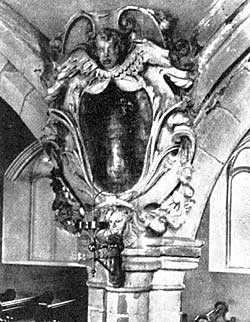
Oldham's tablet, Holme Pierrepont church.
Mr. J. Potter Briscoe, F.R.S.L., followed with a paper about the local poet, Oldham, who is buried here.
Holme Pierrepont contains all that is mortal of a seventeenth century poet, who has been designated " the English Juvenal," because of his satirical writings against the Jesuits; and the tablet to whose memory erected by his patron, is before you. The following is a translation into English, from the Latin inscription on the memorial tablet:—" Sacred to the memory of the poet Oldham, than whom no one was more filled with holy rage, no one in themes was more sublime, or in words more happily daring ! whose fame in every age his own poems will consecrate enough; whom, as he was seized alas with small-pox, amid the earliest caresses of the most honourable William, Earl of Kingston, death unripe beyond measure snatched away and transferred to the heavenly choir. Born at Shipton in the county of Gloucester, a graduate at St. Edmund's Hall, Oxford, he died 19 April, 1683, at the age of 30."
John Oldham, for such was his name, was only thirty years of age when he fell a victim to small-pox in 1683. There is a discrepancy between the burial register and the tablet in-inscription. Oldham had lived at the adjoining Hall with his admirer, the Earl of Kingston. As indicated on the tablet he was not a native of Nottinghamshire, but his writings had attracted the attention of the patron under whose roof he probably died. Oldham, who had formerly been a gay young man, had sobered down and been invited to become Lord Kingston's chaplain. He declined this position, but came as a guest to Holme Pierrepont. Previously to this he had been engaged in educational work in a private family, and before that at Croydon. He took his B.A. degree at Oxford, in 1674. He was the son of a Nonconformist minister. While at the University he printed an anonymous satire which resulted in his being rusticated. Oldham lived at a time when, and among people by whom, religious and sectarian topics were discussed with much zeal and bitterness, facts which greatly influenced his opinions and actions. He penned, as a result, some bitter "Satires upon the Jesuits," and wrote an ironical "Satire against Virtue," several Pindaric odes, many imitations also of Horace and other Latin poets. Oldham's "Satires on the Jesuits" have passed through several editions, and his collected works into about ten editions, the latest being issued in 1854, and forming a volume in Bell's "Annotated edition of the English Poets." He was greatly influenced by Dryden. He lacks the polish of that author, but occasionally excelled him in strength as a satirist. On the death of Oldham Dryden wrote some appreciative lines of which these form a portion:—
"Thy generous fruits, though gathered ere their prime, Still showed a quickness; and maturing time But mellows what we write to the dull sweets of rhyme. Once more, hail and farewell, farewell thou young, But ah, too short, Marcellus of our tongue. Thy brows with ivy and with laurels bound, But fate and gloomy night encompass thee around."
Reasonable allowance being made for the common language and usages of the period, Oldham is entitled to credit for the general tendency of his writings. The end he had in view should be taken into account in forming an estimate of the means he employed. If he descended into coarseness, it was not to stimulate a prurient or depraved appetite, but to turn against vice its own weapons. The licentiousness of the age, the servility of pandering authors, the neglect of literature, the pride and profligacy of the nobility, and the degradation of the lower orders of the clergy, are the topics upon which he gives free scope to his honest satire; and he knew that if he treated them with delicacy and reserve, he must inevitably fail to make the impression he desired. He was too much in earnest to pick and choose his phrases, or trim his versification. He thought only of the matter and was indifferent to the manner. As he has himself frankly acknowledged, the indignation is everywhere paramount to the art.
"Nor needs there art or genius here to use, Where indignation can create a muse."
In the core of his bold and vehement satires there is a sound and permanent material which may be safely liberated from incidental impurities. His faults strike the most careless reader; who soon, however, begins to perceive that they are the faults of an impetuous temperament, and not of ignorance or incapacity, and that Oldham's merits must be estimated by a very different test.