Teversal church
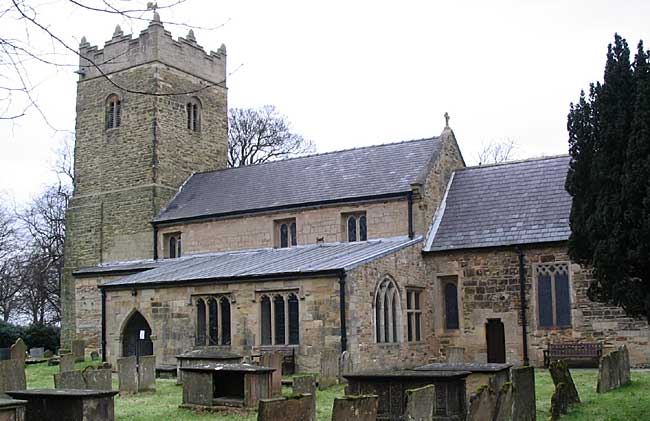
St Catherine's church, Teversal (A Nicholson, 2006).
Leaving Skegby our party proceeded by a winding lane, flanked by high hedges and flower-decked banks, as far as Teversal. Here the vicar, the Rev. G. E. Eaton, welcomed the members to a church full of interesting details and old associations. The flat tombstones of Roger Greenhalge and Anna his wife, the Molyneux busts, the quaint family pew, the remarkable treatment of the arcades and tower, and the fine southwest doorway were all carefully inspected; and the Rev. J. Standish read the following paper, dealing with the architectural details of the church.
Rev. J. STANDISH'S PAPER.
The legend of St. Catharine does not date further back than the 8th century in the East and the 11th century in the West.
It is curious as an evidence of the common life of the East flowing back on the West through the Crusade, to find by the beginning of the 14th century, Venice taking St. Catharine as patroness of her colleges; and some fifty churches dedicated to her name in England.
St. Catharine, who was martyred A.D. 307, was a daughter of the King and Queen of Egypt. She was remarkable for beauty of mind and face; she studied mathematics, particularly astronomy ; also Plato, and would have answered, we are told, the questions of the Queen of Sheba better than Solomon did. Her parents died early, leaving her queen at the age of fourteen; wiser than all around her, but an orphan and alone. Soon after this she became a convert to the Christian religion, and her legend contains at this point, visions of angels with chaplets of white lilies and chaplets of red roses. After her baptism, the Blessed Virgin appeared to her in a dream with the Divine Child. Then the Lord smiled on her, held out his hand, and plighted His troth to her. When she awoke she saw the ring of her spiritual marriage on her finger, and thenceforth despised the world and all its pomps for Christ.
During the persecution instituted by the Emperor Maximin II., St. Catharine, assuming the office of advocate of Christianity, displayed such cogency of argument as silenced her pagan adversaries. Maximin, troubled with this success, assembled fifty of the ablest sophists of Alexandria to confute the saint; but they were both vanquished in debate and converted to a belief in the Christian doctrines. The tyrant thereupon commanded the new converts to be massacred, but for St. Catharine he reserved a more cruel punishment. She was placed in a machine composed of four wheels, connected together and armed with sharp spikes, so that as they revolved the victim might be torn in pieces. A miracle intervened—a flash of lighthing severed the cords with which St. Catharine was bound ; shattered the engine in pieces, causing the death both of executioners and bystanders.
Maximin, however, still bent on her destruction, ordered her to be carried beyond the walls of the city, where she was first scourged and then beheaded. The legend proceeds to say that after her death, her body was carried by angels over the Red Sea, to the summit of Mount Sinai.
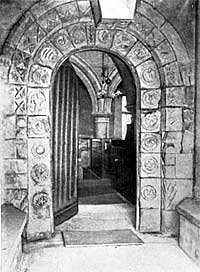
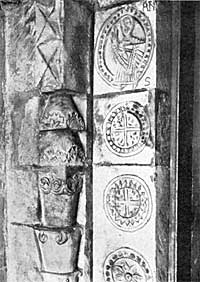
South doorway, Teversal Church.
Now there cannot be the least doubt that this south-west door is Norman in its origin, and that it is meant to carry repeated references to the legend of St. Catharine, of which I have given you the main story. A wheel, a sword, a book, a lamb, a palm, a lily, a rose, are all possible symbols of this church's dedication saint; and the fact that the work is Norman proves the dedication to have been one of the very earliest to St. Catharine.
The extraordinary point about this door is, that as it now stands, it is distinctly composite in character; for it contains worked stones, the presence of which it is difficult to explain. The original doorway may possibly have stood at the west end of the church, prior to the later building of the tower, which was built over part of the western bays of the arcades.
For instance, we find built into the jambs four double capitals with zig-zag or scroll ornament upon them, a single capital has a fleur-de-lys, or lily ornament; the fifth from the floor on the left hand side (west side) has carved on it a priest in vestments, in the act of blessing. Perhaps the Apostle, St. John, is meant to be represented, seeing the stone, as shewn in the illustration we give, bears the name Johannes. The sixth stone has a palm leaf ; the seventh three fishes, a symbol of baptism in the Name of the Holy Trinity; the eighth, a serpent; the central or keystone represents a thorn.
On the right hand side, counting from the floor, the fifth stone bears the lamb supporting a cross, the sixth perhaps a flail, and the tenth the dove, the symbol of the Holy Spirit. Others have the character of Catharine wheels, or roses, and in the serpent and the flail we may have symbols of the Egyptian worship of Serapis, which St. Catharine is said to have refuted.
The tower is built in three stages, each receding from the lower stage. The lowest contains a window, which has a flat segmental arch with the Molyneux cross above it. This window seems to have been inserted by John Molyneux in 1684. The middle stage of the tower contains a modern clock, and the third stage has louvre windows of two lights on all four faces, with label moulds above them.
The peculiarity of this tower is that it has been built over part of the nave arcade, as may be plainly seen from the inside of the church within the tower.
Going round on the outside to the north aisle, we should first of all notice that the present roof has been raised, probably at the time the late clerestory was added. Originally the aisles were lower, and there would be one long roof over nave and aisles.
Notice, too, that there is a late lintel doorway in this north aisle, now blocked up.