
Crocolana — the Nottinghamshire Brough
By T Cecil S Woolley
EXACTLY nineteen hundred and sixty years ago, the Roman Eagles were first set up on British soil. It was during the harvest of B.C. 55 that Julius Caesar effected his landing on the shores of Kent. The invasion was in fact merely a “reconnaisance in force,” but owing to circumstances, the retirement was so rapid that it was not unnaturally regarded by the Britons as a defeat of the invaders. Caesar’s object was, however, gained, and the following July saw the unopposed landing of five legions—some 30,000 infantry and 2,000 horse. it is probable that the invaders did not penetrate further north than the site of the present St. Albans (Verulamium), and that their effective occupation did not last longer than a few months, though it resulted in the nominal subjection of, at all events, a large portion of the country.
The actual conquest did not take place until at least a hundred years later, but there are indications that throughout the intervening period the desire of Rome to become in fact, as well as theory, the mistress of Britain, was gradually growing. By A.D. 40, this interest even affected the fashions of Roman Society, and it was the correct thing for the gilded youth of the capital to drive about in British chariots, and for Roman ladies of high degree to dye their hair red in imitation of British warriors.
Four years later, under the Emperor Claudius, began the real conquest of Britain, and by A.D. 84, the eight years’ generalship of Agricola had led to the practical establishment of the “Pax Romana” over the greater part of our island. Doubtless the great military roads were among the first public works to be completed, and we may suppose that by the end of the first century, the route from London to Lincoln by Wading Street and the Fosse, as set out in the Itinerary of Antonine, would present no special danger or difficulty to the northward bound traveller.
His safety and comfort would be in a great measure due to the more or less regular recurrence of military stations, of which there were twelve1 on this route between London and Lincoln, at an average distance from each other of about thirteen miles.2 The last three were in Nottinghamshire—the very last, almost within sight of the Sovran Hill, being Crocolana or Brough, now a hamlet in the parish of South Collingham. The distance from Lincoln is twelve miles, and is so given once in the itinerary. But where the station occurs in the route from York to London, the distance is stated incorrectly to be “14,000 paces,” i.e., fourteen miles. It may be noted, by the way, that the Roman “pace” was five feet in length. It represented the distance covered in walking between two falls of the same foot, and therefore equalled two of our paces. The Roman mile (mille passus) was consequently about 100 yards short of the English mile.
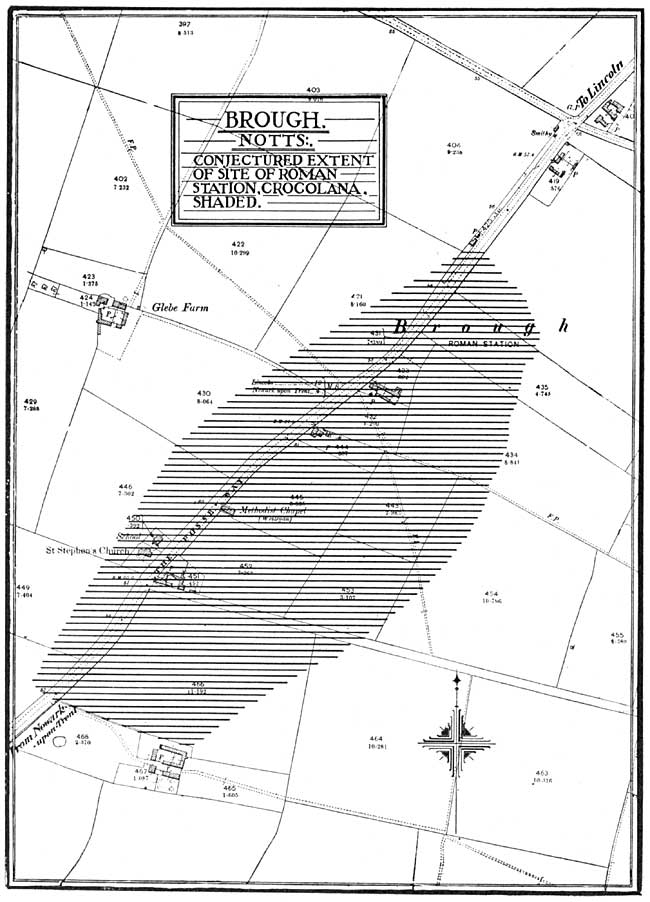
Notwithstanding its nearness to Lindum Colonia, it is evident that Crocolana was a place of some importance. The character of the soil and other indications point to an area of some forty acres as having been included within the inhabited area, and the objects which have been turned up by the spade clearly show that the place was much more than a mere soldiers’ barrack. Nothing in the nature of buildings or earthworks appears above the surface, and, unluckily, the mediaeval and modern builders and road menders have not been content with what lay ready to hand, but have carried their depredations under ground, making such havoc of streets and walls as to render the reconstruction of the plan almost pure guess work. Part of the foundations of a wall five feet thick have, however, been found adjacent, and almost at right angles to the Fosse. This, and the remains of the fallen upper structure, indicate that one at least of the houses in Crocolana was built on a principle which was common in this neighbourhood in the middle ages. Specimens indeed survive at Collingham to this day. The foundations and lower courses are of lias limestone, above is “stud and mud,” and the roof is covered with thatch or pantiles. The mud walls of the Roman house at Brough were carefully plastered inside and painted in various patterns, the colours still remaining quite vivid. The roof-covering consisted of fiat flanged tiles (tegulae) with half rounds (imbrices) over the interstices, the kind of covering which may be seen to-day anywhere in Tuscany, and elsewhere in central and northern Italy. In general appearance it is not unlike our modern English pantiled roof, of which it may possibly be the prototype.
If some, at any rate, of the inhabitants of Crocolana lived in substantial and artistically decorated buildings, it is unfortunately impossible to say with certainty what kind of dwellings served for the bulk of the people. Scraps of evidence, however, partly positive but chiefly negative, lead one to think that they were of a temporary character, probably of timber.
 |
Of the mode of life of the people themselves we can only guess from what we know of the life lived by Roman settlers in similar stations, and from such objects as the recent excavations have brought to light. These objects may he roughly classified as follows:—(i) Earthenware and glass, (2) metals, (3) bones and horns, (4) stones, (5) coins. The accompanying plates give a few specimens of each of the first three classes, and the following brief description will enable the reader to form some idea, at all events, of the degree of civilization reached by the local Romano-British, before the withdrawal of the Roman legions early in the fifth century.
I have placed earthenware first on the list because here as elsewhere fragments of pottery are by far the most numerous of the remains. Fragile as baked clay is, it is practically indestructible and the pottery of byegone civilizations affords perhaps the best means of judging of the conditions under which daily life was lived.
Romano-British pottery falls into two great divisions, the imported and the home made.
The former is generally known as Samian ware. It is of a bright red colour, often with a brilliant glaze, generally speaking rather thick and extremely brittle. It is red all through.
It is believed that this fine ware was never made in Britain as no kilns for the manufacture of it have so far been discovered, though there is evidence that attempts were made with indifferent success to imitate it. The great Italian seat of the manufacture was at Arezzo, and in the museum there are to be seen not only a great variety of perfect specimens, but also many of the moulds in which the vessels were made. The decoration of the Arezzo ware is however more delicate in design and execution than that usually found on Romano-British Samian, which is now believed to have been imported from Gaul.
Plate 1, Figs. 1 to 5 are some of the specimens found at Brough.
(1) I do not count Ad Pontem as a station.
(2) Itinerary of Antonine. Wesseling. Ed. 1735, p.471, 476, 477.