
Dunham, Whimpton Moor, Darlton
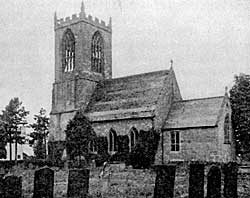
St Oswald's church, Dunham-on-Trent, in the 1920s.
Without making any stop at Ragnall, the party proceeded to Dunham-on-Trent, and after lunch visited St. Oswald's Church, which consists of chancel, nave with clerestory, and a lofty embattled tower containing five bells. The church is not of much interest to the antiquary save for the tower, which has four belfry windows of an exceptionally large size. The registers begin with the year 1654. Some of the party here strolled down to the river, where is situated the only bridge across the Trent between Muskham and Gainsborough.
A move was then made for East Markham, Whimpton earthworks being passed on the way. These are so indeterminate that it was not thought advisable to incur the delay which would be entailed by visiting them, but it is hoped to print shortly (possibly in this issue) a paper by Dr. T. Davies Pryce of Nottingham, who thinks the earthworks may probably represent an ancient village site, and possibly the "Wimentun" of Domesday, but in the absence of spade work no conclusion can be arrived at as to their nature or origin.
In the opinion of one of our members, Mr. William Stevenson, "it would be quite in order for a Roman encampment to be found at such a place as Wimerton, since the immediate neighbourhood of Littleborough, an important Roman ford, would need special protection. A large rectangular area suggests a Roman origin, while a small rectangular area might possibly be nothing more than the moated manor site of Wimerton when it was a manor, that is, before it was reduced by an early king to the position of a berewic."
From a rough plan of the site, furnished by Dr. Davies Pryce, embodying most of its outstanding features, it appears that the rectangular site approximately measures 800 by 1,300 feet.
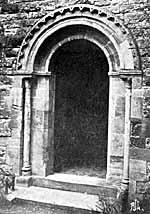
Darlton church, south door.
At Darlton Church the brakes stopped for a few minutes. Here the chief points of interest are a south doorway with dog-tooth ornament and two brasses, representing a knight in armour and a lady, which belong to the early part of the sixteenth, century. The vicar, the Rev. Howard Chadwick, has not been able to discover of whom these brasses are a memorial, but he thinks they probably belong to some owners or tenants of Kingshaugh. The Church possesses a silver chalice with cover of the date 1579. About a mile further on Kingshaugh was passed. This house occupies the moated site of a hunting lodge that belonged to King John, who is said to have formed an extensive park here, and Dr. Thoroton states that as Earl John "he made war in this place against his brother Richard I."