
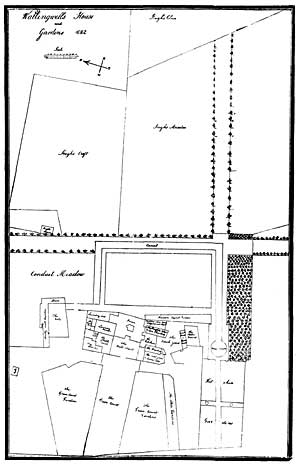
 Plan of Wallingwells. House and gardens, 1682.
 In the Wallingwells library is a book, now very scarce, entitled "The History of Scarbrough Spaw. By W. Sympson, Doctor in Physick, London. Printed for Thos. Simmons at the Prince's Arms in St. Paul's Churchyard. 1679." It is dedicated to the most hon. Charles Pawlet, Marquis of Winchester, etc. It relates several cures, that of Major Taylor first. "In the year 1650 or 51, being told he was dying, he replied he might as well die at Scarborough as anywhere, and had a mind to go there. He was told he would never return alive, so resolved to be buried there. In fourteen days he got well. He returned home, contrary to all expectation very well, not in a litter as he went, but on horseback. He did not go next year, being so well, but did the year after, and so continued till 1664, intermitting one in three or four years, during which time he had his health as well as he could wish. During the time he was abroad at Tangiers, which was about five years, after his return to England he found himself as bad as at his first visit to the water. He drank the waters twice in the summer of the year 1670, and continued drinking them every year except one. He was at Scarborough twice last summer (1678) being the latter time there with my lord of Winchester."
His first wife was accidentally killed at the rejoicings for the Restoration at Oulecotes by a servant discharging a loaded gun.
At Wallingwells are a crimson velvet saddle cloth, embroidered with gold and silver, which belonged to Major Taylor, and a silver christening bowl, cover, and bland, presented by Edward Clinton, fifth Earl of Lincoln, ancestor of the Dukes of Newcastle, who was sponsor at the baptism of Bridget Taylor.
Sir Ralph Knight was a doughty warrior, and many letters are extant addressed to him by "your very loving friend and servant George Monck" (afterwards Duke of Albemarle). He was very instrumental in forwarding the restoration of Charles II., and in that king's magnificent procession through the streets of London, on the 29th May, 1660, Knight rode at the head of the cavalry. He had fifteen children. A quantity of papers concerning him are at Wallingwells, including his funeral sermon, and his portrait, by Kneller, is amongst the family pictures. Miller's History of Doncaster contains a full account of him.
Lady Mary Wortley Montagu stayed at Wallingwells in 1712, and in her works will be found two graphic letters describing her visit and the household life. She was a cousin of her host: Thomas White's great-great-grandmother having been a Pierrepont.
This Thomas White owned most of East Retford, and was M.P. for the town in many parliaments of King William's reign and Queen Anne's. I pass on to his son John, also M.P. for Retford from 1733 to 1761. He is described by Horace Walpole as "governing both Newcastle and Lord John Cavendish." The Royal Historical Society have published the Duke of Newcastle's private letters to him,1 and they certainly bear out Walpole's assertion.
" I have nothing more to add than that I am what I have been for forty years, dear sir, your most affect, friend and most obliged and obedient humble servant, Holies Newcastle."
" My dear old friend,
The many proofs I have had of your valuable friendship lay me under the necessity of troubling those few who are willing and able to advise me. Yourself and my good friend Lord Grantham are the chief friends on whom I can depend. I don't withdraw the full power I have given you and hope to see you early on Tuesday morning. I beg you would communicate this to the Duke of Portland. Pray send me a line to come by tomorrow's fishman (safer than the post?) from Newcastle house what news you can pick up, and what use you may intend to make of this letter.
I am,
My dearest friend, Ever most affectionately yours, Holles Newcastle."
"Confidence in knowing your thoughts and opinion on the present situation. I should be glad to have your advice as soon and as fully as you can give it to me, and you may send your letter by express, enclosed to my trusty friend Mr. Potts, at the post office. I should wish the letters enclosed might be seen by nobody but yourself and the Duke of Portland. The Duchess of Newcastle desires her kindest compliments to you and the Duke of Portland, and we both beg you would, in a most particular manner, assure the whole house of Chatsworth, lords, ladies and gentlemen, of the attachment of Claremont to them."
"My dear old friend,
I must own I was never so much hurt, mortified and disappointed in my whole life, as I was last night, by the receipt of your short, cold, and, I must say, unfriendly letter of the 10th, to the warmest, most confidential, and I think the most interesting letter I ever wrote in my life, wherein I pointed out to you my distress, I implored your advice and assistance. I can call God to witness, that during my whole life, ever since I had anything to do in Nottinghamshire, which is now ever since the year 1711, my whole study has been to shew my love, affection, respect and confidence to your good father and yourself, without any drawback for one moment in my whole life. To you I apply for advice. It is from you I expect the first assistance. Your good father (Thos. White) [was] my first friend. I send this letter by messenger."
Taylor White, who succeeded his brother John, married Frances, daughter and co-heiress of General John Armstrong, one of Marlborough's great captains of war, and a close personal friend of the Duke and of Prince Eugene. He commanded the artillery, accomplished the siege and taking of Dunkirk, and fought in all the battles of the period, including Blenheim. He was fourth in descent from Christopher Armstrong, of Mangerton Castle, Scotland. He founded Woolwich Academy, was Governor of the Tower, and was one of those who signed the invitation to the elector of Hanover to accept the Crown of England.
Taylor White was a patron of the arts, and an honorary treasurer of the Foundling Hospital, whose affairs he managed for a long period of years. His portrait is there, his coat of arms in the east window of the chapel, and the name of Miss Mary White, his sister, who was a liberal benefactress, is inscribed in gold letters on the wall of the children's dining hall. Of his daughter, Anne White, the poet Rogers writes:—"Miss White, a most charming and elegant woman about thirty five, who, after having long excited the admiration of the Pump Room by her wit and her talents, shut herself up in her father's sickroom for two long years, but he is now dead and she lives at present in [what was formerly] Sir J. Reynold's house at Richmond, on an independency of £1,200per annum. You must know her."—Rogers to his sister Sarah. Brighton, 9 November, 1798.
(1) A correspondence marked "Very Secret."