Car Colston church
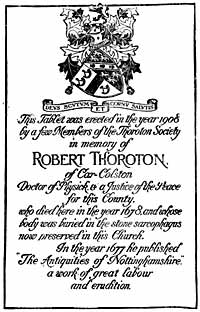
On the arrival of the party at Car-Colston, a little before 3 p.m., the main purpose of the excursion was entered upon. This was the unveiling of a memorial tablet to Dr. Thoroton, of which we give an illustration.
The brass is a handsome tablet of latten, and has been executed by Messrs. Gawthorp & Sons, of Long Acre, London, and placed in the wall of the south aisle, on a black marble slab, by Messrs. Thrale Brothers, of Newark. Above the inscription the arms of Thoroton impaling those of Boun are emblazoned in metal and enamel, surmounted by a helm with mantling and the crest of Thoroton also duly emblazoned. On a ribbon beneath is the motto—DEVS SCVTVM ET CORNV SALVTIS.
A short service of dedication was held in the church at 3 p.m., the vicar, the Rev. Edward Robinson, officiating. The following was the order of service:—
| 1 | Hymn 221 (Ancient and Modern). |
| 2 | The Bidding Prayer (all standing). |
| 3 | The Unveiling. |
| 4 | I heard a voice from heaven, etc. (from Burial Service). |
| 5 | Lesser Litany. Our Father, etc. Almighty God with whom the souls, etc. O merciful God the Father, etc. |
| 6 | Hymn 438 (Ancient and Modern). |
| 7 | The Blessing. |
The Bidding Prayer was said as follows:—
LET US PRAY for Christ’s holy Catholic Church, particularly that pure and reformed part of it established in this kingdom: for all Christian Sovereigns, Princes and Governors, especially His most excellent Majesty our Sovereign Lord Edward, by the grace of God of the United Kingdom of Great Britain and Ireland King, Defender of the Faith, over all persons and in all causes within his dominions supreme : for our gracious Queen Alexandra, George Prince of Wales, the Princess of Wales and all the Royal Family: for the Lords of his Majesty’s most honourable Privy Council: for the great Council of the Nation (now assembled in Parliament): for all the Nobility Magistrates and Gentry of the Realm ; for the Ministers and Dispensers of God’s Holy Word and Sacraments, whether they be Archbishops particularly Randall Thomas, Lord Archbishop of this Province or Bishops particularly the Bishop and Suffragan Bishop of this Diocese, or the inferior clergy, the Priests and Deacons : that all these, in their several stations, may serve truly and faithfully to the honour of God and the welfare of his people, always remembering that strict and solemn account which they must give before the judgement seat of Christ. And that there never may be wanting a supply of persons duly qualified to serve God both in church and state, let us pray for a blessing on all schools of sound learning and religious education: lastly let us pray for all the Commons of the realm: that they may live in the true faith and fear of God, in dutiful allegiance to the King, in sincere and conscientious communion with the Church of England and in brotherly love and Christian charity one towards another. And as we pray unto God for future mercies, so let us praise Him for those we have already received: for our Creation, Preservation, and all the blessings of this life, but above all for our redemption through Christ Jesus: for the means of grace afforded us here, and for the hope of glory hereafter. Finally let us bless his most Holy Name for all his servants departed this life in his faith and fear, —particular the Vicars of this Parish, and builders and Restorers of the Church : together with Gregory Henson: John Whalley, Anna Margaret Sherard, and Robert Thoroton, Benefactors of this House of God: and let us pray unto God that we may have grace so to follow their good example, that, this life ended, we may be partakers with them of the glorious resurrection in the life everlasting :
These prayers and praises let us humbly offer up to the Throne of Grace in the Words which Christ himself has taught us :
Our Father, etc.
After the Bidding Prayer had been said, Mr. George Fellows, who is descended from Dr. Thoroton’s sister Mary, unveiled the memorial, in the following words:—
“On behalf of the subscribers I now, as I have been asked, unveil and commit to the care of the Vicar and Churchwardens this Memorial Brass, erected to the Glory of God and in memory of Robert Thoroton, Doctor and Historian, whose memory in this place they are anxious should not be forgotten, but rather. that he being dead should yet speak to us.”
After the Blessing had been given, Mr. T. M. Blagg read the following paper:—
Dr Robert Thoroton.
by Mr. T. M. Blagg.
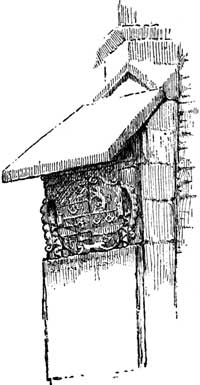
“Robert Thoroton, to honour whose memory we are assembled here to-day, was the eldest child of his parents, and the last of six generations of Roberts in direct male line to reside in this parish. He was born in the year 1623 or 1624, but we do not know where. His parents were married at St. Mary’s Church, in Nottingham, Nov. 30th, 1622, and, as his grandparents were still living in the ancestral home at Car-Colston, it is possible that his parents resided elsewhere during the first years of their married life. At any rate, there is no record of Robert’s baptism in the register of this parish, nor of that of his sister Elizabeth, though his brothers Richard (1627), Gervase (1630), his sister Mary (1632), and his youngest brother Thomas, in 1636, are all entered as being baptised at Car-Colston. The family of Thoroton derived its name from the neighbouring village of Thurverton or Thoroton, where they were seated as landowners as early as the middle of the 13th century. Their property in this parish of Car-Colston was acquired by marriage with the heiress of the family of Morin, who had become possessed of it in like manner by an alliance with the Lovetots, the wealthy family who had founded the Priory of Radford-by-Worksop and endowed it with, among other gifts, the rectory of this Church. Of this descent from one of the great Norman families, Robert Thoroton was always very proud. He refers to it on the tablet which he erected to the memory of his grandfather, in 1664, on the buttress near the chancel door; he quartered the arms of Lovetot and Morin on his shield, and he used the Lovetot lion rampant to uphold the hunting-horn of Thoroton, in the crest with which he surmounted the helm on his achievement.
Of Robert Thoroton’s early years we know very little. He took his B.A. degree at Christ’s College, Cambridge, in 1642-3, when 19 or 20 years of age; proceeded M.A. in 1646, and became Licentiate of Medicine. He is afterwards described as M.D., though I do not know where he took that degree. That he was properly entitled to it seems undeniable, for he invariably uses it after his name, in his pedigree, on the title page of his book, on his coffin, and on the headstone to his grave. Thoroton married Anne, daughter of Gilbert Bohun or Boun, serjeant-at-law, and impales the arms of that knightly family upon his shield. By Anne Bohun he had three daughters; Anne, who married Philip Sherard, grandson of William, Baron Leitrim in the Peerage of Ireland; Mary, who was drowned in 1655; and Elizabeth, who married John Turner, of Swanwick, in the county of Derby. Thus Robert Thoroton left no descendants in direct male line, and the family is now represented by the descendants of his younger brother Thomas, one of whom resided at Screveton, and married the heiress of the ancient family of Hildyard of Winestead, in Holderness. The family is now seated at Flintham, near here, under the name of Thoroton-Hildyard. After his marriage Thoroton appears to have settled down at Car-Colston for the remainder of his life, busying himself with his practice as a physician, his duties as magistrate, and his hobby of genealogy. His mother died in 1660, and his father probably lived with him, and only pre-deceased him by five years. His ancient house, the manor house of the Morins, so ruinous as far back as 1510, that he records that, on his marriage in that year, his grandfather’s great-grandfather had patched it up “by laying thatch upon the slates where any were left,” had now become so bad that it was past further mending, so in 1666 he pulled it down completely and built another house close by, of the elevation of which a tiny sketch was made by John Throsby, when he visited the village in 1792, and reproduced in his book. This house in its turn became ruinous (as Throsby records) and in 1812 was pulled down. On its site was built the present Hall, the white house occupied by Mr. Wilkinson, which we shall presently pass as we go towards Screveton. In 1768 died Thoroton’s descendant, Margaret More Molyneux, daughter of his grandson, Robert Sherard, and in 1781 trustees sold the property to the Rev. Edward Heathcote, of East Bridgford, for £3,100.
"It was during a visit to his friend Mr. Gervase Pigot, of Thrumpton, that the incident occurred which formed a turning point in Thoroton’s life, and was the cause of his attempting the work by which he is remembered. For, staying at the same house, was one of the greatest antiquaries, heralds and genealogists that England has ever produced, Mr. (afterwards Sir William) Dugdale, Norroy King of Arms, and Mr. Pigot bringing out a manuscript History of Nottinghamshire, which had been begun by Gilbert Bohun, Thoroton’s father-in-law, Dugdale urged the Doctor to take up the work and complete it. Thoroton appears to have straightway made a start, and in about ten years, namely in 1677, produced the folio that is so well known to all of us. The work is dedicated to Gilbert Sheldon, Archbishop of Canterbury, who during the Commonwealth, had resided at the Hackers’ House in the adjoining parish of East Bridgford and had been personally known to Thoroton, by whom he appears to have been much beloved and esteemed. A letter to Dugdale is printed as foreword to the volume, and in the following sentences of courteous and happily-phrased English, Thoroton modestly places the work under the protection of the master’s name, as was the custom of those days. ‘Sir,’ he says, ‘By your hand, as it were, I present these Collections to the Nobility and Gentry of our County, and to all other lovers of this kind of knowledge, that your name may procure the Book that esteem, which its own worth cannot give it: This priviledge I claim and use with the greater confidence, not only because I am sufficiently assured of your kindness and good nature, but also because indeed you put me upon the work, and therefore though I may not have done so much, or so well as you intended I should, I think you are a little obliged to countenance your own choice of the Instrument.’ After referring to the incident at Mr. Pigot’s house, already related, and lamenting his inability to get to York, so as to have made use of the vast stores of information in the Registry there, the Doctor concludes: ‘Yet I have made hard shift to be as little justly to blame in other things as possibly I could, so that I hope you will not disown me ; and, if you do not, I shall be less sollicitous what others think, for I allow no man for a Judge who hath not done something of this nature himself. And they that have, even for your sake, I am sure will be apt to be merciful to
Your Faithful Friend and Servant,
Rob. Thoroton.’
For the book itself, though we cannot claim that it is the best county history ever written, we justly believe that it is well in the front rank; and the more one works at such subjects oneself, and the more one has occasion to use the book, the more is one astonished at the vast labour that it represents, at the detail it displays, and at the accuracy of the matter it records. Chiefly genealogical in its effect, its purpose was to record the descents of all the lands in each parish during the nearly 600 years which had intervened between the Domesday Survey and the compilation of the Doctor’s work. Though 230 years have elapsed since it was published, it is the standard work on our county, and must always remain the chief source of information concerning it. The Doctor did not long survive the completion of his great task. Just as, in our own day, our greatest county writer, Mr. Cornelius Brown, was taken from us as soon as he had finished the greatest of his works, so Thoroton, in his day, was allowed but a short time in which to taste the sweets of labour well done. On November 21st, 1678, he died, and was buried, two days later, in the great stone coffin which six years earlier, realising the uncertainty of this transitory life, he had prepared for the reception of his body. In 1842, the coffin was discovered outside the chancel door, near the buttress-tablet on which Thoroton had recorded, in concise Latin, so terse and complete a history of his family. In 1863, being in the way of drainage operations, it was somewhat sacrilegiously taken up, and is now to be seen in the vestry of the church, where its coped lid and wealth of heraldic devices cause it to be an object of much interest.
In 1901, the headstone, made from one of the stone pre-Reformation altars of the church, was found beneath the turf near the same spot, and has been removed into the chancel, where it may be seen fixed against the north wall of the sacrarium, in which it once served so sacred a purpose.1
In 1897, the Society of which we are members was founded for the purpose of fostering all studies in the history, folk-lore, genealogy, and archaeology of Nottinghamshire, and for the preservation of its antiquities, and it was felt that it could be given no more appropriate name than that of the man who by his great industry had saved so much of its history from the wreck of time. At the annual meeting of the Society, two years ago, Colonel Mellish, who presided, suggested that some memorial should be erected to the man .whose name the Society bears; a subscription list was opened, and a committee appointed by the Council, with the result that the handsome brass, which has just been unveiled, has been placed in this parish church to keep for ever bright the memory of him who lived and died, who worked and worhipped, in this place.”
Before leaving the church, many of the visitors made their way to the vestry where they inspected the stone coffin and the parish register containing the entry of Dr. Thoroton’s burial, and the church plate, most of which has been given by the Thoroton family. Mr. Blagg had also placed there some prehistoric and other antiquities found in the parish; and, belonging to his family, two parchment title-deeds bearing the signatures of Robert Thoroton, his wife, father, and other relatives, and of Samuel Brunsell, whose house was to be visited later in the afternoon. There was also a little copy of the lyric poet, Anacreon, with Dr. Thoroton’s autograph on it.
On leaving Car Colston, the party proceeded to Screveton Church, where the Rev. J. Standish read the following paper, dealing with the architectural features of the church. He also added some biographical noes on Richard Whalley and others.
(1) See the Society’s Transactions, Supplement, for 1901, page 55.