
St. Wilfrid's, Kingston-on-Soar, was the next church visited. Here, too, no paper was read, but since the excursion the following notes have been kindly sent to the editor by Mr. E. L. Guilford.
KINGSTON-ON-SOAR CHURCH.
By MR. EVERARD L. GUILFORD.
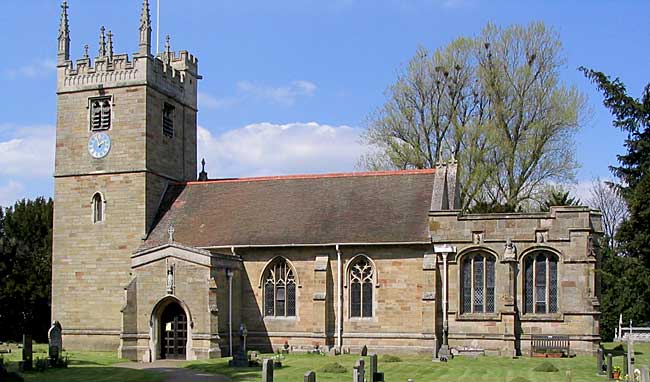
St Wilfrid's church, Kingston-on-soar, was rebuilt in 1900 (photo by A Nicholson, 2006).
In Mr. J. T. Godfrey's invaluable book on the Churches of the Hundred of Rushcliffe, a full description will be found of this church, and especially of the shrine which, since the restoration of the building, is the only object of interest in the church. For a similar reason, nothing need be said about the heraldic sculptures which form so excellent a picture of the Babington family genealogy.
So much still remains to be found out about the Babington family itself that it would be premature to enter upon the subject here.
I shall, therefore, restrict myself to a few remarks on the object and decoration of the shrine.
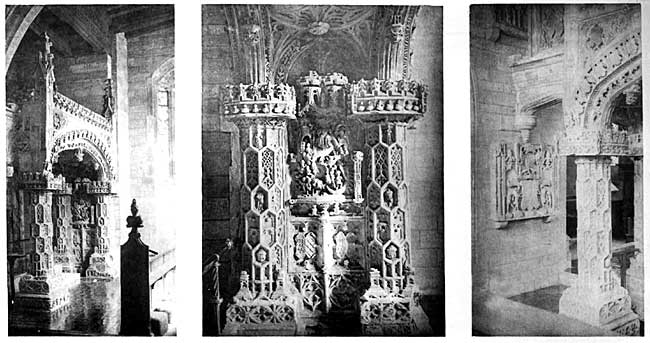
Babbington monument, Kingston-on-Soar.
This shrine was erected in 1538 by Sir Anthony Babington, and in it were said masses for the dead. It was also intended to mark the burial vault of his family. The mediaeval love of punning is well seen in the carving, where the babes and tuns occur at every turn; in one case we find a baboon as well as a babe.
Another noticeable feature is the carving of the Last Judgment. On the right is Hell, represented by a monster's mouth, into which the damned are disappearing; on the left, the righteous are mounting to Heaven through the strait gate; in the centre sits the Almighty.
At first glance the carving appears to be of foreign workmanship, but I have obtained several expert opinions upon the question, and I am assured that the work is English. It is exceedingly interesting to find the beginnings of Renaissance decoration appearing here and there among the florid and somewhat debased work of the Gothic carvers.
On the party reaching Ratcliffe-on-Soar, the church of the Holy Trinity was visited, and there the following paper on the church and the Sacheverell tombs was read by Mr. George Fellows.