Kirkby
BY MR. GEO. G. BONSER.
Kirkby is an illustration of the fact noted by Dr. Isaac Taylor that Saxon settlements were, as a rule, under one lord, while the Danish settlements were generally divided between a number of small freeholders.
The manor place, on whose site we now stand, may have been the stronghold of Levenot who held it before the Conquest. It paid the danegeld for ten bovates. It was granted by William the I. to Ralph Fitzhubert, from whom it descended to the Stutevilles. With them it remained till forfeited by Robert de Stuteville 14, Edward III. (1341) when it was granted to John D'Arcy, who, four years later, had license to make a park. In the 15th century it came to John Conyers, by his marriage with the daughter of Philip D'Arcy. It was sold on 20th October, 1647, by the Committee for Compounding to Robert Thorpe.
Elizabeth, elder daughter and co-heir of Philip Lord D'Arcy, was married to James Strangways, her sister Margery was the wife of Sir John Conyers, who, in her right, had this manor and advowson of the church 14th March, 5 Henry VII., 1492.
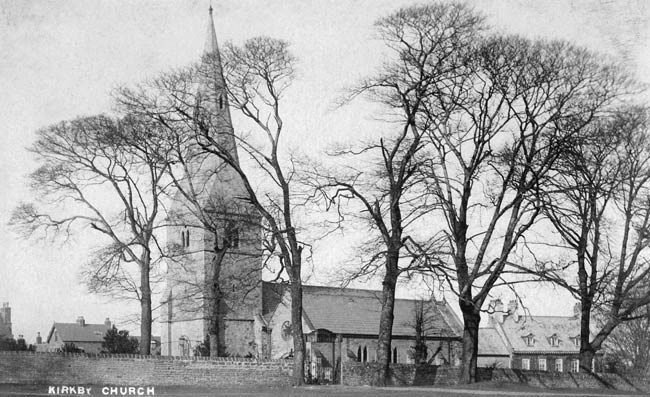 Kirkby parish church, c.1910.
The church, however, seems to have been granted to Thurgarton priory by Radulfus de Aincourt, probably about 1180, as stated in the charter of that abbey temp. Edward III.
On the hill opposite to the south-west stood the manor of the Tayn land which Alvric had before the coming of king William, which was rated to the danegeld at two bovates. It was granted to the De Insulas, Reginald de Insula, in A.D. 1252, confirming the grant made by his ancestors to Pelley Abbey.
A little to the left may be seen the hill on which Sir Charles Cavendish began to build a great house in this lordship, where he was assaulted and wounded by Sir John Stanhope, of Linby, June, 1599; Sir Charles' party, though much outnumbered, finally driving the others off with a loss of three or four killed. Owing to this quarrel, Sir Charles decided not to finish the building.
On the north-west is the manor house of Westwood, or Langton Hall, so named because, after having been granted by John, lord Stuteville, in temp. Henry II. or III. to the Ruddingtons, it came to the Langtons 34 Henry III. (1250). It passed from them by marriage to the famous family of the Fitzrandolphs, one of whom was sheriff of Notts 1166-70 and 1189, another (Christopher) being rector of Kirkby, 1489, while another, Sir Brian, gave his daughter in marriage to Sir Nicholas Strelley, c. 1540. The last representative disappeared from Sutton-in-Ashfield at the end of the 17th century.
A little further north are Kirkby Old Hall and Brookhill Hall, the former at one time the seat of a branch of the Sacheverell family, of Snitterton, Derbyshire, from whom it passed by marriage temp. Edward III. (c. 1370) to the Cokes of Trusley, to whom it still belongs. Brookhill Hall was purchased by them from Sir Ralph Langford in A.D. 1565.
Of Kirkby Hardwick, which lies east, further particulars will be given on arriving there.