
Selston church
By Mr A S Buxton
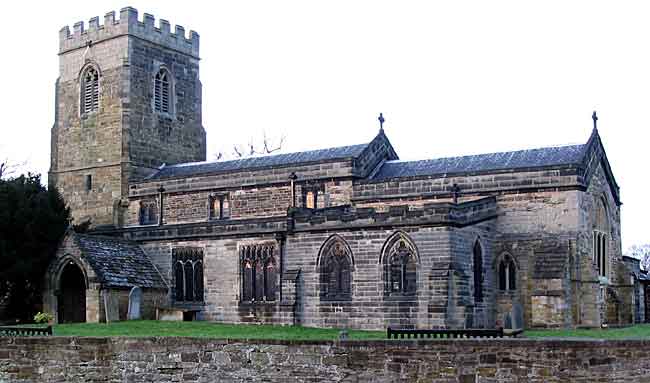
St Helen's church, Selston (photo: A Nicholson, 2006).
At Selston, in the absence of the vicar, the Rev. C. Harrison, his welcome to the Thoroton Society was read by the Rev. F. B. Wardle. The suggestion was made that this parish held "a unique position of power and influence when Saxons founded it, and Danes like Ulric, Ulmer and Gladwin from their three manors exercised their triple control over its inhabitants. Or, even in later centuries, when Peverell, or de Wandsley, or following these the Middletons, the Puseys, and the Willoughbys had residence and rule within its bounds." The chief interest at Selston centred in its finely situated church at which Mr. A. S. Buxton read the following paper kindly prepared by him for the occasion.
Although no part of this church now remaining is earlier than the 12th century, it stands on the site of a much older building. The Domesday survey mentions a church at Selston, and it is said that the three acres of meadow lying north-east of the graveyard were allotted to it in Saxon times. The meadow fell into the hands of the Dixies, the lay rectors of the manor, and so passed out of the church’s possession. This land was where the old tithe barn formerly stood, and to-day part of a barn may be seen there.
At the time of the Domesday survey William Peverel possessed the manor. Subsequently, the Wandsleys made presentations to the living, but, although the principal landowners seem to have held the advowson wrongly and had to surrender it towards the end of the 13th century to the rightful family, in whose line it had descended from William Peverel, viz., that of William de Ros or Roos, and Eustachia, his wife. Early in the 14th century, presentations were made by Nicholas de Cantelupe, who, in 1343, gave the advowson of the church to the Carthusian Priory of Beauvale In addition to the advowson of the church, Nicholas granted thirteen messuages and seventeen-and-a-half bovates of land in Selston and the villeins who held this land in villeinage.
On the appropriation of the church to Beauvale the Archbishop of York reserved, as recompense for damage thus done to his cathedral church, the annual pension of one mark to himself and his successors, and to the dean and chapter 6/8 to be paid by the prior and convent of Beauvale yearly at Pentecost and Martinmas in equal portions.
In the year 1344 the rector of Selston was removed and a monk of Beauvale became vicar. The new vicar was to have a house built at the cost of the prior and convent of Beauvale, the house to stand on the king’s highway, near the church, and all expenses in his church to be borne by the said prior and convent for ever, The stipend was to be of the annual value of six marks sterling, and included the mortuaries, and oblations, and the tithes of wool, and Iamb, and other small tithes.
The present vicarage of Selston still stands on the land appropriated to the vicar’s house in these early times.
Dealing with this connection of Beauvale, it is worth noting how early coal was worked in Selston parish. In 1402, there is a confirmation by John Day, then vicar, of a lease to the priory of Beauvale of all coal, and the right of digging for the same in Selston parish, and of all wood growing there to make “punches and proppes.”
Taking church plans generally the order of growth was, first, nave and chancel, then aisles, and finally, generally in the 14th century, chancel chapels.
But Selston possessed what may be termed a complete typical plan as early as the opening of the 13th century, and in this respect differed from the churches of the neighbourhood.
The plan of the church as it now stands is, with the exception of the vestry, what it was when the monks of Beauvale first officiated there as vicars. Saying this, I am presuming that the church then had a tower at the west end, for the present tower is later. I do not think the supposition is unreasonable, for a church having so complete a plan in other respects would hardly be without so important a feature.
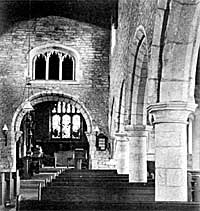
The nave, looking east.
The oldest part of the church now remaining is the north nave arcade, dating from the 12th century. Although this part is somewhat rude, the work is not earlier as shown by the carving on the capitals, which, slight as it is, has a distinctly late Romanesque character. Unfortunately, the bases of the columns on this north side have been cut away, and we have thus lost what might have been a valuable clue to fixing the exact date.
Note that the responds are in the form of pointed bowtells.
The south arcade, south door, chancel arch and chapels come next, belonging to the transitional period between the Norman and early English styles.
The caps and bases of the south arcade are unmutilated, and the columns and walling above thinner than the north.
The corbel respond at the east end of this arcade is new.
The old respond was merely a capital, and the diminutive columns resting on a ball were added at the recent restorations.
Over some of the capitals of this arcade a groove is seen. This is where the old Selstonians placed a hat rail for their comfort, probably an 18th or 19th century innovation when respect for old churches was scant.
Owing to the lowness of the chancel arch and the consequent large amount of blank walling above, the three-light opening between the nave and chancel was inserted at the last restoration, and at the same time the width of the north aisle was increased. The corbels to the chancel arch have been much mutilated, but the one on the south still hears enough trace of the original moulding to class it with the work of the chancel chapels and south arcade. Until the recent restoration the chancel chapels were down, the only indication that they had ever existed being their blocked-up arches in the chancel walling. Probably the chapel on the north side disappeared some time before that on the south, for, in an old 18th century drawing of the church, a square-headed, two-light perpendicular window and a small square one are shown on the north side. The south chancel chapel must have existed as late as the 17th century, as burials took place there at that time.