
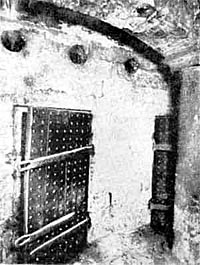
The dungeons underneath Shire Hall in the 1920s.ere
The Mayor and Burgesses, in the 17th and early in the 18th century, owned some property in the High Pavement, viz.:—tenements on both sides of the house now known as the Judges' Lodgings on the north side of the street, and opposite (on the south side of the street) premises known as the Castle Inn, adjoining the County House.1
It is evident the Mayor and Burgesses desired to increase their estate in the High Pavement, and to acquire the property granted to the county by Mr. John Boun and Mr. Julius Hutchinson.
In the fifth volume of the Borough Records, we are told that on October the 10th, 1698, the following resolution was carried by the Mayor and Burgesses of Nottingham:—
"Ordered that Francis Salmon, Alderman, Thomas Collin, Alderman, Master Joseph Briggs, Master Francis Armstrong and Master John Reynolds doe View and measure a parcell of ground near the Market-wall in order to retorne answer to several gentlemen about their proposals of Building a County Hall and that they with Master Mayor do treat with them about the same."
In the sixth volume of the Borough Records, we are told that on the 22nd April, 1724, the Nottingham Corporation deputed the Mayor, Alderman Pennell, and Mr. Morris to attend the meeting at Rufford to treat with the county justices and gentlemen about building a hall as well for the use of the town as for the county of Nottingham, and they were invested with discretionary power to agree with the county justices and gentlemen on reasonable terms.
The Mayor (Mr. Thomas Trigg) and Mr. Alderman Pennell attended the meeting at Rufford, two days later, on the 24th April, 1724, and asked the county justices to build the new County Hall in the Market Place, at Nottingham, with the front of the new building facing Chapel Bar.
Between the back of the new County Hall and the Shambles there was to be "a large alley or vacancy" (in other words, a street), "for the conveniency of people passing and repassing between the new Hall and the Shambles."
The town was willing to give to the county as much ground to build the hall upon as the county justices would require.
The conditions upon which the Market Place site was to be given were:—
- That the town should have the free use of the new County Hall for assizes, sessions courts, and other public assemblies when the business of the county did not interfere and employ the hall.
- That the old Nisi Prius Hall in the High Pavement (i.e., the site given by Mr. John Boun) and the County House (purchased from the Hutchinsons) should be conveyed to the town; the town paying therefore either £1,000 down or £300 more than the best bidder, whichever alternative the county may select. The county gaol and entrance to it were to remain the property of the county.
The town authorities were also willing to pay half the cost of all manner of repairs that "should ever hereafter be necessary or thought requisite by the County for repairing, altering, or amending the Hall in the Market Place; "and they were also willing to pay half the cost of sweeping and cleaning.
The county justices, in order that the fine may be taken off the county, made an order that the County Hall, Nisi Prius Courts, &c., be new built, the old hall in the High Pavement, in their opinion, not being capable of being repaired.
They also considered whether the ground on which the old hall then stood would be a proper place for building such new hall upon, or whether a more proper and advantageous place might not be proposed. Thereupon they agreed to the proposal of the Mayor of Nottingham.
The order was signed by the following county justices:—
"Sir Fr. Molyneux, Bt.
Sir H. Wastenys, Bt.
Sir Thomas Hewett.
Hon. Richd. Sutton.
J. Plumptre.
Julius Hutchinson.
L. Pinckney.
J. Acklom.
Langford Collin.
Thos. Stowe.
J. Mellish.
John Sherwin."
This meeting at Rufford was attended by Sir Thomas Parkyns, Bart., but it will be noticed that he is not one of the signatories to the order.
(1) The Castle Inn premises were subsequently pulled down, and the site of same became the large garden or piece of ground called the Vista, with a summer house thereon, which in 1771 passed into the possession of the Fellows family, who held it until 1833, when it was sold to the county justices. It is now the site of the County Police Station in the High Pavement.