


 |
Bramcote Manor House
By George Fellows.
 |
|
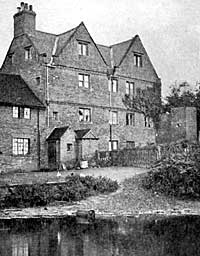
The north side of Bramcote Manor House. |
THE village of Bramcote has, in spite of its populous and industrial neighbours, so far withstood the intrusions of any form of manufacture, with its inevitable smudge of soot and smoke to detract from its rural charm. True, the lower end of the village is kept enlivened by the traffic passing along the main road between Nottingham and Derby; but the higher part of the village, where stands the isolated tower of the dismantled church, has an air of enjoyable tranquillity and seclusion.
It is on the slope of this hill, on the south side of the highest point, nearly 300ft. above sea level, that the old Jacobean manor-house associated with the family of Hanley is situated.
[Section on Handley descent omitted]
THE MANOR-HOUSE.
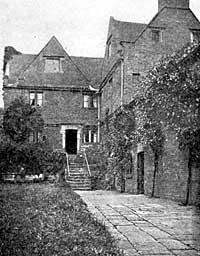
The manor-house, the site of which has already been indicated, is a Jacobean building of red brick, tinted by time to a charmingly mellowed colour. The chief entrance is by way of a forecourt, which is comprised within a wall of mingled stone and brick of blended colouring, very attractive to the artistic eye, and through a south doorway of pretty design, and is overshadowed by a walnut tree of noble dimensions. On entering the forecourt, the entrance to the house confronts one, at the top of two flights of stone steps; and a terrace, which has a wrought-iron balustrade of light and excellent design, was brought, tradition says, from a castle in France. The house and out-buildings stand on the north and east sides of the enclosure; the brickwork is relieved by diamond patterns, formed with bricks burned to a dark blue bronze colour; the windows, each of two lights with stone mullions, and the copings of the gables are also of warm-coloured stone which harmonises well with the weathered brickwork. The present house probably stands upon the site of an earlier one, of which however, no trace remains; there is no stone panel built into the wall, or leaden spout-head, bearing initials or date, to indicate which of the Hanleys built the mansion, neither is there any outside display of the family coat of arms granted in 1612; though such a new possession one would naturally expect to find displayed somewhere about the building. Its absence seems to point to the house having been erected previous to the grant being made, and therefore in the time of the first Henry Hanley.
 |
|
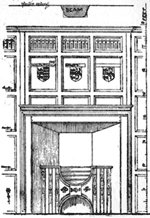
Fireplace. |
The arms on the fire-front of the wainscoting to the front room are of very crude design, and possibly executed by an amateur, in appreciation of the honour that had recently been bestowed upon the family. The panels measure sixteen inches by twelve. The staircase has a plain balustrade of square bar balusters, and a mop-stick handrail. In a paddock a short distance from the manor-house, there was, until a few years ago, a brick dovecote with a gabled roof and a string-course; this has recently been pulled down (1907).
The Hanleys seem to have been of the sturdy, well-to-do yeoman class, which formed the backbone of English supremacy in the days in which they lived. The first Henry Hanley was fortunate enough to have lived in the thriving days of Queen Elizabeth; both queen and subject died in the year 1603, when England was enjoying “a time of conscious power and all-conquering energy,” when men like Drake and Raleigh, and others were making history, and Shakespeare was thrilling the nation with his genius. The Hanleys, being presumably churchmen, must have rejoiced at the growing stability of the English Church, and the rejection of Papal claims.
The second Henry Hanley (1594-1650), under the first Stuart king, lived in more troublesome times than his father had done, under the last Tudor Queen. James 1st was an indifferent monarch, and would have been but little regretted had the Gunpowder Plot proved successful. King Charles 1st raised his standard, and thus embarked on a disastrous civil war, on 22 August, 1642, at a spot only five miles distant from the home of the Hanleys.
 |
|
Manor House, Bramcote. |
The research, entailed in compiling this paper, has revealed nothing that indicates whether the Hanleys’ sympathies were for the king or the Commonwealth probably for the latter, for if the Hanley, of those days, showed his adherence to the king, he and his estate would probably have been swallowed up in the voracious demands of the Royalist cause, in furtherance of the war. The second Henry Hanley died, the year after King Charles was beheaded on the scaffold in Whitehall.
No family papers seem to have survived to the present day, no portraits, no seals; thus the history of the family is rendered more difficult to compile.
The Bramcote estate eventually became the property of the Longden family, whence it passed into the possession of Mr. John Sherwin Gregory, a relative of the Longdens. Mr. Sherwin Gregory died without issue and left his estate to his wife, from whom it passed to her brother, Captain Henry Holden, whose third surviving son, Major E. F. Holden, now holds it on a life interest.
The tenant of the manor-farm, in these days, occupies the old Hanley residence. A line of fine elm trees, and the traces of an old bank and ditch help to define the confines of the manor site. No doubt the amenities of the manor-house have been encroached upon since the Hanleys’ days; for now the farm buildings intrude up to the southern, or chief entrance gate leading to the residence, and several other small additions may adapt the house more fully to its modern requirements, but they detract from its being a typical example of a 17th century manor-house.
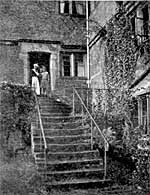 |
|
Front entrance, Manor House, Bramcote. |
The foregoing brings to a conclusion the object for which this paper has been compiled, namely, to put in a concise form the history of the family of Hanley of Bramcote, during the few generations they lived there as lords of the manor. The Wilford branch of the family lived in the stuccoed house, which still stands on the green in that village; but the family has ceased to be identified with the place, residentially, for a number of years. A Mr. Huntington Hanley, in the i8th century, seems to have had a large family; it is possible, that it was due to this numerous progeny that he became impoverished, and the family lost the position they, no doubt at one time occupied.
There are several Handley wills in the Registrar’s office at York, the oldest of which is that of Robert Hanley, of Barton (1468) ; the others are all dated in the 17th century, and include the will of Henry Handley, of Bramcote (1604), elsewhere referred to in this paper.
I have to tender my best thanks to Mr. Harry Gill, who has furnished several measured drawings, as illustrations to this paper, and has also assisted in furnishing some architectural details.
I have also to acknowledge the courtesy of those members of the Nottingham Camera Club, who have permitted the use of their negatives, thus providing some of the excellent illustrations that accompany and enliven the letterpress.
Since writing the foregoing paper, I have been shown a letter, written by a member of the Handley family, now living in South Africa, addressed to a member of his family, now resident in Nottingham. In this letter he states that, about 1768, Bramcote “Hall was burned to the ground and the whole of the family records were lost”: also, that the Handleys no doubt lived at Bramcote for many years before 1560, and that it was about that time that one of the family, named Ralphe, was ennobled by Queen Elizabeth, and took the title of Baron Bramcote. He became the possessor of the estate, together with a valuable piece of land to the west of Nottingham Great Market Place, where the family had a house, and where they were buried, and where the writer of the letter states he has seen the grave-stones, on some of which the names were decipherable.
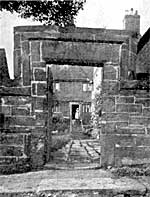 |
|
Entrance gateway, Manor House, Bramcote. |
I have made diligent enquiry, but have failed to find whence the writer of the letter derived his information. He admits that he is writing “on memory entirely,” but he also says that when last in England, he “looked into the records” and traced the family down to 1802. All authorities concur in the opinion that the family was of Yorkshire origin, and bought the manor of Bramcote, in 1564. I can find no confirmation of the statement that the manor at Bramcote was ever burnt down, and no legend to that effect survives in the locality. There is no such title recorded as Baron Bramcote either in Burke’s Dormant and Extinct Peerages, or in his Extinct and Dormant Baronetcies. There is a small burying ground identified with the Quakers, in Park Street; but I have come across nothing that associates the Handleys, with that sect.
© A P NICHOLSON | CREATED: 2 AUGUST 2003