HER MARRIAGE AND ESTRANGEMENT FROM HER MOTHER.
When Lady Henrietta announced it as her fixed determination to marry Edward Lord Harley, the Duchess parted from her "in great displeasure," refusing to countenance the alliance in any way.
The wedding took place at Wimpole, on Monday, 31st August, 1713, and the husband made the following record of it in his Diary: "I was married between a 11 & 12 o'clock at noon, to the Lady Henrietta Cavendishe Holles by Dr. Mat. Brailsford, Dean of Welles. Lord Cheney1 gave her. Ld. Treasurer,3 Mr. Auditor Harley, Mr. John Morley, Mr. William Wenman, Mrs. Anne Grant and Mrs. Judith Brown were Present in the Drawing Room at Wimple in Cambridgeshire. Ld. Cheney went away before Dinner." On the following day, the entry in the Diary is: "John Barroughby the Groom was sent with Letters to the Dutchess of Newcastle then at London." These letters did not mollify Her Grace, who considered that the estates which had been her father's should have been hers on her husband's death, and should not have become her daughter's by what she called the "pretended agreement" with Lord Pelham. She said it was a "wicked marriage," and she called the conduct of the Harleys "unjust brutishness," begging all who wished to be her friends "never to name the Harleys nor their allies to me, they giving me hourly reason to abhor them."
So bitter was the unhappy estrangement that, when the Duchess made her will in October, 1715, she disinherited her daughter so far as she could. In that will she states that her husband had settled upon her his estate at Orton in co. Huntingdon, expressing a desire that she should give the same to their daughter, if by her duty and obedience she should merit and deserve the same; but, continues the Duchess: "it is with the greatest grief that I reflect upon her undutiful and disobedient behaviour to me since her father's death, and I declare that she hath not merited or deserved the said estate of me, or any thing that I have the power of disposing of."
The Duchess died on the 24th December, 1716, but about two months before her demise she and her daughter made peace with one another. On the 4th November, 1716, Humfrey Wanley, Lord Harley's librarian, wrote to his lordship: "I am extremely rejoyced to hear of my Ladies and your Reconciliation to my lady Duchess. I am sure nothing in this world could be more agreable to, or of more Satisfaction & Comfort to her noble Ladiship than this thing." Wanley thought that the occasion was one to be celebrated, and he, therefore, four days later, asked leave to use one gallon of Lord Harley's brandy. He said that he had got some Virginia Snake-root to mix with part of it, and twelve lemons, "being minded to have a Sneaker3 here, in rejoycing for this most happy Reconciliation which I hope may be for Everlasting." He adds that he will in no wise lay his hand upon his Lordship's brandy until he has his noble fiat.
The marriage gave great satisfaction to the Harleys and their friends, and some of the congratulatory letters written on the occasion have survived. Queen Anne wrote to the Earl of Oxford: "I wish you much joy of haveing at last marryed your son, & hope you are soe just to me as to beleeve I shall always be very glad of any good fortune that happens to you or your famely."4 Dr. John Arbuthnot said that he "should not have had a much more sensible pleasure," if his own son had been the happy man. Matthew Prior wrote: "I congratulate your Lordship most sincerely upon my dear Ld. Harley's marriage, for I really love him as much as if he were (what you give me leave to call him) my Brother."5
Dean Swift, had, on the 8th November, 1711, heard a rumour which had "got about all the town," to the effect that the marriage had taken place on the preceding day. He found, however, as he states in his Journal to Stella, that it was not true. But, he continues, " I hope it will be so; for I know it has been privately managing this long time . . . Lord Harley is a very valuable young gentleman; and they say the girl is handsome, and has good sense, but red hair." It is amusing to compare this description of her with the high-flown language of the verses Swift addressed to Lord Harley when the marriage did take place. Lady Henrietta in those verses becomes a celestial nymph
"as Aurora bright,
And chaster than the Queen of Night."
HER HUSBAND.
On the death of his father in 1724, Edward Lord Harley succeeded to the title of "Earl of Oxford & Earl Mortimer." During the whole of his adult life he was a keen collector of books, manuscripts, pictures, miniatures, busts, coins, medals, gems, curiosities and antiquities of all kinds. He made tours through many parts of England, acquiring a vast amount of information about persons, places, works of art and monuments of antiquity, but he did not live to methodize his notes. He was born on the 2nd June, 1689, and he died on the 16th June, 1741. Most of his collections were dispersed by auction, but his manuscripts were sold to the British Museum. His extensive reading caused Matthew Prior to say of him in 1720:
"Fame counting thy books, my dear Harley, shall tell
No man had so many who knew them so well."6
Among his correspondents and friends he numbered many whose names are redolent of the learning and culture of the reigns of Queen Anne and the early Georges.
Keen as he was as a collector, and shrewd as he was in making bargains for books (ably assisted in these matters by the prudence of Humfrey Wanley), he appears to have been lax and easy-going in the management of his estates, but the following gossip of the Earl of Orrery to Dean Swift may be dismissed as gross exaggeration. Orrery wrote, 7th July, 1741: "Poor Lord Oxford is gone to those regions from whence travellers never return . . . His lady brought him five hundred thousand pounds, four of which have been sacrificed to indolence, good-nature, and want of worldly-wisdom." When once a fiction of this kind has appeared in print, it re-appears time after time, and this particular statement is repeated in the Dictionary of National Biography, and in Mrs. Climenson's Elizabeth Montagu, 1906, p. 8.
 |
 |
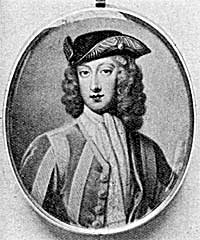
| PLATE III. LADY HENRIETTA HARLEY. By C. Boit, after Sir Godfrey Kneller, 1714. (Welbeck Abbey Miniatures, no. 195.) |
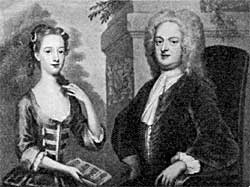
EDWARD HARLEY, SECOND
EARL OF OXFORD, AND HIS DAUGHTER MARGARET. By C. F. Zincke, 1727. (Welbeck Abbey Miniatures, no. 201.) |
HER MERIT AS A WIFE.
Her husband's appreciation of her good qualities is feelingly expressed in a letter which he wrote to her when he was at Down Hall, 9th June, 1728. Adverting to a letter which he had already written to her, he says that it "flowed from a heart truly touched with your most indulgent expressions, but far short of what are due to you from me: but to return to your letter, every time I read it over, which is very often, it fills me with the utmost sense of gratitude to Heaven for bestowing so inestimable a blessing upon me, and I do assure you that I am truly sensible that my happiness entirely depends upon you, and what enjoyment I have in this life reflects solely from you . . My only study is to merit your approbation."
HER CHILDREN.
The first child born to Lord Harley and his wife was a daughter, Margaret Cavendish Harley, commonly called Peggy, to whom Matthew Prior wrote the charming poetical epistle beginning "My noble, lovely little Peggy."
She was born in 1715, on her mother's birthday, February 11th; and on the 11th July, 1734, she married William Bentinck, second Duke of Portland (grandson of William Bentinck, Earl of Portland, the confidential friend of King William III). They were the parents of the Marquess of Titchfield (afterwards third Duke of Portland), who was the recipient of letters, some of which will be quoted on later pages.
Ten years after the birth of Peggy, a son was born to them on the 18th October, 1725. The Christian names given to him were Henry Cavendish, but his life lasted four days only. The sorrowful parents caused a bust of the babe to be executed by J. M, Rysbrack, and this bust is still at Welbeck Abbey.
HER EXCELLENT QUALITIES AND HER ALLEGED DULLNESS.
The proverb "Give a dog a bad name and hang him" indicates a weakness to which compilers of biographical sketches are prone. They find that an unfavourable or disparaging adjective has been applied to the person about whom they are writing, and they straightway accept it as true, seeking no corroboration, and making no independent investigation. They summarize the person in the adjective, just as John Bunyan summarily portrayed a certain unsatisfactory pilgrim by the simple statement that she was "a young woman—her name was Dull." This seems to be the explanation of the depreciatory adjective dull often applied to the Countess of Oxford.
Lady Bute, the daughter of Lady Mary Wortley Montagu, when speaking of the Countess to her mother, exclaimed: "How can you be so fond of that stupid woman? "The question brought upon her a sharp reprimand against rash judgement, ending with: "Lady Oxford is not shining, but she has more in her than such giddy things as you and your companions can discern."7 With this, and the statement quoted in footnote 2, for authority, the writer of her husband's life in the Dictionary of National Biography says of her: "A dull worthy woman, the Countess disliked most of the wits who surrounded her husband, and she hated Pope."8 In like manner, George Paston9 speaks of her as "the dull but estimable Lady Oxford."
She might not be sparkling, or brilliant, or witty, but she had far more valuable qualities that sprang from her kind heart, her amiable disposition and her affectionate nature. The unkind adjective dull does scant justice to her many excellences and attainments, and to the unobtrusive manner in which she shared her husband's interests, accompanying him on some of his antiquarian tours, and receiving with delight his accounts of his observations when she could not go with him. It is wrong that this should be the stock adjective wherewith to describe a woman whose charm won the hearts of a large circle of friends. Dr. William Stratford, writing 24th July, 1714, said: "I never knew any one who had the honour to know her that was not from that moment sincerely her servant."
Considerateness for the feelings of others was one of her most prominent characteristics. Dr. Johnson had a friend, Oliver Edwards, who tried to be a philosopher, but found that "cheerfulness was always breaking in." In like manner, whenever the Countess tried to be in an admonitory mood, amiability was always breaking in. On one occasion she had to reprove her attorney for failure to comply with her directions. Her mild chiding occurs in the early part of the letter she wrote to him, but at the end she cannot forbear adding: "I excuse you sending the books hither, as it is a possible mistake."
Where she gave affection, she gave it whole-heartedly and without reserve. Where she gave friendship, she gave it in all sincerity.
She had good friends who loved her, and whom she loved, and probably she was one of the friends of whom Matthew Prior thought, when he wrote : "Of all the gifts the gods afford If we may take old Tully's word, The greatest is a friend."
(1) This was William, second Viscount
Cheyne of Newhaven, son of Charles Cheyne, first Viscount Cheyne, and his
wife, Lady Jane Cavendish, daughter of the first Duke of Newcastle.
(2) Lord Treasurer, i.e. Robert Harley, first Earl of Oxford.
(3) Sneaker, i.e. a small bowl of punch.
(4) Queen Anne sent a message saying that care should be taken to call her
Lady Henrietta Harley, and not Lady Harley, so that she should not lose her
precedence as a Duke's daughter.
(5) They were members of the Brothers Club.
(6) Prior says that he was never in his life better pleased with his own
work than when, on the morning after the composition of this couplet, he
heard the lines repeated by little Mademoiselle Harley (i.e. Peggy, then
five years old) "with the prettiest tone and manner imaginable."
(7) Lord Wharncliffe's edition of Lady Mary Wortley Montagu's Letters, 1837,
i. 64.
(8) The statement that she hated Pope is alleged to have been made by
the daughter of the Countess (Id., i. 63), but it may be surmised that
the word hated is a stronger one than the Countess herself would have
used to express her feelings.
(9) George Paston: Lady Mary Wortley Montagu, 1907, p. 309