
< Previous | Contents | Next >
Drury Hill, Middle Hill and Garner's Hill
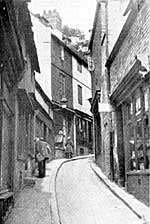
Drury Hill in the 1920s. This ancient street was swept away during the building of the Broadmarsh Centre in the 1960s.
DRURY HILL. This very picturesque and narrow thoroughfare is part of the old mediaeval business thoroughfare through Nottingham which, as we have seen came down Narrow Marsh and passed north along Bridlesmith Gate. Although very steep, the gradient of Drury Hill is comparatively slack when compared with either Long Stairs, Malin Hill or the Hollowstone of its day. It must have been of very great importance, for when the town was fortified in Henry II's. time provision for a gateway, which Thoroton refers to as a postern, was made on the summit. I don't think that this postern is a postern in the ordinary acceptance of the term as just a mere undefended opening in the wall. It is shown in Speed's map as a little, square tower through which the road passed and it was probably defended by gates and a portcullis. It appears to have been pulled down in 1735, but a portion of it was left standing, for Deering in 1745, refers to it as being partially standing in his day. It was protected by a gatehouse which was on the site later occupied by the Postern Gate Inn, or the Bull's Head as it was earlier called. In making alterations to this inn in 1875 a portion of the old gatehouse was exposed and when the inn was pulled down in 1910 a sharp look-out was kept and the ground plan of the ancient building was recovered and details of it were published by Mr. Dobson in the Transactions of the Thoroton Society for 1912. It appears to have been a roughly squared building 17ft. by 19ft.
The old name for Drury Hill was Vault Lane, which became Parkyn Lane, probably after some member of the Parkyn family of Bunny who lived there, and eventually it was changed into Drury Hill, about 1620. There was an orchard at the foot of the hill just where it joins Middle Marsh which was occupied in 1645 by one, William Bayley, but the Drury to which the name refers was a certain Alderman Drury, who was something of a figure in Nottingham in the days of King Charles I. He bought the house which faced Low Pavement and which occupied the site of numbers 2 and 4 Low Pavement and under which are enormous rock hewn cellars or vaults with a fascinating history, which gave the name of "Vault" to the Lane. Of a forebear of this Alderman Drury we have a glimpse in the year 1590. Evidently he was in deep distress through the action of his son. What the story is we do not know but reading between the lines of the following quotation, which is taken from the proceedings of the Nottingham magistrates, for on that date, we can realise that young Drury had been up to no good and the sum of £20 which was probably worth £1,000 or more nowadays shows the seriousness of his offence, "Thomas Drury of Nottingham, cordwainer and Fabian Drury of the same cordwainer to be bound to our Lady the Queen in £20 that the same Fabian shall not shoot with any piece at anything living."
It is obvious why Alderman Drury as a cordwainer or shoe manufacturer should be anxious to obtain a house on Drury Hill which would be so close and so handy for the premises of the tanners in Narrow Marsh.
MIDDLE HILL which used to be called Mont Hall Hill is of course, derived from Mont Hall, "The Hall upon the Hill," which was the name by which our forefathers knew their Guildhall, a queer old building which stood at the top of the hill in Weekday Cross till the end of the last century.
It is interesting to notice that in 1825 a man called Bamford lived upon Middle Hill and he was one of the last men in Nottingham who kept a Sedan Chair for hire.
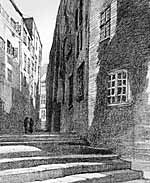
Garner's Hill in c. 1915.
GARNER'S HILL with its steps is a branch of the same thoroughfare which forms Middle Hill. It was formerly called Brightmore's Hill, apparently after a certain William Brightmore who in the early part of the 17th century was something of a divine and wrote a paraphrase of the "Book of Revelation." I have never come across this book. Just opposite the third step in the second flight from the top of Garner's Hill will be noticed a stone which has been retooled in modern times and which forms the base of a modern brick wall on the eastern side of the thoroughfare. This is a piece of the old town wall which is still remaining in situ although of course it has had to be cut down to prevent its interference with traffic. The usual tragedy of old streets is associated with Garner's Hill for it was upon it in 1844 that a very serious accident occurred. In that year a wretch called Saville was publicly executed for the murder of his wife and children in Saville's coppice, Colwick Wood. The graves of the victims can be seen in Colwick Churchyard to this day. A huge crowd had assembled to witness the execution and they became somewhat unruly. After Saville was dead a panic seemed to seize the crowd, the members of which made tremendous efforts to get away. People were pushed over and trampled underfoot and many were thrown down the steps of Garner's Hill. When order was at last restored it was found that no less than thirteen people had been killed and over twenty seriously injured during the disorders.