
< Previous | Contents | Next >
An itinerary of Nottingham
Hollowstone
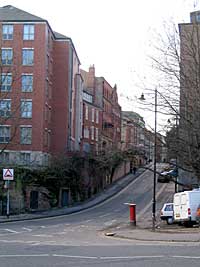
Hollowstone, from Bellar Gate (A P Nicholson, 2004).
HOLLOWSTONE is aptly so called. Originally the cliff extended from the top of Short Hill to Scotland Place and then gradually died out behind the houses facing on to the northern side of Carter Gate. It would be a steep slope, for the height of Scotland Place is not very much less than that of Short Hill. Up this slope a trackway struggled in ancient days. It must have been very steep and inconvenient as the Malin Hill route was found far more convenient, and its importance was slight. This is proved by the earliest reference to Hollowstone, which is in 1366. It is referred to as "Hollowstone, near Malin Hill." With the general adoption of wheeled traffic in the early part of the 17th century it was found that the old route through Narrow Marsh was both constricted and inconvenient, and so a fresh thoroughfare had to be provided. Some sort of road was constructed therefore, up Hollowstone, and we have a note that it was so narrow that two vehicles could not pass, so it was of little use in easing the traffic through the busy Narrow Marsh. But with the advent of coaching and the more general and fuller use of the roads a new era dawned for Hollowstone. It was found very much better to make the coach route into Nottingham pass along High Pavement, Weekday Cross, Middle Pavement and Bridlesmith Gate, and so in 1740 Hollowstone was seriously taken in hand. Plumtree Square was raised so as to ease the gradient and this improvement is still very noticeable, at the same time the pass between Short Hill and Scotland Place was slacked off and a saddle formed through which Hollowstone passed. It was again altered in 1801 and the roadway much widened, and it was left in pretty much the condition that we know it nowadays. Of course, up to that time the district was not built over with great warehouses and business premises as it is nowadays. In fact at the top of the cliff on the northern side of Hollowstone there was a great paddock which was called Plumtree Paddock, and there was only one house between Hollow-stone and Plumtree Street. Over this paddock and its adjoining gardens was a magnificent view into the open country, enjoyed from the windows of Plumtree House, as we shall see when we come to consider Stoney Street. In affecting this change, it was necessary to alter the gradient of Bellar Gate, which accounts for the fact that the old burial ground of St. Mary's is raised some seven steps above the present street level, while the first floor of the houses upon the opposite side of the street are reached by four or five steps. There was probably a gateway across Hollowstone, which would have been somewhere about where Hollowstone takes its sharp turn to the west, but about this gateway nothing is definitely known. It was one of the ancient gateways through the fortifications of the town and may have been as old as 918, the date when Edward the Elder erected his fortification, and it would be replaced in Henry II.'s time when his line of defence was erected, and might probably have had a similar appearance to Chapel Bar.
There are one or two matters of interest connected with the few houses that cluster about the foot of Hollowstone, and in the first place it will be noticed that there is quite a little congregation of public-houses in this neighbourhood, which are probably the descendants of the ancient inns which would spring up outside the town walls to harbour travellers who arrived after the gates had been shut. The shop at the south-west corner of Hollowstone was in 1820 the scene of an attempted assassination. Alderman Barber, who was an energetic and upright magistrate and a terror to evil-doers, was standing in his shop one evening when he was shot at by a miscreant who was lying perdu at the corner of Fisher Gate. A great blunderbus heavily charged with slugs was discharged at Alderman Barber, but although the windows of the shop were shattered and the shop wall was sprinkled over with slug marks Alderman Barber mercifully escaped. A reward of £515 was offered for the capture of the miscreant, but he was never brought to justice, and apparently nothing further was ever heard of him, the contemporary opinion being that it was an act of revenge by some prisoner with whom Alderman Barber had dealt from the bench. The White Lion Inn on the opposite side of the road seems to have had a disastrous effect upon the morals of its inhabitants. At any rate we know that one of its ostlers turned highwayman, or "horseman" as they were called in olden days, and eventually paid the penalty of his misdeeds. It was also the residence for a short time of the ubiquitous Tobias, for we find him stopping there in 1732. Martha visited him there suffering from a "buttered" or blackened eye, but Tobias reports in his diary that "she chirruped up on wine." Tobias also gravely records his expenses paid to Mrs. Trigg, the landlady :—
| £ | s. | d. | ||
| Four nights paid | ... | 8 | 0 | |
| Eight breakfasts | ... | 9 | 0 | |
| Total | ... | 17 | 0 |
which seems not an extravagant sum to pay.
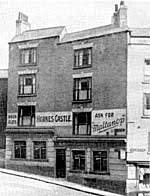
Horne's Castle in the 1920s.
Almost next door to the White Lion is Home's Castle, or "Old Horne's Hall" as it was formerly called. Before its present masking by a modern front, it was an old house the upper floors of which were reached by a great stone staircase which extended to the street, and at the back of it were considerable gardens, traces of which can still be found amongst the courtyards and alleys at the back. In 1729 it was the residence of William Andrew Horne, "Esquire," as his contemporaries called him, using the "Esquire" in its official sense, and not as the mere courtesy title that we now adopt. He was a real bad man, and his death gave rise to the expression: "'I'll chance it, as Horne said.'" He was a man of considerable property, having estates at Butterley, but he seems to have been of thoroughly criminal instincts, and the catalogue of his early crimes include almost every misdemeanour from murder downwards. However, he managed to keep outside the law until he was seventy-four years old, and then his chickens came home to roost with a vengeance. In his younger days he had been associated with his brother Charles in the murder of an infant, and in spite of the fact that he knew his brother to be the possessor of a secret that would hang him he treated him in an abominable and cavalier fashion, not only did he deprive him of his share of the family estates and so reduce him to absolute poverty, but he treated him as a mere beggar. Charles lived at a public-house close to his brother's residence in Hollowstone, and was frequently reduced to holding a gate open, hat in hand, while his morose and terrible brother passed through. In addition to his treatment of Charles and other members of the family, Andrew Home made himself terribly unpopular with his neighbours both in Nottingham and in Derbyshire, and at last a whisper of this murder reached the ears of an outraged enemy whom Home had ruined by means of a lawsuit. Consulting with Charles, this enemy found that rumour spoke the truth, and so he applied for a warrant for the arrest of Andrew Home. Even then Horne could have escaped, had he been less penurious, for his brother Charles came to him and told him of the warrant that was out against him, at the same time pointing out that the only evidence against him was his own, and offering to leave the country if Horne would give him five pounds to pay his expenses to Liverpool. Horne refused this very modest request, and upon his brother protesting and pointing out the danger in which he stood, replied in the phrase which became notorious of "I'll chance it." Anyway he was arrested and tried and condemned and hanged upon Gallows Hill by St. Andrew's Church on his seventy-fourth birthday. He was very indignant because he had been accustomed to eat a plum pudding upon his birthday, and the time of his execution was so fixed that he was deprived of his final feast. He was driven on a wild and stormy day all the way up to Gallows Hill by his own coachman, and the record states that his hoary locks were tossed about his bare head by the tempest as he proceeded up the hill.