< Previous | Contents | Next >
St Mary's church
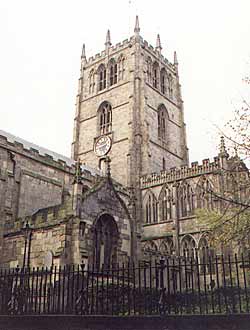
St Mary's church from the north-east (A Nicholson, 2001).
I do not wish to enter into a minute architectural or historic description of the fabric of St. Mary's Church, that is far too great a subject to be treated in a mere itinerary, and it has already received such ample attention from antiquaries and authors that it is unnecessary to re-write what has already been said. It will suffice to call attention to a few of the curious and out-of-the-way peculiarities and incidents associated with the church. There is, as we have seen, slender evidence that there was a church on the site before the Conquest, and certainly this is a very likely fact. Undoubtedly a church existed here during the Norman times, but it, together with its immediate successor, has almost completely disappeared. The present church was commenced somewhere about 1376, and was completed a hundred years or so later; and the tower was erected during the reign of King Henry VII. The difference in design and in craftsmanship between the chancel and the rest of the building is completely accounted for by the fact that the living was impro-priated by Peveril in the first decade of the XII. century to his new Cluniac Priory of Lenton. Under such impropriation the monks would become responsible for the repairs to the chancel, while the nave would remain in the hands of the parishioners. Of course, the monks would not have anything like as deep an interest in the fabric of the chancel, which they never used, as would the parishioners in their portion which they were entering and using many times a day, and consequently they would not be prepared to expend very great sums upon its beautification.
The church has always been of very great importance, and must have been frequented for all sorts of curious purposes in times past. This is shown by the curious fact that it was made one of the three depositories of the Standard Forest Foot. This ancient measure is now lost, but its duplicate at Edwinstowe Church carved in stone above the south door of the chancel is of great interest. The Forest Foot was of eighteen inches and was employed in measuring forest land, but the stone at Edwinstowe is only about fourteen inches long.
Mr. Hood, in his history of St. Mary's Church, gives a very curious instance of the free use to which the nave of the church was put in times back, for he records how in 1504 "a breakfast was eaten in the chapel in the south side of the church of St. Mary at the meeting of Mr. Mayor and his brethren and of Master Pierrepont, Master Byron, etc." Surely a strange use to which to put a church. One of the strangest scenes which has occurred in St. Mary's Church took place in 1649 when George Fox, founder of the great Quaker Society, commenced his ministry here. He records in his diary how as he was descending the hill into Nottingham he saw a great "Steeple House," as he called St. Mary's, and was moved to go and attend the service which was proceeding. He did not agree with the doctrines that were being preached, and without more ado he interrupted the service and corrected the preacher. This led to his imprisonment— and to a great deal more, for his interference converted the sheriff, whose name was Reckless, to his view and led to the formation of the important body of Friends which still exists in Nottingham. I think that these interruptions of services were not so uncommon in times past as we often think. During the stormy days before, during and after the Reformation, when the old ideals and the old awe had been abandoned and nothing had yet been discovered to take their place, many people took upon themselves to express their opinions in no measured terms, and to correct the various ministers of the church. Thus we find that in 1523, a quarter of a century before George Fox's interference, the Rev. Richard Taverner, who was then Vicar of St. Mary's, had found it necessary to bring an action against a shoemaker called Robert Taylor for "obstructing the Divine Offices about to be celebrated and using malicious words against the vicar." There were all sorts of chantry chapels and altars in the church, and probably most of them were served by separate priests, and the various guilds continued their own particular mass or service with very great freedom and what we should regard as lack of decorum, so that by degrees the whole church became a sort of public resort for the town, and gradually the sacred character of the building became forgotten, so much so that by the end of the 18th century the western end of the nave was used as a storehouse for the one and only fire engine of the town, while in 1611 to escape the visitation of the plague the Free School was transferred to the chancel of the church.
Modern tendencies are against pew rents, and it is hard to find a church throughout the length and breadth of England which still retains its old official family pews. Perhaps the modern idea is right, although it appears to have led to the complete breakup of family worship in parish churches, but our forefathers carried it to a far greater length than even its most ardent advocate would be prepared to go nowadays. For instance, the whole of the north transept of St. Mary's Church was granted in 1632 to the Plumtree family as a place in which "to hear divine service, to pray and to bury in," and there still remain interesting monuments to the Plumtree family in that transept.
The present church is a typical church of the 15th century. Its chief feature is the wonderful amount of window space that it displays, and when these windows were filled with the beautiful mediaeval glass which enriched them right down to Puritan times the whole church must have presented an exceedingly beautiful spectacle. It stands upon the almost highest point of the enclosure of old Nottingham and the top of the tower is some ten feet higher than the parapets of the present Castle. Upon entering it, one is at once struck by the difference in details of the craftsmanship between the nave and the chancel, the latter looking thin and poor when compared with the beautiful Perpendicular details of the nave and transepts.
Upon the dissolution of the monasteries Lenton Priory, together with all other priories, fell in lay hands and the ecclesiastical incomes which were derived from the impropriation of livings, instead of going to the upkeep and maintenance of abbeys, went to the enrichment of some Royal favourite. I do not wish to attempt to trace what happened to the endowments of Lenton Abbey, but it is interesting to remember that eventually the endowment of St. Mary's came into the hands of Earl Manvers, who was the last lay Rector.
The feeling of proprietorship in the nave of St. Mary's Church on the part of the parishioners led to all sorts of strange uses. As people were constantly in and out of the church, its sacred character became less and less awe-inspiring, for familiarity always breeds contempt, and the study of mediaeval churches leads to the knowledge of all sorts of strange functions such as Church Ales and Merry-makings which were held within sacred precincts.
In 1724 a very dramatic incident occurred in St. Mary's Church. Dr. Reynolds, the Archbishop of York, had conducted a confirmation service in the church and at its conclusion he retired to the vestry and called for pipes and ale. A messenger was sent to procure these, and on his return was met by the Rev. Mr. Disney, the Vicar, who refused to allow him to enter the church, saying that in his time St. Mary's Church should not be made into a tippling house to please the Archbishop or anybody else. Not only was the one and only fire engine in the town housed in the west end of the nave so late as the year 1770, but the vestry was used as a suitable place in which to elect the Mayor. After the strange custom of burying the mace in Rosemary had been performed, right down to almost modern times, while in 1805 a really violent election took place upon the appointment of a new Sexton. One would hardly have thought that the office of Sexton could have been dragged into the political arena, but such was the case, for John Johnson, son of the late Sexton, was supported by Tory parishioners and Thomas Clarkson by the Whigs. Both sides had flags and bands of music, and polling was continued during six days, eventually Mr. Clarkson was returned by a very substantial majority.