
< Previous | Contents | Next >
Bridlesmith Gate and Pepper Street
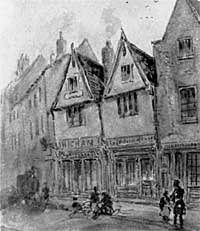
Higham's shop, Bridlesmith Gate in the late 19th century.
The northern end of Bridlesmith Gate was completely re-constructed and widened in 1852 when the modern St. Peter's Gate was formed out of the old mediaeval thoroughfare and unfortunately in the course of this improvement it was found necessary to destroy several very beautiful timbered houses. But there remains one ancient house in Bridlesmith Gate and at its rear up Cave Chambers can be seen the decrepit remains of a half-timbered house of probably the 15th century.
This old house in Bridlesmith Gate is striking in many ways. Its upper stories overhang the footway in true mediaeval fashion. From these overhanging stories we get the many strange irregularities which occur in the sides of the street of our ancient towns for when the rafters which were carrying these overhangings became insufficient for the weight that they had to carry, it was quite common to prop them up with posts from their outer end standing upon the public roads. It seems to have been nobody's business to see that these posts were removed and usually they were generally accepted although they must have been a terrible nuisance, and when the houses were pulled down and re-erected the site upon which these posts stood was taken as the boundary and so a few inches was stolen from the public thoroughfares. There is a good instance of this still going on in Nottingham for the upper stories of the "Flying Horse Hotel" are carried on posts of this description and have been so carried for many centuries.
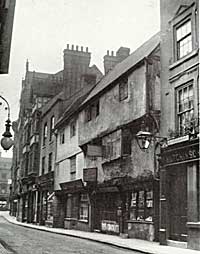
Ancient buildings on Bridlesmith Gate in the early 20th century.
Bridlesmith Gate was part of the coach route between London and Leeds. We have seen how Hollowstone was prepared for the accommodation of coaching traffic, and the coaches proceeded along High Pavement, Weekday Cross, Middle Pavement, Bridlesmith Gate and High Street where were situated a number of inns. One of the main businesses of the coaches was to carry the Royal Mail, and a few notes about the Post Offices of Nottingham may not be without interest. The earliest Post of which we know anything, which under Royal auspices ran between London and Nottingham in 1623 came up the Great North Road as far as Stoke, then across the river at Stoke Ferry and came coasting along the northern bank of the Trent on the track of the very ancient primeval route. It entered Nottingham by Barker Gate. This service gradually developed until the full postal service of coaching days arose out of it. The first Post Office in Nottingham was established in 1779 in the shop of John Raynor who was a seedsman on the west side of High Street. He was assisted in his business by a letter carrier called Tom Croft who used to go about the town with a bell night and morning and when the bell was heard people applied to him to see if there was a letter for them or to give him any mail matter that they might have. By 1833 the business had so much increased that the Post Office was moved to the other side of High Street, to High Street Place, where a building which is still standing was erected for their accommodation by the Duke of Newcastle, and four persons were engaged in dealing with the postal business of Nottingham. In 1834 the office was again moved, this time to Bridlesmith Gate to the site until recently occupied by Lloyd's Bank. Although this was a great improvement, postal conditions were still extremely primitive as we can gather from the fact that there was a little ticket window where one took one's letters and either bought a stamp and stuck it on or else paid the appropriate postage and wrote "P.P." which stood for "post paid" upon the outside. Then in 1840 a great change came; the penny postage was introduced which enormously increased postal business. Up to that time a letter from London cost 10d., from Birmingham or Manchester 8d., from Leicester 6d., and from Mansfield or Derby 4d., so to deal with this increased business the Post Office was erected at the north east corner of the newly formed Albert Street and then in 1846 the Corporation provided what was for its time a really excellent office which is now used for the City Treasurer's department at the corner of St. Peter's Church Side and Albert Street. Here the Post Office remained until 1868 when the government provided a building at the top of Victoria Street which proved sufficient for Nottingham's postal business until the erection of the present Post Office in Queen Street in 1895.
It should be remembered that until quite recent times one had to take all one's small mail matter to the General Post Office which was the only receiving office in the whole town. It was not until 1857 that the convenience of pillar boxes was introduced into Nottingham and it is interesting to remember that on May 24th, 1858, letter carriers made their first appearance in uniform in Nottingham.
Half way between Pepper Street and St. Peter's Gate, Aiscough in 1708 set up the first printing press in Nottingham and he prospered so that, as we have already seen, he had to transfer his business to Barker Gate to more commodious premises. During the 18th century there were two majestic old ladies living in Bridlesmith Gate—one of them, Mistress Marjory Middleton, died at the age of 100 and is buried in St. Mary's Churchyard, and the other, Mistress Tempest, lies in St. Peter's. At her funeral six lady pall bearers officiated. It is interesting also to remember that the last sedan chair in use in Nottingham conveyed an old lady whose name I do not know from her house in Bridlesmith Gate to High Pavement Chapel for services, Sunday by Sunday, 100 years ago.
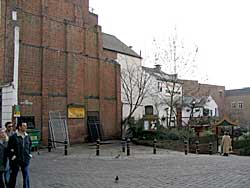
The remains of Pepper Street (A Nicholson, 2004).
Leading out of Bridlesmith Gate is Pepper Street which is a portion of the most ancient route in the neighbourhood of Nottingham and its name is a mystery. It always seems to have been called Pepper Street or something near to it, but it is impossible to believe that pepper which was a very rare and costly luxury could have been sufficiently dealt in to necessitate a special quarter for the pepperers. I have often wondered if it is not a corruption of Paper Street. There is one interesting house in Pepper Street situated at its junction with St. Peter's Church Side and at present used as offices. Its architectural features are exceedingly good and typical of the time of its erection. It was occupied in 1815 by a certain Mr. Coates who was an attorney, but before that it was lived in by the Rev. Dr. Stainton who was Vicar of St. Peter's from 1797 to 1814, so I am rather inclined to think that it must have been originally the vicarage of St. Peter's Church.
Returning now to the end of Bridlesmith Gate we proceed down Low Pavement which was called by its present name as early as 1348. It is of course a continuation of the paved way stretching from the Market Place and occasionally is referred to in ancient documents as Nether Pavement.